Automatic translation made by AI.
Thousands of people are mobilizing to oppose a Trump family real estate megaproject on one of the Adriatic’s last unspoiled coastlines. The environmental struggle, amid social unrest, is turning into a political rebellion against the Albanian government, the capitalist elites, and the surrender of the country to the interests of big international capital.
By Rubén Tzanoff
Environmental complaints and more
The protests that have been rocking Albania since late May represent one of the most significant social movements currently unfolding in Europe. What began as an environmental protest against a tourism megaproject promoted by Jared Kushner and Ivanka Trump in a protected area in the south of the country has quickly evolved into a deeper challenge to the Albanian political regime and the development model subordinated to the interests of international capital.
Albania: From Capitalist Restoration to Dependency
Albania is a Balkan country that, following the collapse of the Stalinist bureaucratic regime in the early 1990s, underwent a process of capitalist restoration and became increasingly subordinate to international organizations, including NATO, of which it is a member, and the European Union, which it hopes to join.
Since then, successive governments have promoted an economic model based on low wages, mass emigration of young people, and openness to foreign investment. While a minority of businesspeople, real estate speculators, and government officials amassed enormous fortunes, large segments of the population saw their living conditions deteriorate.
The current administration of Prime Minister Edi Rama (Albanian Socialist Party), in power since 2013, has further pursued this policy, promoting luxury tourism and the attraction of foreign capital as the main path to economic development.
Powerful and sustained cries
The protests began on May 31 in the Zvërnec area and the Vjosa-Narta lagoon, one of the most important ecosystems in the eastern Mediterranean. The area is home to greater flamingos, monk seals, and numerous protected species, as well as sea turtle nesting grounds.
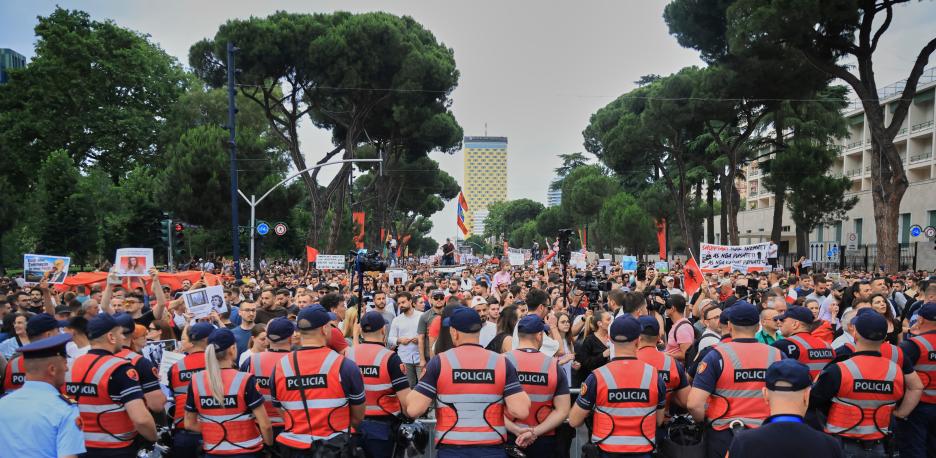
Protesters are denouncing the construction of a massive tourist complex linked to the Affinity Partners fund, owned by Jared Kushner, and to Qatari investors associated with the Power International Holding conglomerate. For several consecutive days, thousands of people took to the streets and squares in Tirana, Vlora, and other towns. The protests included marches, nighttime rallies, roadblocks, and actions denouncing the advance of heavy machinery into protected areas.
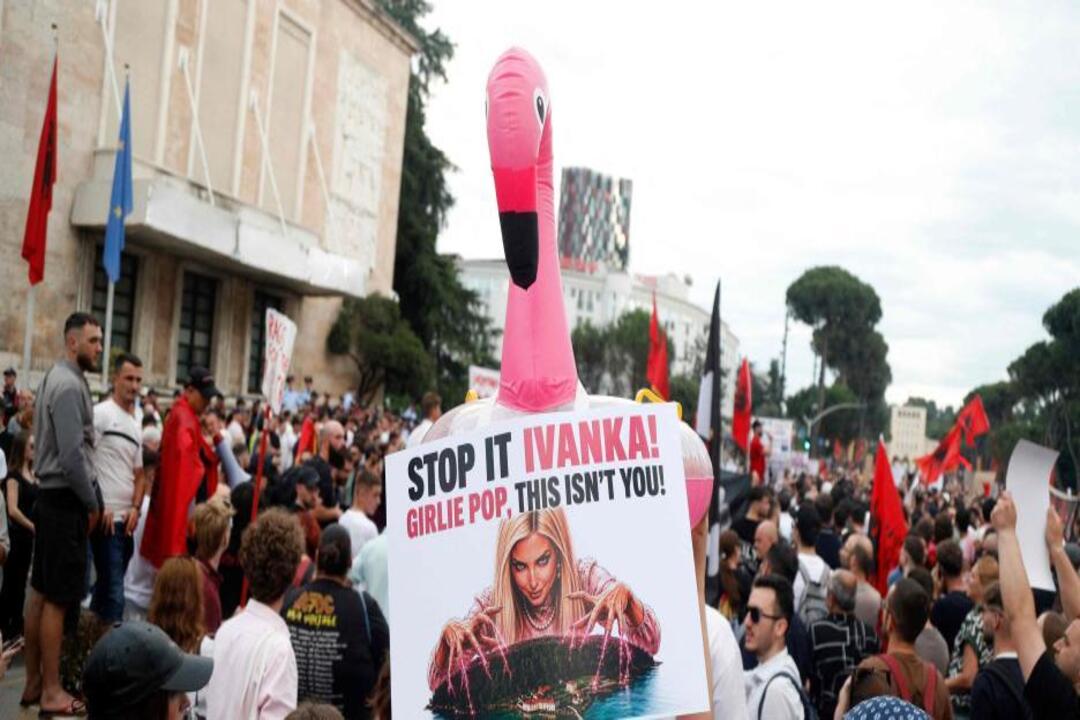
The movement quickly adopted its own symbols. The pink flamingo became the emblem of popular resistance. Protesters dressed in pink, flamingo-shaped floats, and flags that replace the Albanian double-headed eagle with a two-headed flamingo visually express the public’s rejection of the project. The most repeated slogans are: “Albania is not for sale,” “Hands off Vjosa-Narta,” “Cancel the project, Ivanka, go home,” “Rama and Berisha to jail.” The protests even spread to Albanian immigrant communities in Italy, the United States, and Canada.
The root causes of the rebellion
Although the immediate trigger was the defense of a protected natural area, the movement reflects a much broader discontent. Large segments of the population perceive that the country’s best coastal lands and primary natural resources are systematically handed over to local oligarchs, international funds, and large real estate groups through shady deals orchestrated by the government.
The public watches as massive tourism projects promise wealth and development for a privileged few, while workers are left with only precarious, low-paying jobs that are subordinate to the interests of large hotel chains and investment funds. That is why the protest has begun to evolve into a broad critique of the political system built over the past few decades, represented both by Edi Rama’s ruling party and by the traditional opposition led by Sali Berisha.
The government, the European Union, and the international community
The government’s response has combined staunch defense of the project with attempts to discredit the protesters. Edi Rama has described the protests as a supposed “hybrid war” driven from abroad to prevent the country from making a qualitative leap in the tourism sector, and went so far as to insinuate Iran’s involvement in disinformation campaigns. At the same time, he reiterated that the project will move forward because he believes it will attract high-spending tourists.
The Special Prosecutor’s Office for Corruption and Organized Crime (SPAK) launched investigations into alleged irregularities in property transfers linked to the venture, though without questioning the project itself.
While the European Union continues to negotiate Albania’s integration process, it avoids openly confronting a government it considers strategic to its interests in regional stability. The EU has deep disagreements with Trump, but it does not intend to sever the strategic unity between European imperialism and U.S. imperialism; for this reason, it operates within these two constraints. On the one hand, the European Commission has just warned Albania that it must comply with European environmental regulations if it wishes to move forward toward EU accession. On the other hand, it consistently defends the interests of large private investments rather than the rights of the people and genuine environmental protection.
Capitalism, real estate speculation, and environmental destruction
Around the world, financial capital and large real estate funds are encroaching on beaches, forests, wetlands, and nature reserves in search of new profit opportunities. Nature is no longer considered a collective heritage but has become a commodity. Real estate speculation linked to luxury tourism displaces local communities, destroys ecosystems, and concentrates enormous profits in the hands of a small minority of investors and property owners. The defense of Vjosa-Narta is not merely an environmental cause. It is part of an international struggle against an economic model based on the simultaneous exploitation of both labor and nature.
The Trumps in the Crosshairs of Social Upheaval
The involvement of Jared Kushner and Ivanka Trump has given the conflict an international dimension. The Trump family’s business dealings have become a symbol of speculative capitalism based on political privilege, influence peddling, and the use of state power to advance private interests.
Around the world, opposition is growing to Donald Trump’s imperialist policies, which attack Palestine and Iran alongside Israel, target Venezuela, and threaten Cuba; while simultaneously implementing ultra-reactionary austerity and exploitation measures against immigrants and workers in the U.S., who are mobilizing en masse against ICE, for Palestine, and for other demands.
This reality reaffirms that political and social polarization continues to deepen as a central feature of the global situation. This is understood not only as the rise of the far right, but also as a wave of rebellions, strikes, and protests across every continent. There is a long list of uprisings, the most recent of which are those in Bolivia and Albania—both very strong, yet weakened by the absence of revolutionary leadership at the forefront.
Capitalism, the great destroyer of nature and life
We at the International Socialist League (ISL) stand in solidarity with the demands of the popular movement against the real estate project and defend the right of communities to decide on their territory and natural resources.
But the underlying problem cannot be solved within the capitalist system, because land, housing, coastlines, and natural resources will continue to be treated as commodities subject to the logic of private profit, thereby perpetuating these abuses. That is why the consistent defense of the environment and life demands a struggle for a socialist reorganization of the economy, based on social ownership of strategic resources, democratic planning of production, and direct control by workers and communities over decisions that affect their future.
The “Flamenco Rebellion” and other similar uprisings taking place around the world present the challenge of transforming the energy for struggle they embody into a revolutionary political alternative—one capable of confronting not only anti-popular policies, oppression, and exploitation, but also the capitalist system that makes them possible. And to do this, it is necessary to advance the regrouping of revolutionaries at the national and international levels, on the path toward workers’ rule, with socialism and workers’ democracy.