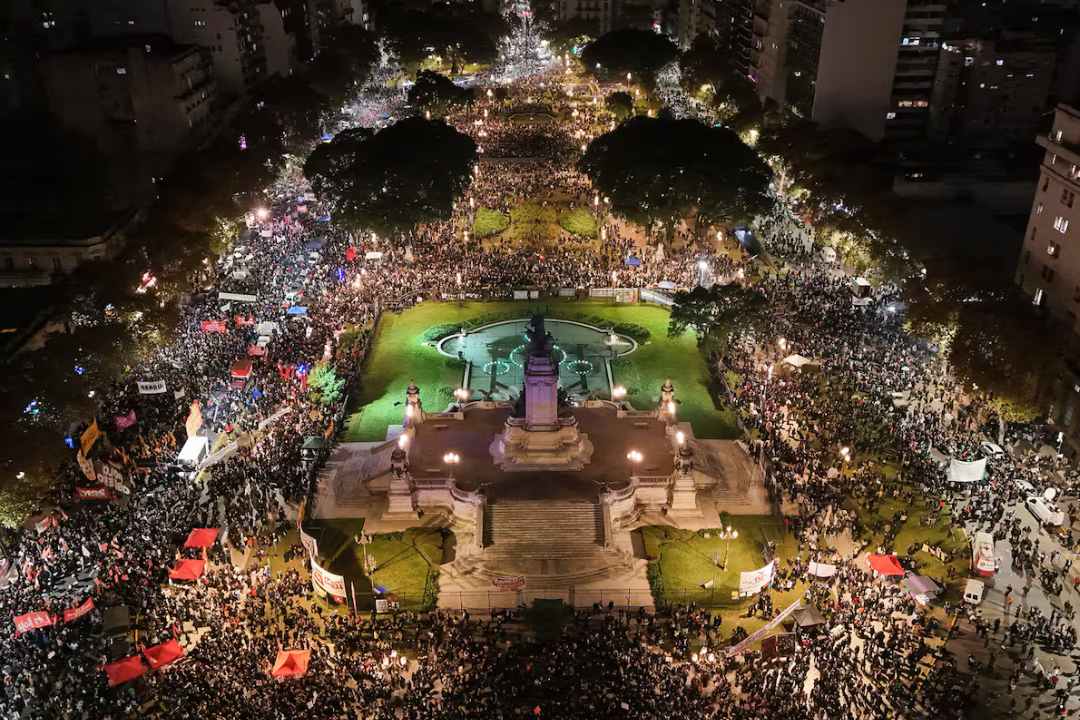
The streets around the National Congress as well as squares throughout the country where shaken by of the largest mobilizations Argentina has seen in recent times. Tens of thousands of voices, thousands of stories, urgent slogans: Ni Una Menos (Not One Less). We want us alive. The State is responsible. The anger for each femicide and the determination to continue fighting converged in a tide of signs, chants and combative hugs. The rage accumulated over a series of recent femicides merged with the rejection of Milei’s reactionary policies that seek to dismantle rights, gut gender policies and discredit the feminist movement. The national mobilization was a massive and determined response to this offensive and the alarming reality women face today.
By Oda Cuentas
A mass action
The streets have spoken once again. Eleven years after the first Ni Una Menos march, tens of thousands mobilized this June 3 in Buenos Aires and cities throuohout Argentina, once again speaking out against femicides, patriarchal violence and the dismantling of gender policies. Around the National Congress the mobilization was massive. Signs, banners, chants and an intense energy dominated the whole day. Anger was transformed necessary action in the streets to demand justice for Agostina Vega, Dulce Candia and Noelia Romero, victims of femicides perpetrated last week. Reading the collective document in front of the Congress, renowned singer Cazzu summarized it with precision: “June 3rd is the cry of disgust that eleven years ago took to the streets in Argentina and spread all over the world, weaving a collective denunciation”.
The mobilization was not limited to Buenos Aires. In Córdoba, epicenter of grief for Agostina Vega, a multitude filled the streets despite the rain. There were also actions and mobilizations in Rosario, Mendoza, Santa Fe, Jujuy, Neuquén, La Plata and dozens of cities throughout the country. “Between June 3, 2015 and May 24, 2026 there were at least 3,205 lethal victims of gender violence. They are not numbers, they are lives torn away by sexist violence”, detailed the document that was read. Because, while women and LGBTI+ people continue to be victims of violence, the government of Javier Milei deploys an ideological and material offensive against the gains of the feminist movement.
Since he took office, Milei has carried out a systematic offensive against gender and diversity policies. Among his first measures, he eliminated the Ministry of Women, Genders and Diversity, reduced or dismantled programs of assistance and prevention of gender-based violence, advanced with layoffs in specialized areas, cut budgets for the protection and support of victims and promoted an official discourse that denies the existence of structural inequalities between men and women. There are also permanent attacks against Comprehensive Sex Education (ESI), the questioning of the legal figure of femicide and the repeated statements of government officials who seek to discredit the feminist movement and present its achievements as supposed “privileges”. It is all part of a political project that combines economic adjustment against the working majority with a reactionary agenda aimed at weakening the tools of prevention, assistance and reparation won after decades of women and LGBTI+ struggle.
The femicides that made this June 3 more urgent
Three crimes that took place over a few days shook the country and gave this year’s march an urgency and rage difficult to contain. The first shock came from Córdoba: Agostina Vega, only 14 years old, was brutally murdered by Claudio Barrelier, 33 years old, her mother’s ex-partner. Her body was found in an open field in the Ampliación Ferreyra neighborhood, south of the city, after seven days of anguished search. It was a femicide foretold: Barrelier had an open case for threats and unlawful deprivation of liberty, but the Cordoba justice system had granted him bail and minimum restrictions consisting of appearing only once a month at the prosecutor’s office. The person responsible for releasing him was Dr. Ivan Rodríguez, head of an investigating prosecutor’s office.
The response of prosecutor Raúl Garzón to the media, full of arrogance and false expectations, intensified the indignation. The accused, a municipal employee and member of the Instituto sports club, also had links to Cordoban Peronist leaders, evidenced in photographs together with local councilors and former officials of the local PJ. This shows that there are no cracks in the institutions or between the bosses’ parties when we talk about patriarchy. This whole framework was denounced today in the document read in the central rally.
Dulce María Candia, 17, was murdered at a construction site in Eldorado, Misiones, after her family reported her missing on May 17. The autopsy determined that she died from mechanical asphyxia. Two days after June 3, the third blow came: Noelia Carolina Rivero, 30 years old. She managed to call the police to alert that her partner was holding her captive in a house in Temperley, Buenos Aires. When the police were finally able to enter the house, they found her stabbed to death. She had asked for help, but the State did not arrive in time.
The origin of June 3
June 3, 2015 marked a before and after in the history of the women’s movement in Argentina and in the global movement. The trigger was the case of Chiara Paez, a teenager of 14, the same age as Agostina Vega, murdered by her boyfriend and buried in his backyard in Rufino, Santa Fe. Against the endless chain of unanswered crimes, a collective of journalists and feminist activists launched the slogan Ni Una Menos (Not One Less) and called for a mobilization: there were marches in more than eighty cities in Argentina simultaneously. Violet (color identified with the feminist movement) and green (campaign for legal, safe and free abortion) covered the streets. There were unprecedented mobilizations in towns and small cities. The images were covered by the media across all continents. Since then, every June 3 in Argentina we return to the squares to denounce violence against women, lesbians, transvestites, trans, intersex and non-binary people. And since then, Ni Una Menos has become more then a slogan against femicides: it has taken on a much greater meaning, with clear demands against those politically responsible for gender violence and the denunciation of the system that sustains it.
A hard earned gain: the history of femicide as a codified legal concept
Argentina was a pioneer in the region in recognizing and legally defining femicide. Prior to 2012, these crimes were simply framed as “homiside aggravated by familial or intimate relationship” in the Penal Code, a category that erased the gendered nature of the crime and diluted its specificity. It was the sustained pressure of feminist organizations, with years of struggle in the streets, courts, Congress and legislatures, that succeeded in November 2012 in incorporating femicide as a specific criminal offense, recognizing for the first time that killing a woman because she is a woman responds to a logic of structural domination that requires a differentiated legal response. In addition, the incorporation of this category allowed these crimes to be investigated and judged with the corresponding gender perspective and framed under the maximum criminal severity provided by law, with life sentences for the convicted.
Milei’s government not only denies the use of the term “femicide” in its official communications, including everything under the euphemism “homicides of women” in order to fabricate statistics, but also expresses its intention to eliminate this figure from the Penal Code. In parallel, Senator Carolina Losada (of Milei’s party) promotes a project to penalize so-called “false accusations”, despite the fact that data colected by the Gender Observatory of the Public Prosecutor’s Offices show that they represent an insignificant percentage of cases. This is an offensive aimed at discouraging denunciations, reinforcing the impunity of the aggressors and advancing agaisnt conquered rights. However, it will not be easy for them to carry out these threats: the power of the feminist movement in Argentina, which has won historic victories, continues to be an obstacle for those who want to set us back decades in terms of rights and protection against gender violence. This Wednesday’s massive mobilization once again demonstrated that there is strength and willingness to fight to confront these attacks and defend each of the conquests achieved.
Fighting to the end
We demand justice for Agostina Vega, for Dulce Candia, for Noelia Rivero and for all the victims. We denounce the government of Milei, whose cuts and denialism build the scaffolding for patriarchal violence to act with impunity. We denounce the government of Córdoba and its judicial apparatus: the police and the justice system that did not investigate or search for Agostina in the first forty-eight hours, the prosecutor Garzón who responded with derision and arrogance, the political power that closed ranks to protect its links with the accused. We denounce the institutional framework that responds in unison when it comes to covering up for its own. Aware that the struggle against femicides cannot be separated from the struggle against a system that reproduces inequality, violence and oppression.
This new 3J showed once again that there is anger and also a lot of strength. The MST-FITU (Argentine ISL seccion) and Juntas y a la Izquierda marched all over the country, raising the most urgent demands and knowing that laws that are not applied and programs emptied of resources are not enough. Nor are the siren songs of some progressive sectors that seek to solve a structural problem with short-term policies, without questioning the system that produces and reproduces violence. We need a budget, support networks and effective justice, but also a perspective that gets to the heart of the problem. Because femicides, precariousness and all forms of sexist violence find their sustenance in this capitalist and patriarchal system. That is why we fight for a socialist feminism, a radicalized class based feminism that denounces not only patriarchy but also capitalism and its institutions. We will continue in the streets and building the political organization that will fight this fight to the end.