By: MST Bolivia
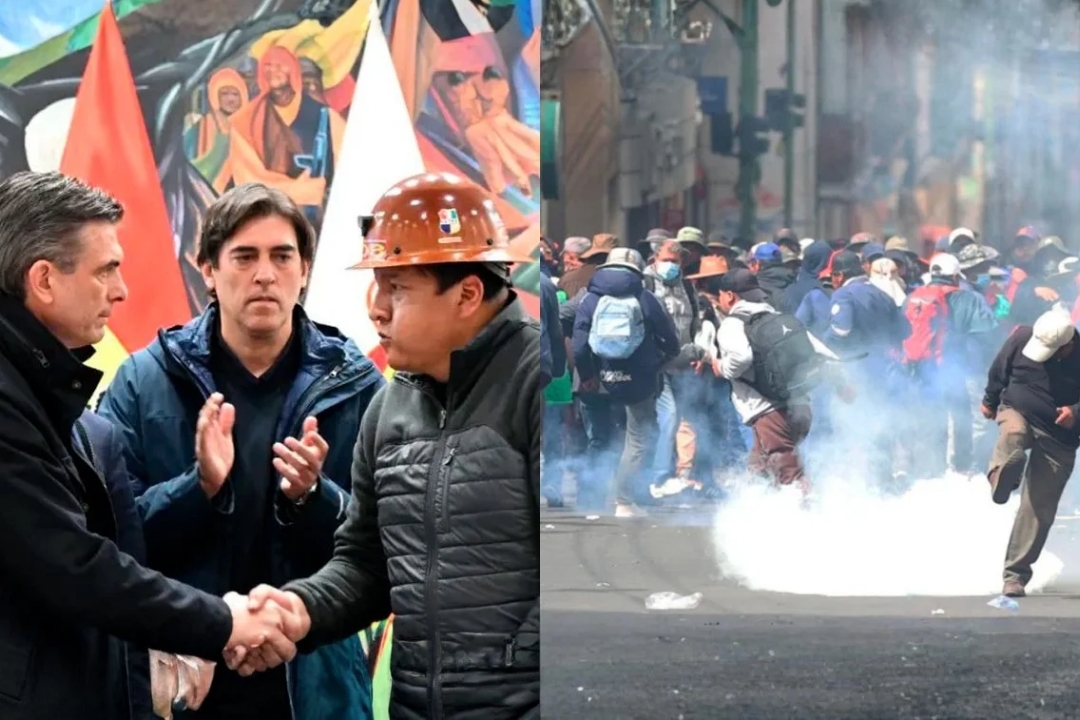
Argollo and leaders of the COB’s dual leadership structure prevent the government from falling, sign an agreement with Paz, and give him 90 days to meet the demands.
The COB leadership handed over power—which was practically in its hands—to Rodrigo Paz’s weak government. Argollo refused to adopt the definitive strategy for seizing power; he spearheaded the agreement after 50 days of struggle and ordered the lifting of the blockades, thereby damaging the alliance with the peasantry and neighborhood organizations in El Alto.
The agreement requires the government to refrain from privatizing public enterprises or handing over natural resources to domestic or international private interests, to ensure non-interference by foreign powers while respecting national sovereignty and to reject commitments to international financial institutions such as the IMF; to guarantee a supply of high-quality fuel at stable prices; and to compensate transport operators for damages caused by substandard gasoline. Protection of the basic basket of goods, wage purchasing power, and job stability. A review of Pension Law 065 to address the COB’s demand for retirement benefits equal to 100% of salary, as well as the formation of working groups to address the COB’s list of demands and the protection of protected areas to preserve the environment, among other requirements.
The agreement also established a legal commission composed of representatives from the government and the COB to work toward the release of those detained during the 50 days of social protests.
The call for demobilization comes amid negotiations between two forces: the leadership of the working class, headed by the COB, and the bourgeois oligarchy led by Paz, with the balance of power clearly tilted in favor of the workers. It is the COB leadership that is propping up Paz, not the oligarchy or imperialism, since bourgeois power was defeated—along with its fascist gangs—by the powerful struggle in the streets. Paz remains in power by the will of the leadership of a class-antagonistic organization, the COB.
Following the agreement, Paz was allowed to govern in an attempt to dismantle the dual power structure from within. The blockades were weakened. Paz took advantage of this situation and declared a state of emergency in the early hours of June 20. However, he does not yet possess the strength of a counterrevolutionary process capable of crushing the masses; rather, he still depends on the agreement with the COB, which is why his offensive cannot impose curfews and relies instead on the use of chemical dispersants.
Nevertheless, a ramshackle government teetering on the brink is allowed to carry out this offensive. It is a massive betrayal that gives it time to recover so it can attempt to defeat the workers’, peasants’, and people’s movement.
Down with the pact with the government!
Reorganize the struggle with the goal of seizing power!
Down with the state of emergency!
La Paz, June 20, 2026