The rally took place from May 15 to 17 in Paris, under the slogans “Imperialist Militarization and Social War Against the World Proletariat” and “Youth Movements.” The debates resulted in many differences of opinion and no joint action, reaffirming the event’s role as a forum for the exchange of views. The International Socialist League (LIS) once again played a prominent role.
By Rubén Tzanoff
Similar to the previous ones
The 2026 Conference did not introduce any significant changes compared to previous editions. The call for participation issued by the “PromotionalCommittee”¹ resulted in the publication of more than 40 contributions and the participation of more than 30 speakers representing organizations from various countries. Of particular note was the presence of exiled activists from China, Taiwan, Sri Lanka, and Iran.
Three expressions, two of which are clearly opposed
To get a sense of the rally, it may be helpful to sketch out the political landscape. There was a diverse mosaic of parties and groups with Marxist, Trotskyist, and anarchist leanings. However, three distinct blocs emerged, consisting of: Lotta Comunista (LC)2, the International Socialist League (LIS)—which represented clearly opposing poles of opinion—and the New Anti-Capitalist Party–Revolutionaries (NPA-R)3, which put forward positions emphasizing one issue or another depending on the speaker and engaged in more debate with the LIS than with LC—an organization it prioritizes in its international perspective, just as it prioritizes Lutte Ouvrière at the national level, even though that ultra-sectarian party systematically rejects them.
Day One: Experiences in the Youth Movement
Only a few organizations demonstrated a connection to young people. For example, LC spoke about other issues and mentioned young people only to argue that we must devote ourselves exclusively to the labor movement. The LIS shared the experiences of GAM-Germany and MST-Argentina with a new autonomous youth group aimed at recruiting hundreds of young people, seeking to capitalize on the opportunity that has opened up in the country amid Milei’s decline, the crisis in the PJ, and the historic opportunity to strengthen the FIT-U.
Days 2 and 3: Differences Take Center Stage
The discussions centered on differences in analysis, characterization, and policy. The LIS presented the political platforms of its parties in Europe: “No to austerity for imperialist war; for workers’ government and a Socialist Europe.” It also made the global situation and the revolutionary policy needed to address it the central focus of the debate, highlighting Trump’s stalemate in Iran, the widespread upheaval this is causing in the U.S. and other countries, and the need to promote the broadest possible unity of action in the mobilization to defeat him. Nevertheless, the debate took a different turn. The most discussed topics revolved around the inter-imperialist conflict, the characterization of China and Russia, “campism,” the nature of the war in Ukraine, policy toward Palestine and the Middle East, the national question, how to intervene in mass movements—with what proposals—and how to approach broad anti-capitalist parties.
Some of the main differences are outlined below.
The “national question”: a recurring theme, not an anachronism
The recurring debate on oppressed and/or attacked nationalities is not arbitrary. It resurfaces in connection with events that intersect with reality—such as the invasion of Ukraine, the genocide in Palestine, the occupation of southern Lebanon, the war against Iran, and attacks on other countries in the Middle East and Latin America, such as Venezuela and Cuba. Addressing the ongoing relevance of the “national question” is a necessity imposed by reality in order to develop political strategies and build a party where these processes are unfolding. On this issue, several organizations put forward arguments rejecting Lenin’s historical positions on the importance of intervening in the struggle for self-determination with a revolutionary policy. Among them, LC stood out; therefore, it is worth devoting a separate paragraph to the political implications of its positions regarding Palestine.
Palestine: Dispelling a Misconception
According to LC, in Gaza and various other countries , the national question “is immediately caught up in the inter-imperialist struggle…” and “any progressive role—and, consequently, any possibility of a revolutionary use of the struggles for national self-determination—has disappeared.” The main tasks would be revolutionary defeatism and solidarity among proletarians “to avoid getting hooked onto the bandwagon of this or that faction of global capital…” Thus, LC’s strategy consists of not supporting the just struggles of the peoples—since it considers them to be co-opted by bourgeois imperialist interests—and limiting itself to advocating for proletarian unity.
Consequently, the LC’s policy in Gaza and the West Bank involves turning its back on the resistance for a free Palestine from the river to the sea and calling on Israeli and Palestinian proletarians to simultaneously defeat Netanyahu and Hamas. Regarding the pro-Palestinian demonstrations in Europe, the LC argues that “it is no coincidence that the largest demonstrations coincided with a media campaign cynically orchestrated by the very same sectors of the bourgeoisie that are at the forefront of arms sales to Israel.” It is therefore no coincidence that LC, although it claims to support the Palestinians in the face of the bombings, has not participated in most of the demonstrations held in Italy.
The remarks by our comrades from the PCL and by LIS coordinator Alejandro Bodart laid out clearly the differences and the need for a principled political line based on the understanding that the national question involves aggressors and victims, oppressors and the oppressed; and by conceptualizing the underlying debate regarding the relationship between movements and their leaders.
Without confusing the movement with its leaders
The positions of LC and other organizations stem from a misconception of the relationship between movements and their leaders. The decisive factor in revolutionary processes is the independent mobilization of the working-class and popular masses. There is a difference between the masses and their leaderships, which is why a struggle can be progressive even if it is led, at least partially or initially, by reformist, bureaucratic, or nationalist leaders. The key is to intervene in these actions because it is through them that consciousness is transformed and the balance of forces is shifted. This does not mean politically adapting to inconsistent or treacherous leaderships, but rather combining unity of action with the masses with an independent class policy, contesting leadership through transitional slogans, workers’ democracy, and the building of the revolutionary party. The aim is to avoid two deviations that are two sides of the same coin: sectarianism, which shuns struggles because they are led by non-revolutionary currents, and opportunism, which capitulates to those leaderships.
How should we respond to broad-based anti-capitalist parties?
It is a debate that has begun to take shape. Some parties are revitalizing themselves in the wake of the rise of the far right, such as Die Linke, while others are emerging in response to the crisis among pseudo-progressive factions, such as Your Party. Both those who get lost in their own ranks and those who refuse to adopt a policy toward these political phenomena—such as LC and NPA-R—are enabling their reformist leaderships by giving them free rein. In contrast, the experiences recounted by our comrades in Germany and the United Kingdom regarding tactics toward Die Linke and Your Party, respectively—without abandoning the strategy of building a Leninist-style socialist and revolutionary party—were instructive.
Using the transition program method
The importance of the program and its characteristics were called into question. Some speakers pitted the social needs of the masses against their democratic needs, underestimating the importance of having a program and prioritizing union-based, economic-focused action or propaganda. In other words, they oscillated between minimal and maximalist proposals, without bridging the gap between the immediate and strategic needs of the working class. The most extreme—though not the only—misconception came from LC, which characterized the Transitional Program as Trotsky’s worst “invention.”
How can we build unity among revolutionaries?
A key point in the debate is what to do at the international level. At the rally, there is an overwhelming majority of organizations that identify as internationalist and advocate for the creation of a global organization. The differences lie in how to go about it.
The NPA-R emphasized the need to bolster the rally in order to “gradually build confidence through joint work”—an effort it is primarily undertaking with LC—and even to try to form a “revolutionary pole”; whereas in France they insist on joining forces with Lutte Ouvrière, an ultra-sectarian organization that rejects any such alliance.
The LIS, which held its Third Congress in Turkey in December 2025, is embarking on a new initiative. It is moving forward by emphasizing the search for common ground on the main facts of the current reality, with principled programmatic agreements and democratic centralism to patiently and democratically debate any differences that persist or arise within the framework of a common organization. These are the basic frameworks for joint action in the class struggle and for building trust among revolutionaries who come from different traditions but are open to building a new tradition together. The views mentioned above lead to some reflections on the Meeting.
You may also be interested in: “Third LIS Congress: Documents and Resolutions.”
A forum for discussion
There is no plan for a common strategic organizational framework. Over the course of four years, the Mitin has taken on a distinct profile: a limited call for participation, the publication of newsletters featuring written contributions, two or three days of debate with few agreements, many significant differences, and no joint action. There are no signs that would support the prospect of forming a “revolutionary pole” or an International, which reaffirms the Mitin as a forum for debate among certain heterogeneous revolutionary voices.
The Positive Aspects
The Meeting has valuable aspects. It serves as a forum for exchanging opinions and clarifying political positions. It allows groups with the greatest common ground to deepen their relationships in order to explore the possibility of converging toward an international regroupment of revolutionaries. This is a concrete example of the LIS’s experience with comrades from the former OTI and the L5I. It also facilitates the maintenance of fraternal relations of exchange and collaboration between currents with different political positions and international organizational frameworks, but which are willing to continue exploring points of common ground. This is the case with the LIS, whose French comrades are active in the NPA-R, even though the NPA-R has observer status with the United Secretariat.
A Prominent Presence of the LIS
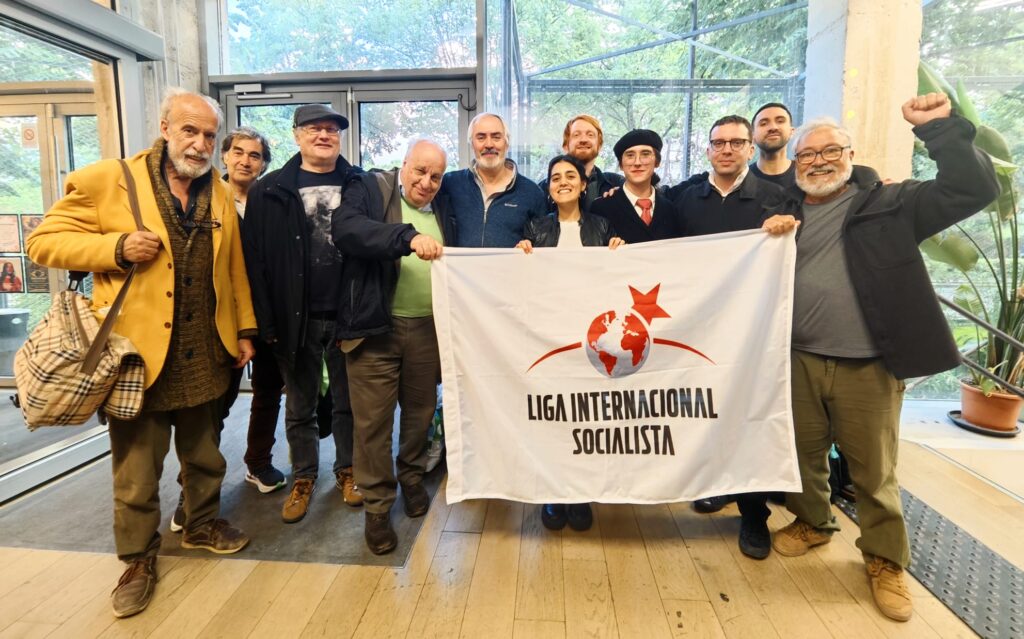
The LIS presented written contributions and speakers. In attendance were Alejandro Bodart, coordinator of the LIS; Rubén Tzanoff of Socialismo y Libertad (SOL—Spain); Marco Ferrando and Franco Grisolia of the Partito Comunista dei Laboratori (PCL—Italy), Martin Shukanek from the Gruppe ArbeiterInnenmacht (GAM—Germany), Willi Schulz from Revolution, KD Tait from Workers Power (WP—United Kingdom), Joao Pascoal from the Movimento Alternativa Socialista (MAS—Portugal), and comrades from the LIS in France. We welcome the participation of the comrades from La Aurora, whose contributions also reveal points of agreement that we look forward to exploring further.
The LIS supports the new call for the Rally in 2027, while remaining focused on promoting the international reunification of revolutionaries.
You may also be interested in: “Our Contributions to the Internationalist Meeting in Paris”
1. Organizing Committee: Associazione Marxista Rivoluzionaria Controvento, ControCorrente, Lotta Comunista, NPA Révolutionnaires, Partito Comunista dei Lavoratori, and Rivoluzione Comunista.
2. Lotta Comunista: an Italian organization founded in 1965 by Arrigo Cervetto and Lorenzo Parodi.
3.- NPA-R: a French organization composed mainly of the L’Etincelle and A&R factions.