By Juan José Villa – Leader of the Bolivian MST
Automatic translation made by AI.
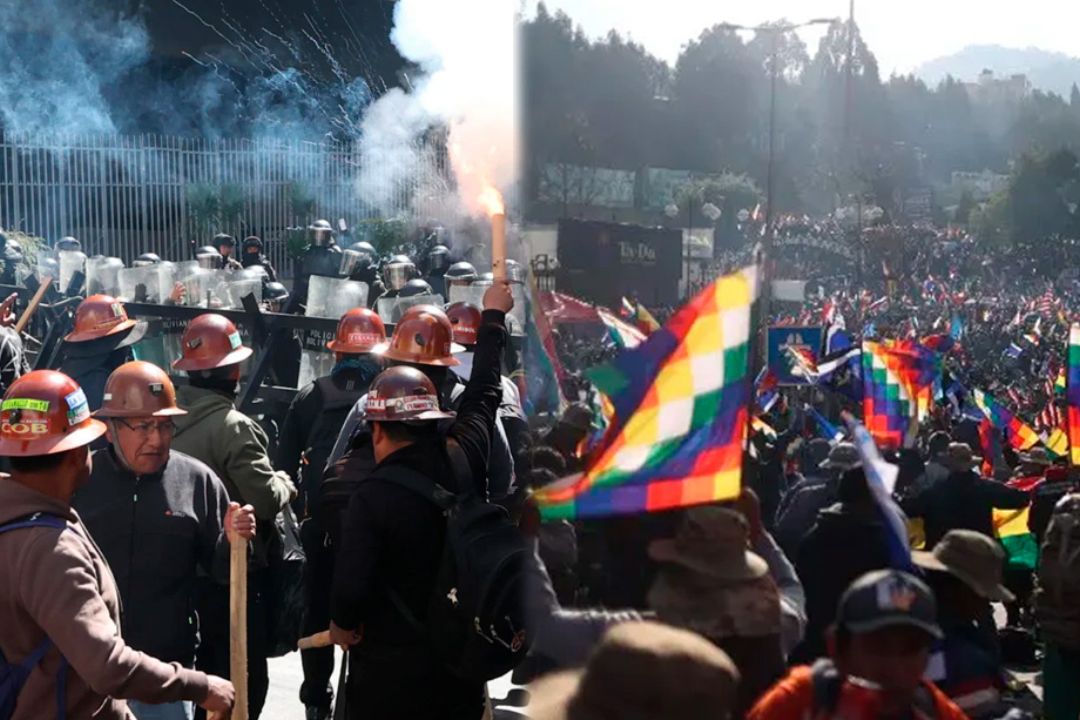
For 50 days, an alliance of workers, peasants, and the people took control of the country’s main streets and highways. Road and commercial traffic, as well as the supply of food and medicine, ceased to depend on the government and passed into the hands of the emerging power of the mobilized grassroots. The Legislative Assembly, the Supreme Court of Justice, and even the electoral body were disregarded. The protesters chanted at the top of their lungs, “Rodrigo Paz, resign!” and the main body that unified the demonstrations and blockades was the Bolivian Workers’ Confederation (COB), led by the mining proletariat and recognized and strengthened by the organizations of thousands of peasants and popular sectors.
The strength of the struggle raised the issue of seizing power and carrying out a social revolution, but the COB’s bureaucratic leadership refused to take on the colossal task that history had placed in its hands and betrayed the movement by signing a pact with the government. This is the second major betrayal by this leadership at the helm of the masses’ organ of dual power. However, the final outcome has not yet been decided. Bolivia remains in a revolutionary process that is shaping up to a coming struggle, for which it is crucial to reorganize the forces.
Below, we outline the background, as well as the results and prospects of this revolutionary struggle by the masses.
THE NEW REVOLUTIONARY RISE: FROM “OUT WITH ARCE!” TO “OUT WITH PAZ!”
The MAS government led by Luis Arce Catacora disappointed the masses by implementing draconian, pro-imperialist austerity measures; it deepened the economic and social crisis by causing prices for the basic basket of goods to skyrocket[1]. The currency suffered a drastic devaluation amid a dollar shortage, giving rise to a parallel market where the exchange rate reached three times the official rate, rising from Bs 6.96 to Bs 20. At the same time, the crisis of the extractivist economic policy erupted, alarmingly depleting hydrocarbon reserves, which began to run low along with fuel supplies, making transportation, food, medicine, and the cost of living for the working class even more expensive.
On August 12, 2024, the rebellious Túpac Katari Peasants’ Federation—composed of the militant “Red Ponchos” of La Paz—resolved to fight for Arce’s resignation[2]. The protests grew, and the year 2025 became explosive. Transportation workers took to the streets in response to fuel shortages; public hospital workers and teachers mobilized for higher wages, demanding increased budgets for health care and education; and labor unions and neighborhood associations protested the rising dollar and the cost of living. They all unite in the struggle under the slogan launched by the Ponchos Rojos: “Arce Must Go!”[3]
The masses identified not only Arce but also the MAS as a whole—including Evo Morales—as responsible for the crisis. The surge in social protests was decisive in the party’s downfall, bringing the government to the brink of collapse; a new revolutionary upsurge emerged, rather than the supposed shift to the right that MAS leaders had been touting so much.
THE 33RD MINERS’ CONGRESS AND THE REORGANIZATION OF THE PROLETARIAT
In this context, the wage-earning mining workers organized against the demobilization policy of COB leader Huarachi—a political cadre linked to the MAS—and in March 2025 held the 33rd Congress of the Bolivian Mining Workers’ Union Federation (FSTMB). They voted on a political document[4]demanding the restoration of class independence and the building of their own Workers’ Party[5]in open rejection of Arcism, Evism, and the traditional right. Finally, they elected a new leadership—inexperienced and bureaucratic, but with a mandate to restore the proletariat’s vanguard role and fight for the realization of the long-delayed COB Congress. The conciliatory labor bureaucracy began to tremble.
This congress marked a historic turning point in the mining proletariat’s break with the MAS, following 20 years of its dominance, and paved the way for a reorganization along leftist lines. It presented an opportunity to build a revolutionary leadership from the grassroots of the FSTMB.
THE ELECTORAL DIVERSION OF THE STRUGGLES
At the time the struggles against Arce were unifying, Evo Morales attempted to ride the wave of the protests with the main slogan of enabling his candidacy for the presidency—a call that resonated among the rank-and-file in the Chapare. But he was rejected by the vast majority of protesters who were demonstrating against Arce. Evoism ended up confronting the protesters instead of confronting the government. Its mobilization turned into a counterrevolutionary response in favor of Arce.
In this way, peasants from northern Potosí have categorically broken with Evo[6]. The working people of Llallagua[7]and Vinto also expressed their rejection in the streets and at town hall meetings, as did the Ponchos Rojos from the 20 provinces of La Paz. The mobilization of the working people defeated Evoism, but at the cost of interrupting the main struggle for “Arce Out!”
In June, the leadership groups headed by the Túpac Katari faction changed their strategy, directing their rank-and-file members to oust the government through the electoral process rather than through direct action. This marked a shift in the struggle toward the ballot box. But it was merely a detour, not a defeat; the grassroots forces were waiting for the next battle.
THE 18TH COB CONGRESS
The 18th COB Congress was held in October 2025, driven by the mining proletariat, amid an electoral ebb in the struggles. The political document is influenced by the class collaborationism of the bureaucratic leaderships linked to remnants of the MAS that still remained in various unions and took advantage of the lull to impose their collaborationist orientation, arguing that the country is experiencing a“resurgence of the right” and that Rodrigo Paz’s candidacy would be a“sui generis alternative”[8], without clarifying that there had been a mass uprising against Arce, that the process led to the recovery of the FSTMB, and that, in reality, a new revolutionary wave was on the horizon that would pose the problem of power to the COB, just as the theses of the Socialist Workers’ Movement (MST)[9] had pointed out.
However, the revolutionary process left its mark on the final votes, ratified the resolutions of the miners’ congress, mandated the restoration of class independence and a refusal to support any bourgeois government in power—thus breaking with the MAS’s previous positions—and determined the formation of the COB workers’ own party. Huarachi’s seven-year reign was brought to an end, and a new leadership was elected—one that was bureaucratic but committed to mobilization.
RODRIGO PAZ AND EDMAND LARA WIN THE ELECTIONS WITH POPULIST RHETORIC
The first-round elections reflect the rise of the revolution, with invalid and blank ballots emerging as the country’s second-largest political force[10], defeating the candidate of the hard-line right, Tuto Quiroga, and the MAS, which nearly lost its legal status by a narrow margin.
Rodrigo Paz and his running mate, Edmand Lara, won the first round with a “popular front” platform, promising to grant new benefits, defend social gains, and maintain food and fuel subsidies. They do not adopt a right-wing platform at all, adapting instead to the new wave of mass mobilization in a campaign rife with lies designed to win votes.
In other words, the masses did not shift to the right, as the MAS political leadership and indigenous intellectuals claimed; rather, Paz’s candidacy had to masquerade as left-wing in order to win, because there was no room for the right in the new revolutionary process. Thus, in the runoff election, the invalid and blank votes shifted to support this candidacy, crushing right-wing candidate Tuto Quiroga in the vote count.
THE DECEMBER–JANUARY GENERAL STRIKE AND THE EMERGING DUAL POWER OF THE COB
The new bourgeois government takes office on November 8, 2025. It immediately abandons its populist promises to openly align itself with the plans of U.S. imperialism under Donald Trump. It eliminates the tax on large fortunes, implements the IMF’s austerity measures that harm the economy of the working majority, and enacts Supreme Decree No. 5503, containing more than 120 articles that facilitate the handover of natural resources to imperialist corporations.
The masses that had mobilized against Arce retained all their strength intact, and were not willing to tolerate another pro-imperialist austerity measure, much less the plundering of the country. The rank-and-file workers and peasants held assemblies within their respective organizations. On December 18, the Miners’ Federation decided to go to the COB’s expanded meeting with a proposal for a general strike. The COB’s expanded meeting on Friday, December 19, brought together the country’s worker and peasant delegates and resolved to call for an indefinite general strike against Decree No. 5503. The strike began on Monday, December 22. Workers spent Christmas and New Year’s Eve fighting in the streets. Just one month and a few days after taking office, the Paz administration found itself on the brink of collapse.
In January 2026, the alliance between workers, peasants, and the people is strengthened. The Túpac Katari, CSUTCB, and FEJUVEs organizations of El Alto, along with trade union confederations—all of which have organic representation within the COB—will intensify the general strike led by wage-earning miners, and from the grassroots, the slogan “Out with Rodrigo Paz!” will gain momentum.
The struggle culminated in a resounding victory. The capitulationist decree was defeated. The COB ceased to be a mere labor union; it reclaimed its historic role as a people’s center and an organ of dual power. The masses believed they could go further; that their strength was not only sufficient to repeal a decree, but also to defeat the entire austerity plan and oust, through revolutionary means, the right-wing government that had disguised itself as left-wing in the elections.
A GOVERNMENT THAT SURVIVES THROUGH THE BETRAYAL OF THE COB LEADERSHIP
However, the COB leadership reached a preliminary agreement with the ministers of peace to repeal the decree and instructed members to lift the blockades, arguing that the strike had been called solely in opposition to Supreme Decree 5503. The peasant rank-and-file, in disagreement, punished their leaders with whips and chased after the car of the COB’s top leader, lashing it with their whips[11].
This was the first act of betrayal by the leadership of Mario Argollo, an executive of the COB; Vicente Salazar, an executive of the Túpac Katari; and Andrés Paye, an executive of the FSTMB—to name the main ones. Finally, on January 12, with the repeal of Supreme Decree 5503 in hand, the order to lift the blockades was carried out.
From that moment on, Rodrigo Paz was no longer sustained by his own strength, but by the leadership of a class-antagonistic organization, the COB. The government, in crisis, had severed ties with Vice President Lara (who criticized its austerity measures) and revoked several of his powers by decree. The bureaucracy led by Argollo limited itself to advising Paz, Lara, and Congress to “govern for the people” and reached an agreement with the government on Supreme Decree 5516[12]imposing the gasoline price hike, accepting the bourgeois argument that the economic crisis was caused by state fuel subsidies.
The breathing room provided by the workers’ and peasants’ bureaucracy allowed Paz to regroup for a new package of laws. The elimination of the hydrocarbon subsidy was finalized, causing public transportation prices to skyrocket; the flour subsidy was eliminated, causing the price of bread to skyrocket; a campaign was launched to push state-owned companies into bankruptcy, paving the way for their privatization; and the government, together with the parliamentary right wing, pushed through the Anti-Blockade Bill to shield itself from upcoming protests.
The last straw was Law 157 on land ownership, which was to be reinforced by Law 1720 on land conversion, allowing the oligarchy to seize the lands of small farmers and indigenous territories. At the same time, he expressed his total rejection of the peasant councils and the COB’s list of demands, which was based on wage demands.
But, like any bourgeois government that is propped up by the leadership of a class-antagonistic organization, it is so weak in practice that these events serve as a prelude to a new revolutionary uprising.
THE PEASANTS’ COUNCIL AND THE WAIT FOR THE PROLETARIAT TO TAKE THE LEAD
On April 11, in the city of El Alto, a peasant assembly was held, led by the rank-and-file members of the Túpac Katari Federation and the CSUTCB. The leaders reestablished their authority by enduring the lashes of their rank-and-file members during the January struggle. The assembly resolved the following:
1- Elimination of the lifetime pension for former heads of state who receive Bs. 33,000 per month without doing anything. 2- A 50% pay cut for members of Congress who earn more than Bs. 20,000 a month while working part-time. 3- Land titling for the peasant sector. 4 – Reversal of land concessions. 5 – Repeal of Law 157. 6 – Rejection of the judicial system. 7 – Respect by the ALP for the Bolivian people; respect by the president for the Bolivian people. 8. Elimination of the anti-blockade bill. 9. A 15-day deadline for the government to comply with the town hall’s resolutions. 10. Resignation of the entire executive and legislative branches in the event of failure to comply with the resolutions.
The peasantry expressed their strong opposition not only to the government but also to the judicial system and the Legislative Assembly, and gave them 15 days to comply with the resolutions; otherwise, they would begin the fight to oust the executive and legislative branches.
The deadline expired on April 26. However, even though several peasant leaders railed against the COB at the town hall meeting, the grassroots peasant movement waited for the COB to organize its own town hall meeting scheduled for May 1 and call for a general strike to launch a unified struggle.
This gesture by the grassroots of the movement paved the way for the proletariat to lead the second phase of the struggle against the government.
THE COB AND THE BEGINNING OF THE 50 DAYS OF STRUGGLE
On May 1, the COB Executive Committee declared an indefinite general strike to demand wage increases, pensions equal to 100% of salary, the defense of peasant lands against Law 1720, opposition to the privatization of education and health care, opposition to layoffs, labor market flexibility, and tax policies targeting labor unions; it demands an end to fuel shortages and the use of contaminated gasoline; and it endorses the farmers’ list of demands, among other demands.
From the miners’ delegations, shouts can be heard demanding that Rodrigo Paz resign, but Argollo’s leadership has made the request contingent on giving the government time to meet the demands, and then, if it fails to do so, demanding his resignation.
But that conciliatory policy had already been in place since January. The rank-and-file workers and peasants outpaced their leaders, and in the first week of the struggle, they united all sectors under a single slogan: “Rodrigo Paz must resign!”
THE NON-BETRAYAL PACT AND THE ALLIANCE OF WORKERS, FARMERS, AND THE PEOPLE
On May 6, labor leaders, peasant leaders, and representatives of the working classes were forced by their rank-and-file members to sign a document titledthe “Pact of No Betrayal.” Argollo’s remarks at a press conference that day describe the situation very well:
“We have been questioned and punished, and our provincial authorities have been lashed out at, because (the rank and file) have thought that we have sold out. The government has had the opportunity to reconcile with the people, to work for all Bolivians—for those of us who brought it to power, for those of us who voted for it— and unfortunately, it now works and passes laws in favor of certain powerful families in this country—the business class, the agro-industrialists, the bankers, and the millionaires of this country. And unfortunately, for the people, there’s nothing—laws that bring hunger, laws that bring misery. The cost of living isn’t getting any better; as for fuel, they’ve removed the subsidy and given us junk gasoline.[13]
In that regard, the people’s patience has its limits; that is why, in this hall, a decision has been made—involving various organizations across all sectors, not just the leadership of the Bolivian Workers’ Confederation (CSUTCB); the leadership of the CSUTCB, the leadership of the 20 provinces, our colleagues in the transportation sector, the Intercultural organizations, CONAMAQ, the Neighborhood Councils, and other sectors that are joining this call. In that regard, it has been decided to form an Alliance for Bolivia (…) It has been decided to establish this Pact of No Betrayal; in that regard, if the president lacks the will to resolve the issue, he must step down, comrades.”[14]
With this, the rank and file overrode their leadership—not by ousting it, but by calling on it to fight and go beyond what it had intended to achieve. The words of Vicente Salazar of the Túpac Katari movement describe this conclusion:“The people have overtaken us; they are already tired of this government, and the sole demand of the 20 provinces is the resignation of Rodrigo Paz. (…) An alliance is being forged with all sectors; the discontent is not limited to a single sector—it spans the entire Plurinational State of Bolivia (…) The people have already risen up in anger, and today they are demanding the resignation of all four branches of government.”[15]
The revolutionary process challenged not only the executive branch but the entire bourgeois and oligarchic institutional framework; as Salazar pointed out, the struggle is also for the“resignation of the four branches of government.”
DOUBLE POWER IN MAY AND JUNE
“Today, the blockaders are ruling Bolivia”[16](Agustín Zambrana, vice president of the Pro Santa Cruz Civic Committee. May 30, 2026).
For 50 days, the alliance of workers, peasants, and the people took control of the country’s main streets and highways, chanting, “Paz, resign!” At the forefront were the FSTMB and the Túpac Katari Federation, along with the CSUTCB, CONAMAQ, Intercultural organizations, Departmental Labor Federations, urban and rural teachers’ unions, Neighborhood Councils of El Alto and La Paz, and trade union organizations, all centralized under the COB and with organic representation within it. Even small, unaffiliated sectors known as “autoconvocados” joined in, recognizing the COB’s leadership. The method of struggle was road blockades and protest marches in the major cities. The police report of May 26 documented 150 roadblock sites throughout the country[17]. Road and commercial traffic, as well as the supply of food and medicine, ceased to depend on the government and passed into the hands of the mobilized grassroots. The COB Assembly on May 31 and, subsequently, the town hall meeting on June 2 held in the city of El Alto resolved to open a corridor for this purpose. This strengthened the struggle and made the dual power structure increasingly evident.
This was not merely a struggle that simply created obstacles for Rodrigo Paz to govern; rather, it effectively organized an alternative government in the streets and on the highways. And it was not a petty-bourgeois anarchic process; rather, it channeled its emerging power into the workers’ main organization, the COB—a labor institution transformed by the masses into an organ of dual power.
Rodrigo Paz and Congress backtracked, repealed Law 1720 on land conversion, and set aside consideration of the Anti-Blockade Law. The executive branch promised a bonus to teachers and announced that it would reduce his own salary and those of all his ministers, as demanded by the town hall meeting on April 11—though the latter was a lie intended to call for dialogue and demobilize the movement. But it didn’t work. The rank-and-file members, in assemblies and town hall meetings held on June 1, resolved not to attend any dialogue with the government and remain firm in their demand for the president’s resignation.
On May 24, the Pro-Santa Cruz Civic Committee, a body of the pro-imperialist oligarchy, published a statement titled “Final Warning to President Rodrigo Paz and His Cabinet” in which they acknowledge that there is a power vacuum and that, to overcome it, a state of emergency must be declared; otherwise, they themselves would take to the streets to break the deadlock[18]. This statement incited the fascist Union of Santa Cruz Youth.
But the government had already imposed a de facto state of emergency by launching two police-military offensives against El Alto and the roadblocks in the west, on the roads leading to La Paz, Oruro, and Cochabamba. In the two offensives that the government disguised as “humanitarian corridors,” the state’s repressive apparatus—led by Minister Zamora’s convoys—ended up fleeing the roadblocks[19]. The dual power of workers and peasants triumphed in the western part of the country, overcoming tear gas and bullets with dynamite, sticks, and stones.
But the oligarchy believed it controlled the east. So on June 6, the government, together with the Pro-Santa Cruz Civic Committee, launched a third offensive to physically crush the protesters in San Julián, a municipality of Santa Cruz de la Sierra. The police and the military escorted the Unión Juvenil Cruceñista and supplied them with firearms and tear gas. This marked the beginning of the looting of homes and attacks on residents. In other words, a fascist offensive was launched.
Immediately, the people of San Julián organized themselves[20]. Mobilization grew, the roadblocks intensified, and the fascist gangs were forced to flee the area along with the military.[21]The police were forced to abandon the local police station, which was seized by the masses[22].
The power of the Workers’, Peasants’, and People’s Alliance demonstrated that it controlled not only the western part of the country but also the eastern part. The government, the oligarchy, and Donald Trump’s imperialist interference were completely defeated.
THE PROBLEM OF THE SEIZURE OF POWER AND THE BETRAYAL BY LEADERS
With three military and fascist offensives defeated, the oligarchy acknowledging the power vacuum and that, if there is any government at all, it is that of the blockaders[23]; with a peasant base that had decided the proletariat should lead the struggle, and with the COB—a workers’ organization—that had centralized the rural and urban workers’ organizations, the question of seizing power was clearly on the table and within reach.
“All Power to the COB and the organizations in struggle!” was the slogan that was needed to deepen the revolutionary struggle. The goal of workers’, peasants’, and the people’s power—achieved through their concrete organs of struggle—was crucial to raising the consciousness of the nascent alternative government that already existed in the streets and on the highways. In this way, the self-sufficiency that was already emerging through supply corridors at roadblocks and the victorious self-defense that defeated the military and fascist gangs would be further strengthened under the leadership of the organized working class.
Reports on the soldiers’ morale were favorable to the struggle. Peasants from Omasuyos and Chayanta informed leaders of the Socialist Workers’ Movement (MST) that the military bases had agreed not to fire on the people if a state of siege were declared. It was precisely for this reason that the government’s military offensives were defeated. This process spread to all 20 provinces of La Paz and was gaining support nationwide. In this situation, a call for revolution could inspire the soldiers not only to sympathize but to definitively mobilize alongside workers and peasants, provided that the strategy for seizing power was presented to them in no uncertain terms.
But the leadership did not want to escalate the struggle; deep down, it did not want to overthrow the government through revolutionary means. When Comrade J of the MST called on the FSTMB leader, Paye, to fight for a workers’ and peasants’ government led by the COB, Paye responded that he did not agree to “embark on an adventure.” When Comrade JV of the MST took the floor at the COB’s Enlarged Meeting on May 31 and called on the entire leadership to lead the COB to seize power, they refused to take up this revolutionary proposal.
At the COB Strike Committee meeting on May 31, which included comrade JJ of the MST, the delegation of miners from Huanuni and Colquiri reported a decisive fact: during the massive marches in the last week of that month, they managed to break through the police cordon at Plaza Murillo, holding their ground for 45 minutes of intense confrontation against chemical agents and overcoming the enemy. They called on everyone to enter en masse, but when they turned around, the peasants and neighborhood committees had already dispersed due to the tear gas. The miners were left alone at the front. The report concluded, “If they hadn’t dispersed, the struggle would have ended right then; we would have achieved our goal.” They were critical of the disorganization of the marches surrounding the perimeter of the government palace. And indeed, the leadership of the Pact of No Betrayal did not organize any joint strategy to seize the seat of power—which was the final step remaining—leaving the rank-and-file and mid-level cadres to fend for themselves.
In practice, the leadership implemented its true political line: to wear down the masses’ strength with 50 days of blockades and marches lacking a clear direction toward power, and to take advantage of their exhaustion to reach a settlement with Rodrigo Paz once and for all. And that is precisely what happened. Because of this policy, they failed to guarantee the right to strike in the mines, so the proletariat had to find ways to take the lead in the struggle—maintaining work shifts on the one hand, and sending delegations of miners to the blockades and demonstrations at the seat of government on the other.
During those 50 days, several leaderships betrayed the movement—such as the urban and rural teachers’ confederations, which sold out for a measly annual bonus—but sectors of their rank-and-file remained mobilized in La Paz. The leadership that paved the way for the demobilization was that of the Confederation of Industrial Workers and its Cochabamba departmental federation, which struck a deal with the government that undermined the 50-day struggle by opposing the demand for Paz’s resignation. This industrial leadership, with bureaucrats who have held their positions for 20 years since the MAS era, defied the decisions voted on at the COB’s expanded meetings and the assemblies of the workers’, peasants’, and popular alliance, in order to ensure the right-wing government’s continued rule.
Finally, on June 17 and 18, the mining leaders from Colquiri and Huanuni—the main centers of the workers’ struggle—reached an agreement with the government, paving the way for Argollo to sign the treacherous pact on June 19.
THE STATE OF EMERGENCY OF A GOVERNMENT SUPPORTED BY THE COB LEADERSHIP
Following the agreement, the COB leadership ordered the lifting of the pressure tactics, and the protest subsided. Of the 150 roadblocks in place at the height of the protests, only 12 remained. The farmers and neighborhood councils of El Alto accused the COB bureaucracy of betrayal. Nevertheless, they held their respective assemblies and, after three days, lifted the remaining roadblocks.
The government declared a state of emergency just as the struggle was losing momentum. It is a lie to say that repression was what put an end to the protest. It lacked the strength to assert itself after being defeated three times in its military and fascist offensives. It was the COB leadership that dismantled the mobilization and gave Paz permission to govern. In this way, they once again became his mainstay.
The agreement granted the government a three-month reprieve and urged it to work with the COB to secure the release of those detained, to refrain from politically persecuting leaders and to preserve the right to protest, to refrain from privatizing public enterprises or handing over natural resources to domestic or international private interests, to ensure non-interference by foreign powers while respecting national sovereignty and to reject commitments to international financial institutions such as the IMF; to guarantee a supply of high-quality fuel at stable prices; and to compensate transport operators for damages caused by substandard gasoline. Protection of the basic basket of goods, wage purchasing power, and job stability. Revision of Pension Law 065 to address the COB’s demand for retirement benefits equal to 100% of salary, as well as the establishment of working groups to address the COB’s list of demands—comprising more than 100 specific requests—and the protection of protected areas to preserve the environment, among other demands.
However, this commitment was a ruse used as a pretext to grant Paz the ability to govern. Once the dual power of the streets had been neutralized, the government broke the agreement by declaring a three-month state of emergency—the same duration of the truce granted by the leadership—and launched a new wave of selective persecution against leaders. More than 500 people have been detained since the 50-day struggle began and have not been released.
Argollo’s bureaucracy is on the list of those being targeted, but its members have not been arrested and are maintaining a complicit silence. The pro-imperialist austerity plan continues with new decrees raising water and electricity rates; the devaluation of the boliviano against the dollar has been made official, and another step has been taken toward privatization with the free importation of hydrocarbons, while fuel shortages and the crisis involving contaminated gasoline persist.
However, protests against these latest measures are taking to the streets in various regions, from the west to the east of the country: transport workers are protesting over fuel prices, and hundreds are demonstrating against rising loan and land costs due to the boliviano’s latest devaluation against the dollar. Public complaints about high rates for basic services are fueling a new wave of mass protests against the government.
The state of emergency is not being upheld, and the only thing Paz can do is prosecute the leaders without releasing those who have been detained, but it is impossible for it to crush the masses, because although the dual power has been temporarily dismantled, the movement has not been physically defeated and can resurface in the face of provocations. The government remains weak.
FOR DEMOCRATIC ASSEMBLIES TO REORGANIZE OUR FORCES WITH THE GOAL OF GAINING POWER.
Given that the masses have not been crushed and new protests are weakening the state of emergency—while the government cannot sustain itself through its pact with the COB—forces can be reorganized for the next battle, which will likely take place at the end of the three-month truce. October will bring with it the memory of the 2003 revolution that toppled the neoliberal government of Sánchez de Lozada. The working class must prepare for the third round of the struggle.
To achieve this, we must restore the relations between the peasantry and the proletariat that have been damaged by the treacherous bureaucracy. We must rebuild the COB, separating the leadership’s betrayal from its capacity to serve as an organ of dual power for the masses. This latter quality must be preserved, since no other organs of power have yet emerged in the struggle.
The main task for this period remains the reorganization of the working class for the seizure of power. If this task is not made clear, the mobilizations run the risk of being sapped of their energy and betrayed once again by the leaderships.
From the Socialist Workers’ Movement—an organization that has been active in the struggles to oust Arce, fighting for a new revolutionary leadership at the FSTMB Congress and the COB Congress, advocating for workers’ and peasants’ power to secure Paz’s resignation, and participating in the general strike against Decree No. 5503 and the COB assemblies from December through June—we call for a struggle to establish democratic assemblies in every union to conduct a thorough assessment of the 50 days of struggle. Let the leaderships submit to evaluation by the rank and file, as is proper in a democracy. Let the sector-by-sector assemblies lead to the COB’s grand assembly to reorient and energize the struggle with the goal of seizing power. Let us fight for the right of workers to organize themselves into rank-and-file committees within each union and the COB to carry out democratic debates and prepare for the struggle ahead.
The government intends to impose more pro-imperialist austerity measures on the exploited and oppressed majority; it knows full well that a major struggle is on the horizon, which is why it is seeking to protect itself by reviving debate on the Anti-Blockade Law in Congress.
That is why it is imperative to reorganize with the goal of rescuing the COB from the bureaucracy’s betrayal by conducting clear assessments in democratic assemblies and resuming the struggle. An Emergency Congress must be convened—but one that is truly democratic—to vote on seizing power and forming a workers’, peasants’, and people’s government, leaving behind the political theses that failed to foresee the current revolutionary upsurge against Paz. However, we must uphold the gains we have achieved, such as the congressional mandate for class independence, non-support for any bourgeois government, and the building of the COB Workers’ Party—resolutions that the current leadership has disregarded.
The MST issues a fraternal call to the militant vanguard to build together a revolutionary leadership with a view toward establishing a genuine working-class government.
Down with the already weakened State of Emergency! End the selective persecution of leaders! Freedom for those detained! Down with pro-imperialist austerity and sellout laws! Fight against the plundering of our resources; for the restructuring of the productive apparatus under democratic workers’ control. For the genuine nationalization of natural resources and authentic industrialization, with a positive impact on mining, hydrocarbons, electricity, lithium, and mutún, among others. Fight for the expulsion of imperialism. For a new workers’ and peasants’ state that establishes a monopoly on foreign trade in the service of the country. Fight for retirement benefits at 100% of the wage benchmark with a sliding scale, under the full administration of the working class. For a genuine wage increase to ensure a decent cost of living, with a sliding scale adjusted for inflation; the immediate reinstatement of laid-off workers; employment for all with a sliding scale of working hours; the restoration of university autonomy to forge ties between the student body and the working people; the expropriation of the new large estates, respect for and access to land for peasants and indigenous peoples, among other demands that make up the program of the socialist revolution.
La Paz, July 13, 2026
Socialist Workers’ Movement of Bolivia
References and notes:
[1]El Deber. (June 11, 2024). Arce acknowledges that the rise in prices for basic household goods is “burdensome.”
[2]Correo del Sur. (August 12, 2024). Túpac Katari farmers call for Arce’s resignation
[3]Resumen Latinoamericano. (May 30, 2025) Bolivia. Roadblocks, marches, and protests demand Luis Arce’s resignation amid the economic crisis.
[4]The consolidated policy document—Capasirca, Manquiri, and San Vicente—was the historic resolution adopted at the 33rd Miners’ Congress.
[5]We at the MST Bolivia contribute to the proletarian debate with the document “Contribution to the 33rd Congress of the FSTMB,” in which we analyze the revolutionary situation, the opportunity to break free from the MAS apparatus, and the strategy of building the COB Workers’ Party to seize power.
[6]Neox Estudio Noticias. (June 13, 2025). Farmers in northern Potosí protest, stating that they will not allow Evo Morales to run for office again.
[7]Agencia de Prensa Gráfica. (June 13, 2025). Llallagua City Council Declared Evo Morales a Persona Non Grata
[8]General Confederation of Bolivian Industrial Workers. (October 2025). Political Platform.
[9]In October 2025, the Bolivian MST contributed to the workers’ congress by presenting the document: “Theses for the 18th COB Congress.”
[10]MST Bolivia. (October 2025). A Revealing Assessment of the Elections in Bolivia.
[11]Éxito Noticias. (January 11, 2026). “He’s sold out”: Pochos Rojos attack Mario Argollo’s vehicle and reject an agreement with the government.
[12]Bolivian Radio Education – ERBOL. (January 13, 2026) COB reports that Decree 5516 was adopted by consensus and declares itself proud of having “fulfilled its duty.”
[13]Wara TV Satellite Channel. (May 6, 2026). Organizations sign a “no betrayal” pact and intensify roadblocks, demanding Rodrigo Paz’s resignation.
[14]Wara TV Satellite Channel. (May 6, 2026). Organizations sign a “no betrayal” pact and intensify blockades, demanding Rodrigo Paz’s resignation.
[15]Wara TV Satellite Channel. (May 6, 2026). Organizations sign a “no betrayal” pact and intensify blockades, demanding Rodrigo Paz’s resignation.
[16]Tele Estrella Noticias. (May 30, 2026). Zambrana: “Blockers” Rule Bolivia.
[17]Fides News Agency (May 26, 2026). Police report 150 roadblocks across the country and rule out another humanitarian corridor due to the protesters’ intransigence.
[18]Pro Santa Cruz Civic Committee. (May 24, 2026). Final Warning to President Rodrigo Paz and His Cabinet.
[19]Bolivian News Agency. (May 24, 2026). Minister Zamora Arrives in La Paz After Third Ambush in Tilata During the Humanitarian Convoy’s Return.
[20]Visión 360. (June 6, 2026) The presence of the Unión Juvenil Cruceñista at the roadblock removal draws criticism and heightens tensions in San Julián.
[21]Bolpress. (June 6, 2026). Police, military, and union members fail to clear the blockade in San Julián; 32 injured, five by gunshot, and one possible fatality.
[22]Unitel. (June 6, 2026). This is what the San Julián police station looked like after the officers withdrew
[23]Wara TV Satellite Channel. (May 30, 2026) Zambrana, vice president of the Pro Santa Cruz Civic Committee: “The roadblockers are governing Bolivia.”