By: David Morera Herrera
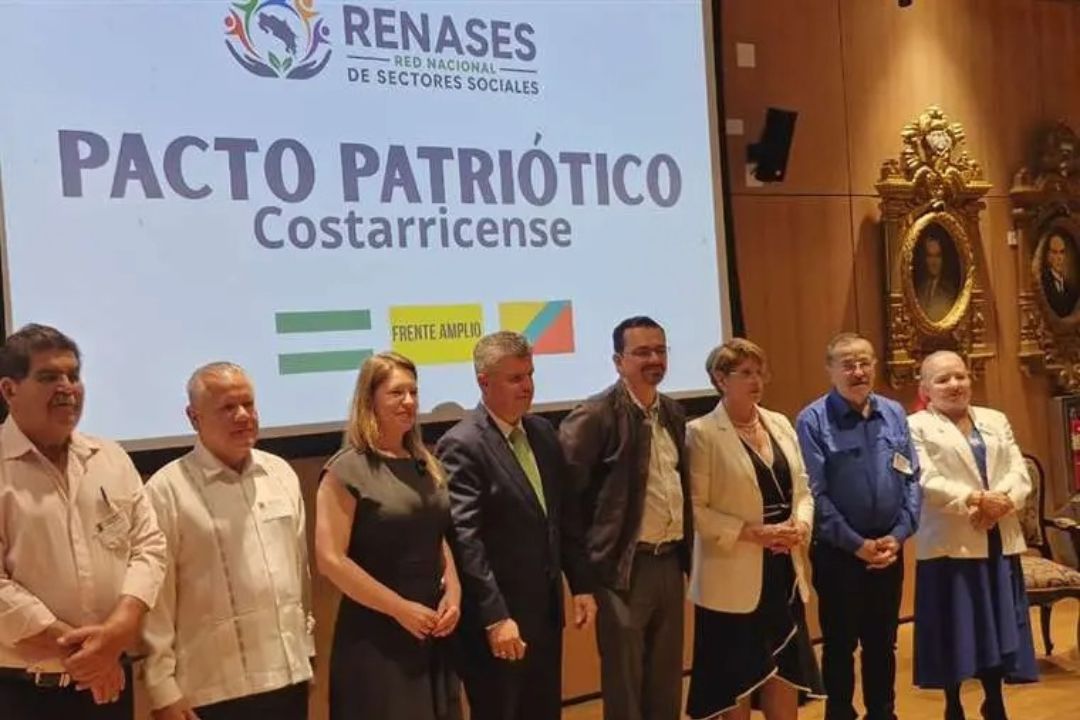
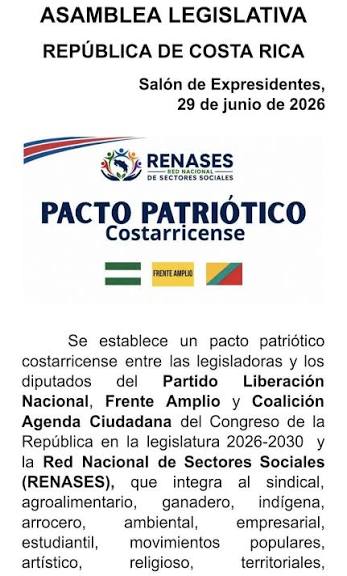
On June 29, the national press reported that the legislative caucuses of the National Liberation Party (PLN), the Broad Front (FA), and the Citizen Agenda Coalition (CAC), and the National Network of Social Sectors (Renases) had signed a “patriotic pact” with the goal of developing joint solutions to the country’s main challenges. Renases, in turn, brings together labor unions, agricultural organizations, indigenous groups, environmental organizations, student groups, academic organizations, territorial groups, religious organizations, and social movements.
Teletica reports that:“(…) The pact includes, among many other provisions, commitments to the unrestricted defense of the social rule of law, the strengthening of democratic institutions, respect for the Constitution, the separation and independence of powers, freedom of expression, citizen participation, and the full enforcement of fundamental rights. Furthermore, it advocates for support in the fight against organized crime, the strengthening of the budgets for the Judicial Investigation Agency, the Public Prosecutor’s Office, the Public Security Forces, and other law enforcement agencies, and a “profound transformation” of the Directorate of Intelligence and Security (DIS) to establish democratic controls and accountability. The agreement also includes the defense and strengthening of the Costa Rican Social Security Fund through a plan to pay off the government’s massive debt, reduce waiting lists, address the shortage of specialists, and ensure full respect for its autonomy.”
“The signatory parties also agreed to move gradually toward fulfilling the constitutional mandate to allocate 8% of the Gross Domestic Product to education, strengthening the system from early childhood through public universities, as well as guaranteeing job security for teaching, technical-teaching, and administrative staff,” Renases stated.
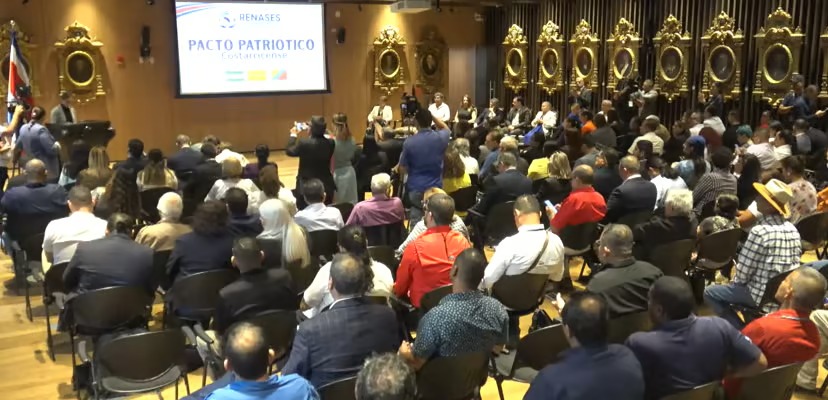
Many honest comrades view this political project favorably, with one important caveat: we must unite all sectors to confront the government of Laura Fernández and Rodrigo Chaves, given its increasingly authoritarian drift. We understand this, but we do not believe it is the right path.
Below, we present our perspective on principles, tactics, and strategy.
Class independence: an unwavering principle
In the tradition, history, and teachings of Marxism and Bolshevism, the principle of the most unwavering class independence is non-negotiable, as is the categorical rejection of any form of coalition government—whether in the executive or legislative branches—or of a permanent political united front. This stance stems from the Marxist conception of the class struggle, which holds that the interests of the working class are diametrically opposed to those of the ruling class or bourgeoisie—even when certain bourgeois sectors may eventually don the guise of “progressives.” Why? Because, “no matter how much silk the bourgeoisie wears, it remains bourgeois.” In other words, due to its socioeconomic position, the bourgeoisie or the capitalist class will always seek to increase its profits at the expense of the working class’s interests, for two fundamental reasons:
- The first and most important reason is that the source of their wealth—their accumulation of capital—stems from the exploitation of the working class’s labor power. The working class receives a wage to cover its basic needs and replenish its energy to continue working, but it does not receive full compensation for all its effort; part of the value of each worker’s labor is appropriated by the bourgeoisie in the form of profit. This is most evident among the working class in maquila factories, construction, corporate services (fast-food chains, large supermarkets, etc.), and agro-industries (pineapple, banana, and palm oil plantations). The bourgeoisie is interested in increasing the amount of profit it extracts from its workers, but it cannot reduce wages to levels that are unsustainable for the working class; therefore, there are only two ways to increase profits: by extending the workday of its employees or through technological innovation to accelerate and make production more efficient, but this is costly, so it in turn requires further prior accumulation of capital (the primary source of which is the exploitation of labor power) to make such reinvestment possible.
- Due to fierce competition from other companies in the market, private capitalist enterprises are forced to constantly increase their profits. Otherwise, they face the possibility of bankruptcy or being taken over by larger companies. One example is how national supermarket chains have been driven out of business (with the exception of Automercado) by the large U.S. corporation Walmart.
On the other hand, if employers intensify exploitative conditions—through wage cuts, budget cuts, restructuring, layoffs, and longer workdays—to maintain or increase their profit margins, the working class is obviously directly affected. If the working class is politically aware of its class interests and is organized, it is also compelled to confront the employer against these measures that lead to precariousness and poverty. That is why the interests of workers and the bourgeoisie are incompatible. This is called the class struggle, which Marx called the “engine of history.”
Opportunism and Sectarianism, Tactics and Strategy
Many people might rebuke us, saying, “But you are very sectarian, extremists.” Today, the broadest possible unity is needed to confront the onslaught of an increasingly authoritarian government with an openly and cynically “anti-communist” stance. True, but we disagree with the FA on the “how.” Undoubtedly, it is troubling to hear the president, her “superminister,” and their acolytes label one of the traditional parties of the Costa Rican bourgeoisie—the PLN, with its long history of neoliberal policies—as “communist.” They also label the Frente Amplio as “communist”—even though, in our view, it is not; rather, it is a social-democratic party linked to progressivism, similar to Lula’s PT in Brazil. Ariel Robles himself explained during the election campaign that under a potential Frente Amplio government, investments in free trade zones would be respected, including the preservation of the current tax exemption regime, and, of course, private property in general—none of which is in the least bit communist. Certainly, the Chavistas are creating the ideological and political conditions for a “witch hunt.”
So we might once again be asked: In the context of this far-right offensive, is it wise or not to promote the Costa Rican Patriotic Pact? We believe it is not, lest we go against the tide of the diffuse majority of what is called the left. But there are some caveats to this issue.
In the PRT, we are not die-hard sectarians; we do not oppose tactical and temporary agreements with bourgeois political forces. It depends. If it helps mobilize around a specific, timely issue of interest to the working class and the people, we accept it without hesitation. But we always march alongside those bourgeois forces separately, without forming permanent fronts or confusing their banners with our own. One example was the great struggle against NAFTA, in which we formed a unity of action with the PAC, which at that time was led by Otón Solís. But we never even considered a permanent, organic front, which is very different from that unity for specific, one-off action.
Background information worth mentioning:
The Free Trade Agreement (CAFTA)
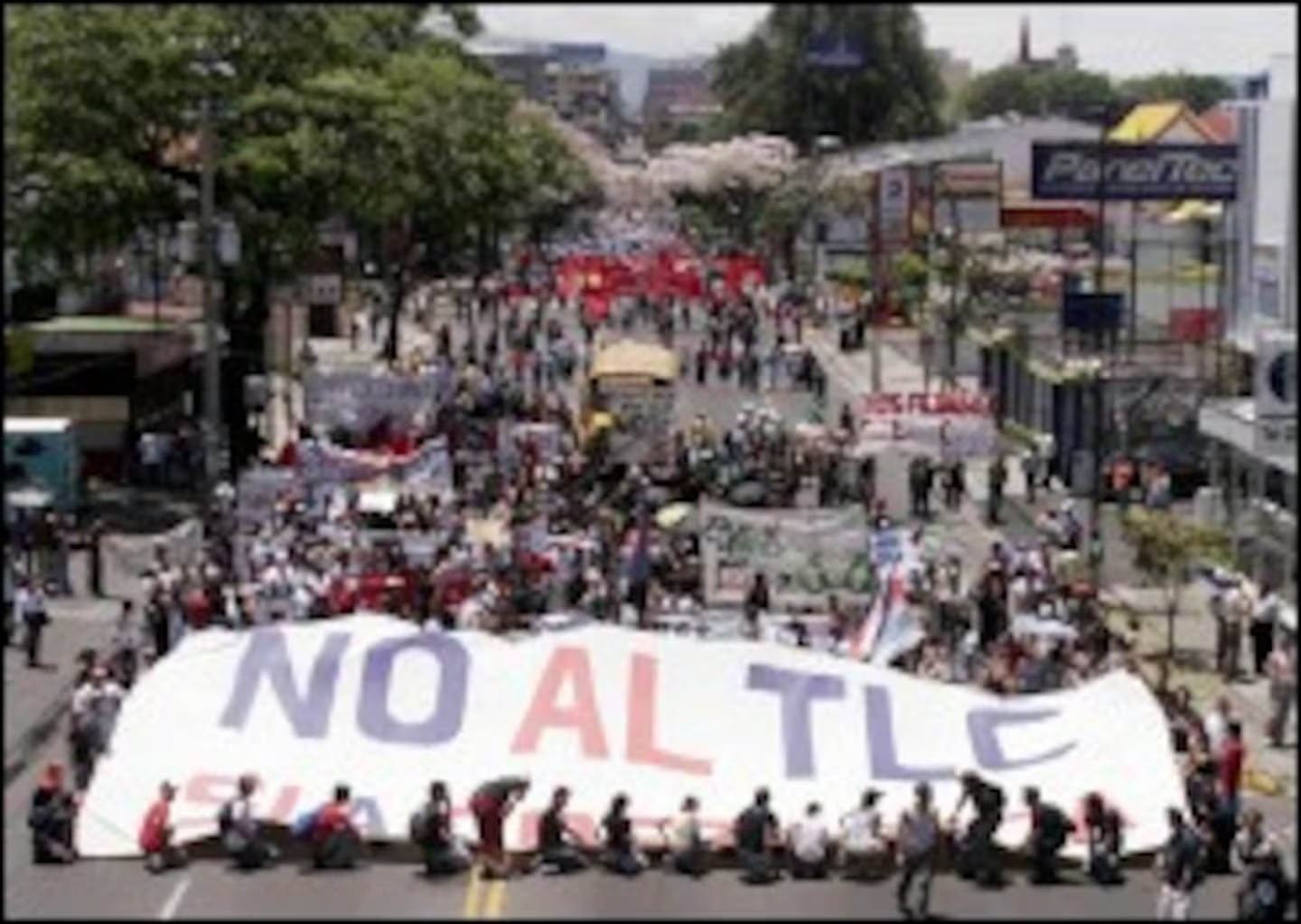
In the great workers’ and popular struggle against the CAFTA in 2007, both the Frente Amplio and its “progressive” bourgeois ally, the PAC, ultimately served to divert the movement onto the dead-end track of the electoral process. At a time when the Arias government was on the ropes due to the massive popular mobilization, those political forces gave it the breathing room it needed. The trap was the referendum, in which the regime as a whole and big business used all their media resources and resorted to extortion—such as forcing their employees to vote “Yes” on the FTA by ordering them to take a photo of their ballot with their cell phones at the polling station to prove they voted “Yes,” as a requirement for continued employment, and despicable lies told to workers in agricultural and industrial plants by Oscar Arias himself—promising bridges and roads and assuring them that with the FTA, they would drive to work in BMWs rather than on motorcycles or bicycles. The icing on the cake was the CNN report featuring a so-called U.S. expert who, in violation of the election blackout period, appeared on Teletica’s most-watched program, claiming that Costa Rica would become as isolated as Cuba if the FTA were not approved—and they also resorted directly to fraud. Ultimately, what the government and its allies failed to achieve in the streets, they imposed through this rigged referendum: defeating the “No to the FTA” movement by a narrow margin. It was not just any defeat; it was the beginning of a protracted process—with its ups and downs—of a profound setback for the labor and popular movements.
What was the FA’s subsequent political response?
The Anti-Neoliberal Front; The Alliance for Costa Rica
In the May 2011 issue of Bandera Roja No. 79, we offered a critical analysis of the document titled “The Frente Amplio and the Unity of Progressive Forces.” The document states, among other things, the following:“The convergence of political parties, social movements, and independent individuals into a progressive-popular bloc is possible, as was demonstrated by the great patriotic struggle against the FTA.” And further on, it adds: “We wish to express our willingness to move forward together, to coordinate unified efforts in the areas of political action, social mobilization, and electoral participation. We are open and willing to (…) build a coalition rooted in everyday challenges and the democratic electoral struggle, one that will enable a new majority to take office and advance a different set of policies for the benefit of the people. The building of this progressive electoral coalition for 2014, with solid and broad majorities in parliament (…), is possible through the unity of the progressive and decent forces of our country.”
The truth is that the FA’s enthusiasm was driven by electoral considerations, as it sought what it called the “grand alliance” or “anti-neoliberal front” with the PAC, which it labeled as progressive. What was the outcome of that strategy? Well, it was very bad for the working class and the people. It didn’t take long for its true colors to show.
Later, in *Bandera Roja* No. 83, December 2011, we stated that:“(…) FA Representative José María Villalta was the first to nominate his PAC colleague, Juan Carlos Mendoza as legislative president, and he was one of the most determined and enthusiastic promoters of the ‘Alliance for Costa Rica,’ which on May 1 was unveiled as an anti-PLN bloc, including the PUSC, ML, PAC, PASE, and FA factions. Thus, the FA’s “unifying” spirit was put into practice with such disparate political forces. (…) Under Mendoza’s new presidency and the Alliance for Costa Rica, 56 deputies voted in favor of the reform granting constitutional status to “solidarismo”—a favored anti-union weapon of the employers. This reform was approved with the votes of all legislative factions, except for that of Deputy Villalta. We warned early on that the reactionary nature of the Alliance for Costa Rica was already becoming apparent; far from helping popular organization and mobilization, it was proving to be a millstone around their necks.
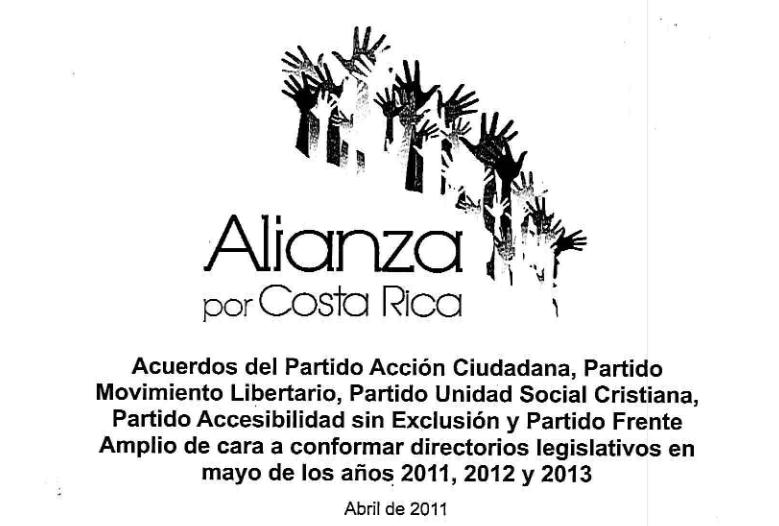
(…)All the hopes and diplomatic efforts of the Frente Amplio leadership with the PAC came crashing down on September 17, following Otón Solís’s (PAC) surprise pact with Laura Chinchilla’s government (…) in order to impose the tax package aimed at alleviating the fiscal deficit that successive governments (particularly that of Oscar Arias) have deliberately created through the plundering of national assets, the awarding of public works contracts, clientelism, and the tax haven for investors—which, of course, remains untouchable.”
A plan to tie the popular movement to the parliamentary process
But enough background information. It has been more than proven that “progressive” reformism—which draws support from sectors of the college-educated middle class and sectors of the union bureaucracy—does not fail to learn from these experiences; rather, it reflects its accommodation to the regime on which it depends, as its “left” wing.
Returning to the aforementioned pact, Teletica reports: “(…) the idea is for all those involved to form permanent technical and political teams that will channel legislative proposals from social sectors and strengthen political oversight by the Legislative Assembly.”
No call for mobilization against this disastrous government, no plan of action—the Pact’s sole focus is to invite “social sectors” to revolve around legislative proposals with little or no chance of moving forward, given the PPSO’s decisive majority in parliament and on committees.
How strong will that pact be? It will be extremely fragile. Moreover, we predict its imminent collapse (as happened with the Alliance for Costa Rica, which we have already analyzed) in the face of the blows dealt by this disastrous government, along with the practice of buying votes and seats in parliament, the economic and social crisis that will only deepen, and conflicts among the bourgeoisie. We stand for the class struggle!
We cannot trust anyone from the PLN, nor can we trust the CAC, with its sole member, Claudia Dobles, who served in the supposedly “progressive” PAC administration—the administration of her husband, Carlos Alvarado—which ended up being the one that made the most progress on neoliberal counter-reform.
A Litmus Test: Security
Fernández-Chaves’s “iron-fisted” legislative package is modeled after Bukele’s approach. It is alarming. They are using the real issue of public insecurity as a pretext to militarize society and strip away constitutional rights—including the right to due process and the right to a defense. But there is no clear agreement on this matter. Only general statements. However, the PLN has not wasted any time and has acted on its own.
As Teletica reports, “(…) The National Liberation Party (PLN) faction urged President Laura Fernández to introduce, during the special sessions, five bills on security matters that they had drafted themselves.” We do not know what those bills are, but the question arises: why weren’t they agreed upon earlier as part of this so-called pact? At the very least, it seems suspicious.
For a class-conscious and revolutionary left, built from the grassroots up and dedicated to the struggle in the streets
In the aforementioned issue No. 79 of *Bandera Roja*, we wrote the following conclusion, which we believe remains entirely relevant, so we will not add a single word: “(…) what is needed is not legislative maneuvers and opportunistic pacts aimed at accumulating yet another slice of institutional influence; it is not the race to obtain—at any cost—more shares of power, votes, and seats, as if one were accumulating stock in a company; in short, it is not about seeking to be a ‘power option’ within the framework of the rotten machinery of this neocolonial bourgeois state; rather, what is required is to forge the revolutionary social alliance, from below, for the struggle in the streets, which will be decisive. On this path, and guided by these principles, the PRT wishes to engage in honest dialogue with all social activists across the country to discuss the profile, tasks, and challenges facing the revolutionary left.”