Naira Carcelen—Socialist Alternative
The official confirmation of Keiko Fujimori’s victory, with 100% of the votes counted, ushers in a new political cycle in Peru marked by the consolidation of an authoritarian bloc that had already been taking control of the main state institutions. Her inauguration on July 28 represents not only a change in government but also the consolidation of a project that aligns the executive branch, Congress, and sectors of the judicial system with conservative, neoliberal, and deeply anti-rights interests. The composition of his cabinet, with a minimal presence of women, is not a minor detail but a reflection of the structural exclusion that characterizes this new political era.
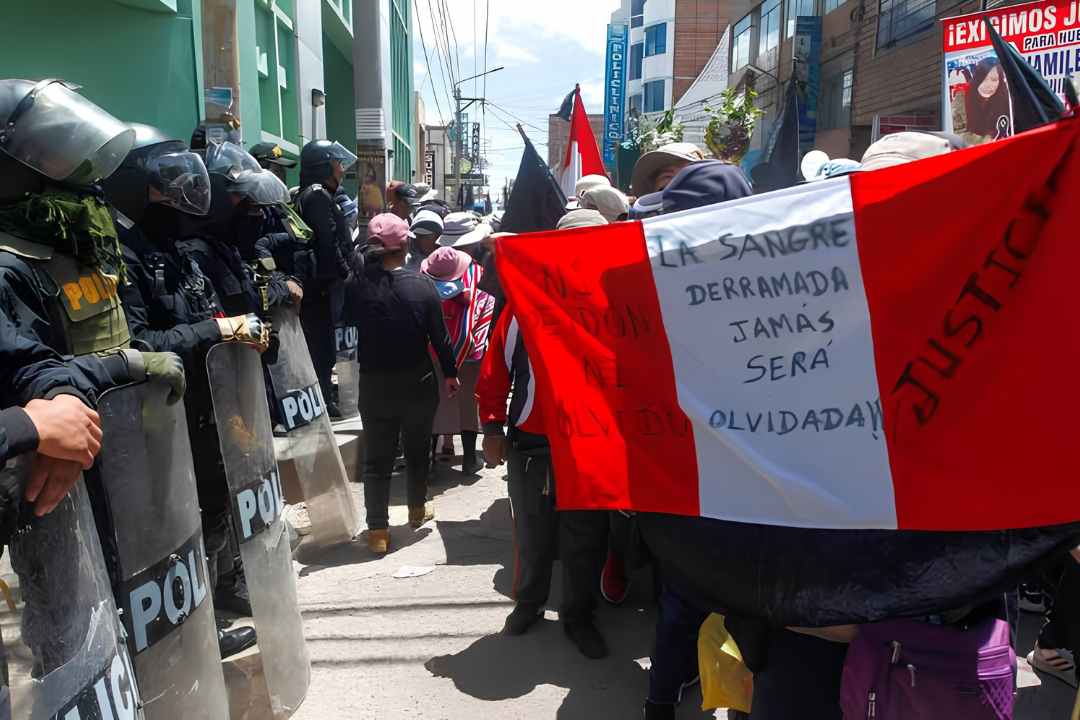
In this context, the recent passage—in a second vote—of the bill that incorporates the crime against humanity into the Penal Code, sponsored by Fernando Rospigliosi, clearly demonstrates the direction the country is taking. Far from strengthening justice, this reform seeks to distort the very concept of crimes against humanity in order to restrict its application and promote impunity. Under the pretext of preventing alleged abuses by the so-called “caviar mafia,” a narrative is being promoted that legitimizes shielding military and police personnel from potential accountability for human rights violations. This is not a technical reform: it is a political decision aimed at protecting their own and ensuring that crimes of the past—and of the present—are not prosecuted as such.
In this regard, human rights groups and members of Congress, such as current Congresswoman Ruth Luque, have warned that the law “completely distorts the definition of crimes against humanity,” while human rights organizations have pointed out that it represents a “serious setback” and a violation of the State’s international obligations (The Swiss 2026). By altering the criteria under which these crimes are tried, the law opens the door to the reclassification of cases of enforced disappearance, torture, and extrajudicial executions as common crimes, undermining victims’ chances of obtaining justice and reinforcing a historical pattern of impunity in the country.
This authoritarian move is also part of a direct attack on gender rights and education. The elimination of the Comprehensive Sex Education (ESI) approach, formalized through Law No. 32535 sponsored by Milagros Jáuregui, constitutes a serious setback in the protection of children and adolescents. Under the pretext of promoting “scientific, biological, and ethical” education, all references to a gender-based approach have been eliminated, replaced by a conservative vision that prioritizes the traditional family, abstinence, and control over sexuality. This change is not neutral: it responds to an ideological agenda that seeks to dismantle progress toward equality and restrict hard-won rights.
The consequences of this measure are particularly troubling in a country plagued by alarming levels of sexual violence. In 2025, the Women’s Emergency Centers recorded 13,096 cases of rape against women and 21,609 against children and adolescents, which amounts to an average of 35 cases per day. By 2026, an average of 20 rapes per day is estimated—that is, one every 71 minutes (Promsex, 2026). These figures, moreover, represent only a fraction of the problem, considering that more than 70% of victims do not report the crime. In this context, eliminating ESI is not only irresponsible—it is a decision that further endangers children and reinforces conditions of violence and impunity.
What we are seeing are not isolated incidents, but rather part of a single process: the consolidation of a regime that combines political authoritarianism, the rollback of rights, and institutional fortification. Fujimori’s rise to power, together with Congress’s actions, is creating a scenario of concentrated power in which the rules are being rewritten to protect the elites and discipline society.
Faced with this situation, passivity cannot be the answer. A period marked by persecution, the erosion of rights, and the closure of democratic spaces is beginning. The country’s recent history clearly shows us the risks of this path. For this reason, social organization, the coordination of movements, and active activism become essential. The defense of human rights, education, and justice will depend on the ability of the working classes to resist and challenge this new political cycle.
Difficult years lie ahead, and that is precisely why, now more than ever, organization and collective struggle are essential.