By Jeremy Dewar
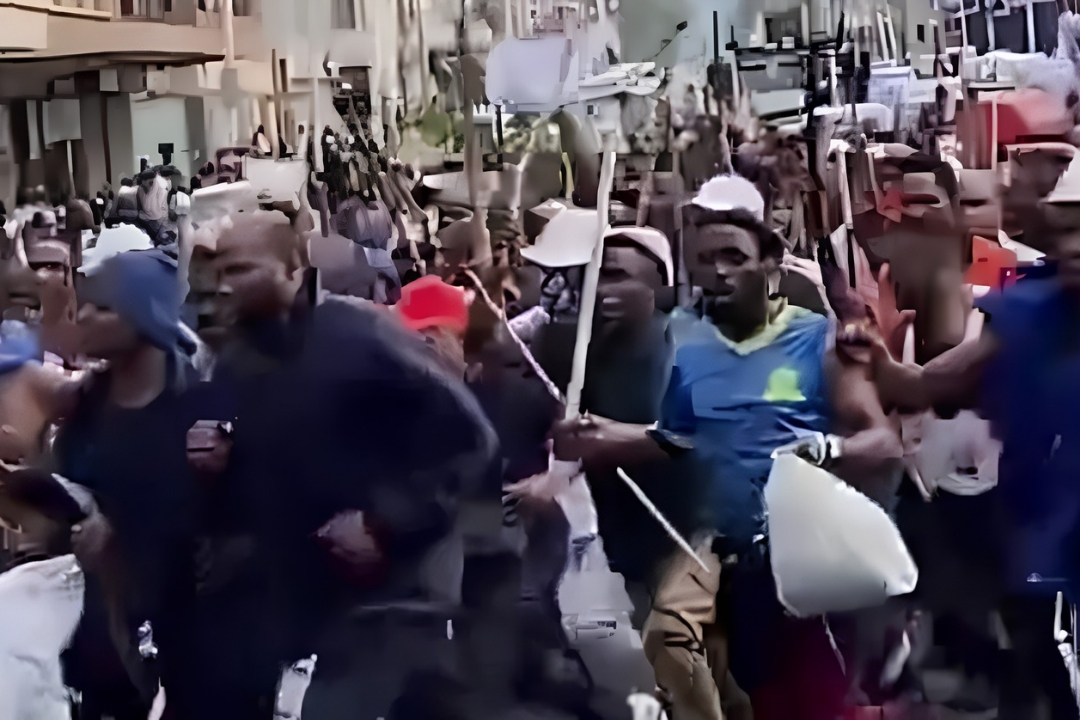
The June 30 unofficial deadline, set by the March and March organisation, for all undocumented migrant workers to leave South Africa has passed. Thousands attended 120 separate protests on the day.
‘Abahambe!’ (They must go!) was M and M’s main slogan on the demo. The slogan was first popularised by the far right party Patriotic Alliance, which is now part of President Cyril Ramaphosa’s Government of National Unity alongside the ANC and the Democratic Alliance.
Jacinta Ngobese-Zuma, the former radio presenter who founded the March and March anti-immigrant movement in 2024, often uses far right phraseology, saying for example, ‘South Africa is being invaded. South Africans have become refugees in their own country.’ This is the language of anti-migrant racists around the world from Trump in the USA to Nigel Farage and Tommy Robinson in Britain.
She told the crowd in Durban, ‘Every Thursday, for the next six months, we are marching until they [undocumented immigrants] are gone’, a threat familiar to migrants across the world. Clearly the organisers want to keep the momentum going.
Many of the protesters wore traditional Zulu costumes and carried ‘traditional’ weapons, knobkerries (clubs) and the sjamboks (whips), displaying not just hostility to migrants from other African countries, but their identification with the Zulu people, rather than South Africa as a whole.
Durban and Johannesburg have seen the worst of the violence generated by the movement. Throughout April and May, suspected migrant-owned shops were looted and burned out, and hospitals invaded as racist gangs searched for migrant patients.
Migrant workers have fled their homes in fear, with many Congolese sleeping on the streets, Malawians erecting a tent city to find safety in numbers, or Zimbabweans seeking refuge in their country’s consulate. With vigilantes roaming door to door in search of ‘foreigners’ they feel they have no choice.
Many South Africans are caught up in the chauvinist zeal of the pogromists, as the rioters go by language alone; if you don’t speak the regional language of Zulu, you are immediately identified as a ‘foreigner’.
The week before the demos, racist vigilantes demanded the government check the papers of 457 migrants camped outside the Home Affairs building in Durban. All but two in fact had the correct papers, but armed vigilantes nevertheless interrogated them slapped them, and beat them up. Since 2022 148 Africans have been killed in anti-migrant attacks, leading Malawi, Ghana, Nigeria and Kenya, among others, to pull their citizens out.
Yet the police publicly praised the organisers for the ‘peaceful’ nature of the protests. They still made over 900 arrests, however, mainly of migrant workers. This targeting of the victims of racist violence shows that the state does not really oppose this racist vigilante street movement, but in fact utilises it to clamp down even harder on migrant workers.
The spread of anti-migrant chauvinism is also being turned against fellow South Africans who have moved provinces in search of jobs. For example, the National Coloured Congress has echoed calls by the Democratic Alliance’s Helen Zille for Black African Eastern Cape residents, who have migrated to the Western Cape, to be ‘remigrated’.
Who are March and March?
Ngobese-Zuma founded March and March in 2024, but it really hit the headlines about a year ago, when its supporters started attacking migrants, demanding to see their papers, destroying their property and dragging them out of hospitals, homes and workplaces.
In December, they set the unofficial deadline of 30 June 2026 for all undocumented (they call them ‘illegal’) migrants to leave. The Government of National Unity (GNU) has not been slow to respond – not by combatting this but by ramping up the rate of deportation.
The Government claims to have ejected 109,000 migrants from South Africa (RSA) since it was elected two years ago, and turned back another half a million at the border. Since the 30 June ‘deadline’ was declared, 25,000 workers have been deported, with at least another 40,000 arrested and waiting to go. This underlines how complicit the ANC is in this anti-migrant ‘movement’.
Ngobese-Zuma claims March and March is a ‘citizen-led movement’ but this does not stand up to scrutiny. The aforementioned Patriotic Alliance (PA), which gained just over 2% of the vote and nine delegates to the National Assembly in 2024, is heavily involved.
PA is part of the 10-party strong GNU now and its leader, Gayton McKenzie, is the Minister for Sport, Arts and Culture. In that position he has suggested South African national team footballer Ime Okon is not South African enough because his father (who died when Ime was six) was Nigerian. PA demands mass deportation of ‘illegals’ and preferential treatment in jobs, services and business licences for South Africans. In 2013, McKenzie publicly threatened to ‘switch off the oxygen of illegal foreigners’ in hospital intensive care units.
ActionSA (1.2% vote in 2024) is based in Johannesburg and has similar policies. It also supports the movement. Further to the right is the Soweto-based, fascistic Operation Dudula (dudula is Zulu for ‘force out’), which along with other vigilante street movements has led the way in physically confronting migrants. They are also central to the mobilisations. An antifascist group Kopanang Africa Against Xenophobia (KAAX) was formed to combat Operation Dudula.
Not surprisingly the Inkatha Freedom Party (IFP) also backs the movement. The IFP, based on Zulu chauvinism, played a counter revolutionary role, dividing and undermining the anti-apartheid struggle in the 1980-90s. The IFP Mayor of Durban addressed the main rally on 30 June and is in constant dialogue with March and March’s organisers.
More in the mainstream, the Democratic Alliance (formerly the ruling Apartheid-era National Party) also held talks with March and March before the marches. But the biggest backer and probable source of March and March’s funding is disgraced former president Jacob Zuma’s uMkhonto WeSizwe (MK) party. MK’s brand of racist populism is a perfect fit for March and March and there are rumours that Ngobese-Zuma might seek a candidacy in November’s municipal elections with MK or ActionSA.
But the blurring of lines between mainstream parties and the vigilante movement runs even deeper than this. In 2021, retired General Maomela Motau launched the SANDF (the army) ANC Cadre Group on a platform of not only mass deportations but criminalising those ‘harbouring’ them, i.e. businesses who employ them. This shadowy group is also believed to be close to March and March. Last year this group, with strong ties to the military, called openly for the return of the racial classification of all citizens.
This is a familiar pattern. A supposedly spontaneous group attacks migrants and demands tougher border controls. Its support spreads from outright fascist groups to populist parties and then to the neoliberal centre ground, and finally to the police and armed forces and the government itself.
Ramaphosa has not only called March and March’s demands ‘legitimate concerns’, he has also started to implement them, using the street movement as cover for stepping up authoritarian measures to deport migrants and prevent more from coming to look for work.
Roots of racism
Many socialists around the world will be shocked by these developments, wondering where did racism against fellow black people come from, (some call it Afrophobia)? Are not the South African masses rightly famous for their heroic anti-Apartheid struggle? Clearly something has gone badly wrong in Archbishop Desmond Tutu’s and Nelson Mandella’s ideology of a “Rainbow Nation. But what caused this, and why now?
As always with Africa’s problems, it is essential to look at the legacy of colonialism. In all their major colonies, the British perfected the divide and rule strategy, usually promoting pre-exiting rulers or minority ethnic groups, particularly what they termed ‘martial races’ i.e. ones that initially put up staunch resistance to their takeover. The Afrikaans ruling class continued this for keeping white minority control, when the Apartheid regime took over in 1948.
They turned these distinctions into the Bantustan system of quasi-self government. Right to the end, the apartheid regime used Mangosuthu Buthelezi’s IKP to divert support from the multiracial ANC. Today, the ANC Cadre Group has shamefully resurrected the discredited policy of racial classification.
Added to this was the system of internal migration and cheap labour from neighbouring countries, notably Southern Rhodesia (i.e. Zimbabwe) and South West Africa (Namibia). This system continues today under the name of the Southern African Development Community (SADC), a free trade area, designed to keep these countries in semi-colonial subservience to South Africa.
The mining industry in particular uses workers from neighbouring countries as ‘temporary sojourners’ who are segregated, treated brutally and underpaid. But the South African ruling class does not stop there. It has sent troops to the DR Congo in defence of mining concessions in the cobalt-rich eastern provinces. It acts like an imperialist power, albeit one with a regional reach, and the consequence of this has been the promotion of a semi-racial hierarchy.
So promoting ‘racial’ difference among Black Africans has a history in the RSA, and the ANC has built on it. Several of the ANC’s politicians, notably Phophi Ramathuba, have echoed the right wing’s racist demands in language indistinguishable from the likes of PA.
Economic factors
It should be no surprise that, when the global crash of 2008 broke upon South Africa, racist pogroms broke out, killing 62 people and driving 150,000 from their homes. In the austerity decade of the 2010s and again in 2021, several more similar incidents regularly took place, albeit on a smaller scale. This year marks a rise in violence towards immigrants, back towards the level of 2008, but with far greater organisation behind it and the ANC’s hegemony fading fast.
Today, the economy is again at breaking point. Unemployment stands at a staggering 32.7%, with rates for 15-24 year olds (60.9%) and 25-34 year olds (40.6%) even higher (all RSA government statistics). Those living below the poverty line account for 38% of the people. With stagnant growth rates (1.3%) and rising inflation (3.8%) – i.e. stagflation – one of the world’s most impoverished populations and unequal societies is staring into the abyss.
The bosses and their political class are desperate to pin the blame for all this on anyone but themselves. As in many other countries, they are fanning the flames of racism.
But the economic charges against migrant labour do not add up. There are an estimated 2.4 million migrants in South Africa, making up 10% of the workforce. The biggest single occupation of the migrants is domestic service (18.4%), followed by construction (17.2%), logistics and retail (13.6%) and agriculture (8.9%). These are low-paid, seasonal and low-status jobs. The real cause of structural unemployment is deindustrialisation, neoliberal economic measures and the rise in the use of precarious labour contracts.
The mining industry has witnessed a sharp reduction in its contribution to GDP, falling from 11% in 1993 to just 4.8% in 2023. The number of miners has fallen from 650,000 in 1992 to 450,00 in 2025. Deindustrialisation has also hit manufacturing jobs under ANC neoliberal policies.
Moreover, the trade union movement is in a worse state to mount resistance to the bosses’ onslaught, which is designed to make the poor pay for the crisis in their system, than was the case in previous crises. COSATU was for 30 years (1994-2024) embroiled in the tri-partite popular front government with the ANC and South African Communist Party (SACP), becoming corrupted in the process and losing its way as an independent fighting force. COSATU today condemns anti-migrant vigilantism but nevertheless supports tighter border controls and privileges for South African workers.
It lost the majority of the miners in 2012 to the Association of Mineworkers and Construction Union (AMCU) after the Marikana massacre, which went on to form the South Africa Federation of Trade Unions (SAFTU), alongside the Food and Allied Workers, then joined by the metalworkers’ union NUMSA, who were led into a series of failed projects and conflicts by general secretary Irvin Jim.
Despite the six-month great platinum miners’ strike of 2014 led by AMCU, strike figures remained low in most of the subsequent years. Likewise, the progressive social movements of previous decades, like the Anti-Privatisation Forum, have largely disappeared. Even the Rhodes Must Fall student movement of 2014-15 has left no trace, having suffered from the stultifying grip of the Economic Freedom Fighters (EFF).
Added to this, the casualisation of the labour market means that today only one in five jobs has a standardised labour contract. In the informal sector, there is no union to back them up and develop some rudimentary form of class (trade union) consciousness.
The left
The working class has never felt so defenceless against the state, the bosses and alien ideologies like racism. So what has the left been doing?
Feeling the cold after being shunted from government, the SACP decided to call a Conference of the Left on 29-30 May 2026. Despite the participants electing a steering committee to keep the show on the road, the conference was notable mainly for who it invited and who it did not.
First, the unwelcome invites. MK was well represented and even tried (unsuccessfully) to get Jacob Zuma onto the platform, all while the party was involved in pogromist activities across the country. Zuma presided over the greatest ever ‘state capture’ (corrupt privatisation deals) in South African history – among other heinous crimes. The fact that he was there condemned the conference to irrelevance for the purpose of mounting a fightback.
NUMSA’s Irvin Jim was also there (and did speak). Jim has already squandered several opportunities following his union’s expulsion from COSATU in 2014, including the United Front, which he discarded as soon as it was formed, and the ultra-Stalinist Socialist Revolutionary Workers Party, which also quickly disappeared. It is believed Jim has accepted funding by US tech billionaire Roy Singham
The EFF’s Julius Malema gave a speech condemning the racist anti-migrant movement. But his party has not been immune from using xenophobia itself , for example seeking out and then chucking out ‘foreigners’ from restaurants, when it has opportunistically suited him. The working class can expect nothing from this self-seeking cult leader. Malema, like Zuma, has also faced charges of embezzlement.
Then those who were not invited to attend. These include SAFTU (COSATU was invited), any of the community or student movements, or the Trotskyist groups (of which the Marxist Workers Party – CWI seems the most active).
The SACP itself has not accounted for why it remained for so long buried in the ANC, nor what it did in government for 30 years. Its ‘stages’ theory of first a democratic revolution, and only much later a socialist revolution, condemns it to mislead any real fightback.
Indeed, its list of invitations reveals that it is only interested in regrouping the ‘left’ of the ANC, presumably because it wishes to get back to the days of the popular front, rather than solve the problems of today and lead a struggle for socialism. Its solutions involve tying the country to Chinese and Russian imperialism, a knot that comes with a very heavy price for the working class, ‘native’ as well as ‘foreign’.
Where next?
South Africa, like many other parts of the world, is suffering from an acute and chronic crisis of leadership. As a (relatively developed) country in the Global South, it faces a huge economic crisis, which is going to rock the working class, no matter how many migrants are deported.
The working class in these circumstances needs to regroup its fighting forces on the basis of class struggle. This starts with massing the forces prepared to counter the racists – with argument in the communities, workplaces and schools, and with physical defence of migrants where argument would be futile.
Antifascist forces, like the KAAX, need to form suitably prepared militia to counter the knobkerrie and the sjambok wielding thugs and to prevent police arrest of undocumented migrants. Siyafana Sonke (‘We are all the same’) is a grassroots coalition of over 160 organisations, who have been leading the defence of migrants in their hour of need.
The SAFTU should call its own conference of the internationalist, anti-racist and socialist left, and challenge COSATU-affiliated unions to attend on this basis. There, participants could hammer out an action programme to break apart the anti-migrant movement and link it to a real defence of workers’ jobs and wages, and for a sharp uplift in social services in the township and urban centres.
Secondly, workers need to force their trade union leaders to fight every cut and closure with strikes and occupations. Make the bosses pay! SAFTU’s May Day rallies were held under the slogan, ‘Stop the Jobs Bloodbath!’ Now is the time to turn words into action. Any serious strike must reach out to COSATU members, undocumented workers, the informal sector, the youth and communities, so it can become a beacon of resistance against the real enemy, capitalism.
Thirdly, we need a force that does not give an inch to racist and xenophobic ideas but confronts them and counterposes the idea of a socialist society in a socialist world, where every worker is a sister, a brother in a united struggle against discrimination, exploitation and degradation.
Finally, the working class in South Africa needs to break free from the shadow of Stalinism and form its own revolutionary party, as the Communist Party youth in Kenya have done. In place of the revolution of distinct and separate stages, which never manages to reach the ‘stage’ of socialism, it must imprint on its banner, the permanent revolution, that is the fight for workers’ power in South Africa as a staging post to a socialist Africa and world.