By Asif Rashid
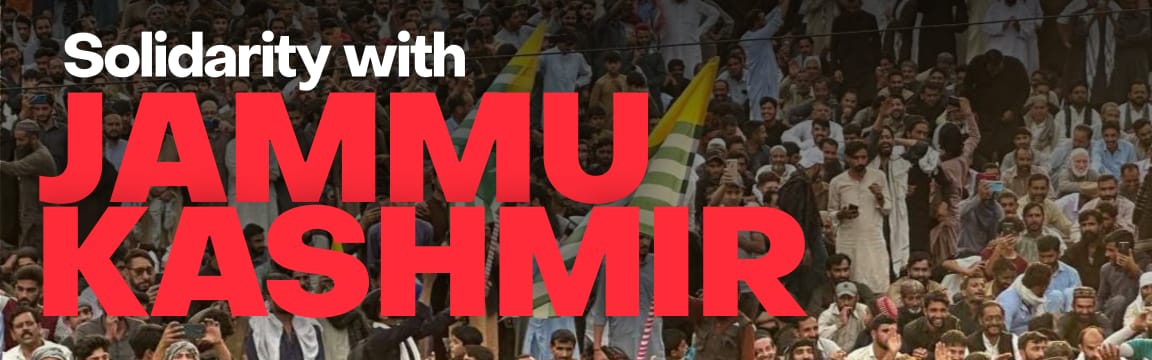
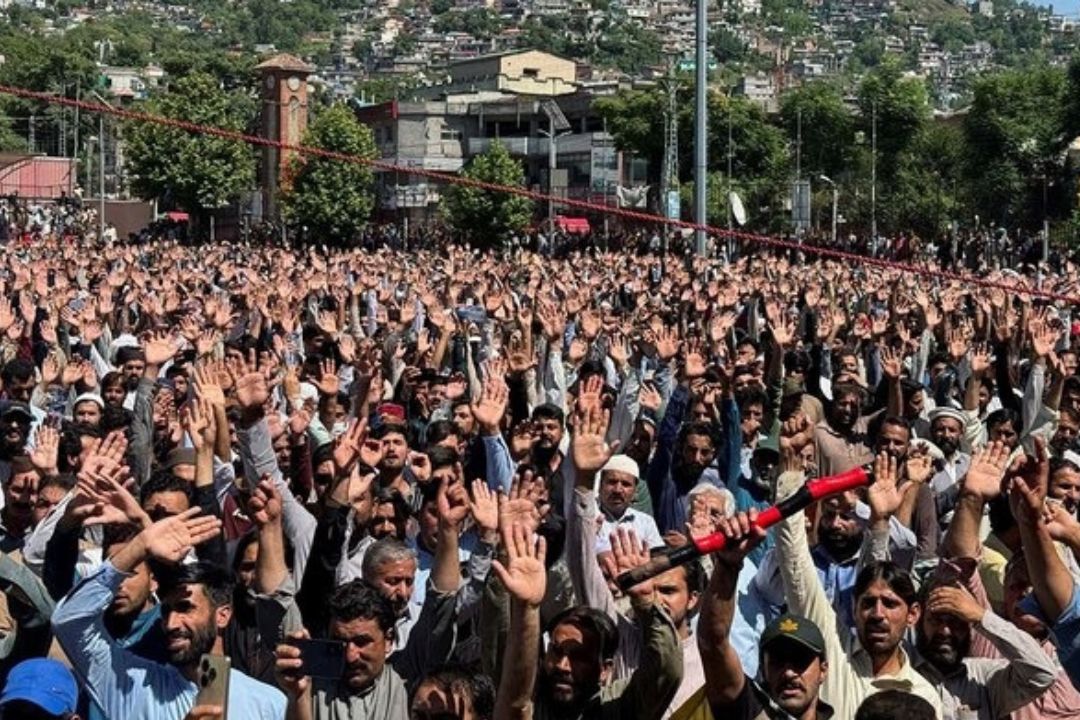
The ongoing movement for popular rights in Pakistani-administered Jammu Kashmir has reached such a critical juncture that it has become imperative to reassess all aspects of the past three years of struggle: its achievements, sacrifices, the strategy adopted by its leadership, and the conduct of the state. During this period, through sustained and courageous protests, sit-ins, shutter-down strikes, wheel-jams, long marches, and other forms of resistance, the people initially succeeded not only in securing their economic demands but also in expressing their rejection of the decaying and comprador traditional politics and the prevailing imperialist-colonial administrative order.
No popular movement can be understood merely on the basis of its immediate slogans or demands. Rather, it is crucial to understand the historical factors underlying it, the global and regional circumstances, class contradictions, the balance of forces, state structures, and the question of control over the productive forces and resources. The present movement in Jammu Kashmir, too, was not merely about inflation, the prices of wheat flour and electricity, taxes, or the privileges enjoyed by the state bureaucracy and the political elite. Although, like working people across a world afflicted by a deep capitalist crisis, the people of Kashmir have also been subjected to increasingly unbearable living conditions by these economic problems—and these issues have served as a catalyst for the recent upsurge—the economic demands have, over time, brought several deeper and historical political questions to the fore. Who controls the resources of this region? Who makes political and state decisions here? What, ultimately, is the “Kashmir issue,” and how can it be resolved? How can the people of Jammu Kashmir determine their collective future and attain the right to self-determination…? At the present moment, these are the burning questions that have assumed immense importance in determining the course of the historical struggle of the people of Jammu Kashmir and the fate of the current movement.
History’s Verdict
To characterize what the people have achieved over the past three years as a minor success would be an injustice to history and an act of dishonesty. Viewed from the standpoint of its initial gains, this is a movement of international significance that has succeeded in winning highly concrete and substantial demands. Consider simply the achievement of cheap flour and a significant reduction in electricity tariffs—electricity at 3 rupees per unit and flour at approximately half the prevailing rates, compared with 50 rupees or more per unit of electricity in Pakistan—and it is difficult to find a comparable example anywhere in the world. Even in Sri Lanka, Nepal, Bangladesh, and elsewhere, where people have toppled entire governments and shaken the foundations of the state in recent years, they have failed to secure gains that amount to tangible economic relief in their everyday lives. By contrast, the advance of the Jammu Kashmir movement, the acceptance of its initial (economic) demands, and the state’s retreat demonstrate that organized popular power has the capacity to alter the course of history.
However, the initial success of any movement also raises the question of what its programme, methods, and course of action should be going forward. Protest can force a government to change a policy. It can secure the acceptance of demands, at least partially. But an alternative system cannot be built through protest methods alone. This requires higher and broader forms and methods of popular organization and agitation. Particularly in occupied regions such as Kashmir—surrounded on all sides by imperialist states, with an industrial proletariat that is more or less nonexistent, no army of their own, and an economy dependent not on local means of production but on remittances, tourism, and other external factors—the spread and expansion of a movement to other regions, at a particular stage, becomes decisively important. In such circumstances, methods such as sit-ins can challenge the functioning and authority of the state only temporarily.
It should be made clear here that, in Pakistan’s recent political history, the practice of long marches, sit-ins, and similar forms of protest was popularized by the Pakistan Tehreek-e-Insaf (PTI). Unfortunately, however, in the present period of crisis in the workers’ movement and retreat of class struggle, the indiscriminate use of sit-ins has also gradually permeated proletarian and popular movements. Meanwhile, far more effective methods of political struggle, suited to particular times and circumstances, have faded from popular memory or fallen into disuse. The problem is that no method of agitation, protest, or struggle—including sit-ins—can remain effective under all circumstances. There is always a need to alter strategy according to the balance of forces and the prevailing conditions. It is among the fundamental and most important responsibilities of a leadership to continually assess circumstances and developments and to change its methods when necessary. Just as in military battles, political struggle also requires every kind of strategic manoeuvre, including advances, retreats, and holding one’s ground. A popular movement is based on a confrontation between living forces. It has never had, nor can it ever have, a ready-made blueprint, formula, or plan.
Similarly, serious problems arise when the means and the objective become confused with one another. Protest is not an end in itself; rather, it is a means of achieving a particular objective or demand. For example, when long marches or sit-ins cease to be means of achieving an objective and instead become objectives in themselves, there is a danger of losing sight of the destination. Maintaining and sustaining a sit-in for a prolonged period also becomes a problem. Quite apart from financial, administrative, and security issues, people begin to suffer from fatigue, frustration, and boredom. In such circumstances, there is generally an attempt to maintain their morale through increasingly fiery rhetoric. This can give rise to a number of political problems. Moreover, salaried employees, workers, daily-wage labourers, students, and others cannot indefinitely suspend or postpone their professional and educational activities. Prolonged disruption of everyday life, without the prospect of a major success or the achievement of a substantial objective, inevitably affects the popular support enjoyed by movements.
Similarly, simply rejecting the prevailing ruling politics and traditional political parties is not enough. An alternative must also be presented to the people who have become active in the movement and are prepared to fight and make sacrifices. What that alternative should be depends, once again, on the time and circumstances; and for this reason, the established method of entering electoral politics cannot simply be ruled out. Indeed, under certain circumstances, revolutionaries may even have to contest elections to extremely crippled and powerless parliaments. Marxist teachers such as Lenin did not devote hundreds of pages to this subject for no reason. These are precisely the stages at which popular movements must move beyond immediate protest politics and transform themselves into a permanent and durable political force or formation. Otherwise, popular power gradually dissipates with time, fragments upon encountering a major obstacle, or ends up being used by precisely those forces whom the people had taken to the streets to reject.
The Essence of the Movement
The struggle that began against the exorbitant increases in the prices of electricity and flour—an escalation linked not only to the economic crisis of the Pakistani state but also to the broader crisis of global capitalism—has, in the background, been driven by a historically rooted question of control over resources and the right to govern, as well as by anger in Jammu Kashmir against the existing state structure. This is why political demands began to emerge alongside demands of an economic and class character, while the historical national question of Kashmir increasingly came to the fore. In regions inhabited by oppressed nations, these issues are inevitably interconnected and cannot be separated from one another through any artificial or mechanical method. External control and domination over resources have a direct impact on the lives of working people. In Jammu Kashmir too, demands concerning electricity, flour, taxes, employment, education, healthcare, and land ultimately become connected to the question of control over natural resources and political affairs. In an era of the global domination of imperialist capitalism, separating the national question from the class question—or the class question from the national question—inevitably leads to erroneous analysis, a mistaken perspective, and flawed programmes and strategies. This can prove fatal for movements and may set back the struggle for class and national emancipation by decades. From Kurdistan to Balochistan and Jammu Kashmir itself, history is replete with the disastrous consequences of attempts to find shortcuts or seemingly “easy,” “practical,” and immediate solutions to such questions. In states founded upon the subjugation of nations, such complex historical questions can only be resolved through revolutionary means. This requires linking the demands for national independence, emancipation, and the right to self-government with the class demands and interests of workers, peasants, students, and the lower middle classes at both the national and international levels. This is certainly an extremely difficult, arduous, and at times bitter process. But there is no alternative to going through it. Emotions devoid of a concrete revolutionary programme, and slogans devoid of reasonable political demands, may be as attractive and rousing as one likes in the short term, but ultimately they lead movements into a dead end. There, on the one hand, tendencies toward despair and compromise emerge, while on the other, tendencies toward adventurism and extremism arise. Despite appearing contradictory, these tendencies are, in reality, mutually complementary.
State Repression and Political Deadlock
Despite the people’s unprecedented courage, fearlessness, sacrifices, remarkable displays of collective creativity, and the historic examples they have set, the movement in Jammu Kashmir is currently facing a crisis. Before treating an illness, it is necessary to make a correct and honest diagnosis. No matter how bitter the facts may be, acknowledging them is the duty of a serious and sincere political activist. Just as one must guard against despair and pessimism, it is equally necessary to avoid false praise and artificial optimism. At present, the greatest and most immediate challenge facing this movement in Pakistani-administered Jammu Kashmir—which, despite enjoying broad popular support and sympathy, has become largely confined to Rawalakot—is state repression. Over the past two months, the deaths of more than a hundred young people, hundreds of arrests, thousands of cases registered against people, the suspension or shortage of food rations and medicines, and intense economic and administrative pressure on activists and their families have made the situation extremely grave. The termination of employment, freezing of pensions, bank accounts, and properties, cancellation of identity and travel documents, and the filing of serious cases against political activists also demonstrate that state intimidation and repression are no longer confined to protesters participating in the sit-ins. Rather, they are being extended throughout Kashmir and even into Pakistan and abroad. The aim is to spread fear throughout society, so that ordinary people are compelled to think that the heavy price of political struggle and resistance may have to be paid not only by the individual concerned but by their entire family.
But the present situation has also revealed another reality. For many participants in the movement, the avenues of retreat have now largely been blocked as well. This is not simply because of fear of the state’s retaliatory measures. Those who have lost comrades and loved ones, endured imprisonment, and are now facing every form of economic and administrative repression, including draconian charges, cannot reasonably be expected to end the sit-in and return home merely on the basis of verbal assurances. To expect this would amount to ignoring the realities on the ground.
Thus, the situation is contradictory in nature. It also makes clear that the courage, bravery, and spirit of sacrifice of the people are certainly a source of strength for a movement. They can shake the foundations of even the most intimidating and oppressive halls of power. But if this spirit does not find expression through a concrete and dynamic political organization, a clear strategy, and a far-sighted course of action, that very same spirit can lead to unnecessary or “premature” confrontation, the loss of precious human lives, and even devastating anarchy. Revolutionary politics treats sacrifice not as an end in itself but as a means; it seeks to minimize, as far as possible, the loss of life and material damage, and transforms the passion and enthusiasm of the people into a political force capable of protecting their shared interests.
Negotiations or Resistance?
So far, the state has made no serious or meaningful attempt to engage in negotiations. Even when there is talk of negotiations, the fundamental condition imposed is that the sit-in must first be ended. This condition, in fact, alters the very meaning of negotiations. Moreover, this situation also reflects the general attitude and conduct not only of Pakistan but of capitalist states in general in the specific national and international circumstances of our time, in which wars, genocides, state repression, and crises have become the norm. No reasonable political strategy can be developed without considering these seemingly “unnecessary,” but in reality fundamental and important, matters.
Thus, the condition of ending the sit-in, imposed from a position of arrogance born of state power, effectively becomes an attempt to bring the movement to the negotiating table from a position of weakness. On the other hand, it is not easy for the movement simply to continue the sit-in indefinitely either. As mentioned earlier, keeping popular power concentrated in one place for a prolonged period creates various problems within a movement, including fatigue. At the same time, it gives the state an opportunity to confine the movement within a particular set of boundaries. Therefore, the real question is not whether to end or continue the sit-in, but how to transform it into broader political and social resistance by the people. The form of protest may change. But the political and social process of popular resistance must continue.
There is also a concern that, rather than negotiating, the state may attempt to end the sit-in by force and remove its leadership from the scene. It is a tragedy that, even after years of struggle, the political life of the movement still depends largely on a key sit-in or a handful of central leaders. In the event of a major crackdown, the situation could potentially erupt in an explosive manner. But this is merely a possibility. What is a reality, however, is that years of popular struggle have still failed to transform themselves into a concrete and enduring political organization or formation. There is an urgent need to overcome this grave tragedy and to work on an alternative strategy in the event that the sit-in is crushed. For this purpose, people—including women—need to be organized at every grassroots level: districts, tehsils, union councils, wards, marketplaces, educational institutions, workplaces, and so on. It is this popular organization that can become the movement’s resistant force against a blow aimed at its heart and against generalized state repression.
The Electoral Arena and the Political Vacuum
Throughout this entire period, the leadership of the movement has been unable to present a unified position or a serious plan on the question of elections. During this period, several revolutionary and progressive political circles not only disagreed with the strategy of yet another long march but also proposed entering the electoral arena with an alternative political programme. More than ten individuals who were active in the movement and enjoyed credibility among the people even submitted their nomination papers. However, amid the long march, confrontations, sit-ins, deaths, and state repression, this process came to a standstill. The nomination papers of the majority were rejected at the behest of the state, while the remaining candidates rightly decided to boycott elections that were coercive and devoid of transparency. The boycott was accompanied by clear conditions: the popular demands must be accepted, restrictions imposed on the movement must be lifted, arrested activists must be released, and political cases must be withdrawn. This was not an escape from electoral politics; rather, under the specific circumstances that had emerged, it was an entirely correct and pro-people political strategy.
Now the situation has taken a new turn. Elections have been held in all three divisions and on the seats reserved for refugees, with only seven seats remaining to be contested. These are the most controversial and least transparent elections in the history of Kashmir, imposed in an environment of state repression and crackdown. Although the Joint Awami Action Committee (JAAC) had not formally announced a boycott of the elections, the majority of the people nevertheless not only rejected them but also mounted vigorous protests against them. There were arrests during this period, as well as around a dozen deaths. Despite this, the process of forming a so-called government is moving forward. Because of the movement’s indecision on the question of elections, anti-people forces have found the electoral arena completely vacant, which they are now readily exploiting despite widespread popular rejection, hatred, and contempt for them. If the newly formed government invites the Action Committee to negotiations, it will also be an extremely delicate question whether such an invitation should be accepted. And if negotiations with this government are deemed unacceptable, then what is the alternative?
Consequently, in the period ahead, the debate over building an electoral alternative must also be advanced and brought to its logical conclusion. The struggle for the abolition of the 12 seats reserved for refugees and for other electoral reforms should continue. But on this basis, maintaining an ambiguous, contradictory, or indecisive position toward elections would continue to prove harmful. Moreover, if the recent elections are fraudulent and unrepresentative, there should be a clear demand for fresh, transparent, and acceptable elections. At the same time, however, it must also be made clear that if elections are held again, what position, programme, and political platform the movement itself will put before the people.
Over the past few years, the movement has largely eroded the credibility of the traditional political parties. A large section of the population has become disillusioned with the traditional puppet parties. Even after the elections, differences and struggles over government formation continue among these parties. This situation is not merely a sign of the weakness and failure of the ruling class; it is also an indication of a broader political crisis. When traditional politics fails to respond to popular demands and people themselves take to the streets to seek solutions to their problems, it places a question mark over the entire established political order and the relationship between that politics and the state. But a revolutionary, or even a relatively pro-people, electoral alternative does not emerge automatically from a crisis of traditional politics. This vacuum has to be filled through conscious political intervention, an alternative political programme, and an organization representing the people.
The Test of Leadership
The Awami Action Committees have now become a source of hope for an alternative among a large section of the people. The fundamental reason for this trust lies in the gains achieved through the struggle so far. But this very trust is also a stern test of the leadership and places a heavy responsibility upon it. The weakness of the movement is not that it has failed to secure the necessary popular support or willingness to make sacrifices. Quite the contrary: its fundamental problem is that such broad popular support and power have still not found a clear ideological and political direction upon which a long-term struggle for the future can be built. The movement’s leadership is an amalgamation of different political and ideological tendencies, which also clash with one another from time to time. This broad, multi-faceted character was a source of strength for the movement in its initial stages. But once the movement moves beyond immediate demands and confronts historical questions and demands, this ideological ambiguity and lack of strategy become a major obstacle and problem. This situation can also lead to unnecessary, ill-timed, or futile confrontations with the existing system. Alternatively, the movement may ultimately begin seeking solutions within the prevailing system itself. As a result, temporary agreements, promises, assurances, and minor administrative reforms can narrow its horizons. Or movements may oscillate between these two extremes and eventually dissipate. The real test of the movement now is precisely whether it can protect itself from such tendencies and find a way to move forward.
The Need for a Political Programme
The demands of the movement, as well as the new questions and challenges that have emerged, must now be addressed through a concrete, clear, and coherent political programme, as demanded by the time and circumstances. Issues such as electricity, flour, taxes, bureaucratic privileges, and electoral reforms cannot be viewed separately from the prevailing imperialist capitalist system, because they are problems produced by that very system. But, at the same time, that system cannot be challenged on a long-term and decisive basis within the confines of Kashmir alone.
If the resources for generating electricity exist here, then who will decide the price, production, and distribution of electricity? If natural resources exist, who will have control over them? If the region’s budget itself is limited, how can financial decisions be made differently from the current situation? How can the region’s budget and government revenues be increased? How can employment opportunities be created locally? If constitutional and legislative powers are limited, how can they be expanded? Similarly, the demands for securing the right to self-government, breaking free from the colonial-style administrative structure, achieving genuine fiscal autonomy, and establishing popular control over resources must be organized into a coherent political programme. If the movement considers the existing constitutional arrangement (Act 74) to be a fundamental obstacle, then its alternative must also be made clear. Likewise, the demand for a Constituent Assembly could become an important component of such a programme.
Revolution: Not Merely a Slogan, but a Programme
The idea of revolution is being discussed within the movement. But revolution does not simply mean a change in the composition of the government or assembly. Even paralysing the existing system may be only one stage of a revolution. There is no need to go too far back in history. From 2011 to the present, history is replete with examples of revolutions that failed to move beyond this stage, and whose subsequent retreat brought even greater devastation upon the people. If one ruler is replaced by another, privileged classes retain control over resources, the administration continues to exercise the same powers as before, and working people remain excluded from decision-making, then this is neither freedom nor any fundamental social transformation.
In our view, revolution means a fundamental transformation in property relations and a complete reversal of the balance of power between the classes. It is not enough merely to say that the existing system is wrong. It must also be clear what system will replace it. How will the problems of education, healthcare, employment, electricity, infrastructure, and livelihoods be resolved? On what basis will natural resources, the tax system, local government, fiscal powers, and state institutions be reorganized? How will the people take the reins of their destiny into their own hands?
National Liberation and Class Struggle
The national question of Jammu Kashmir cannot be separated from economic demands, the class question, or the people of India and Pakistan. The local elites of these occupied or colonial regions, the rulers of the regional imperialist states, and the global imperialist powers are different links in the chain of a universal imperialist system. Therefore, in the present era, no struggle for national independence and liberation can succeed without being grounded in class politics. Only by linking the demands for freedom from national subjugation with the burning economic demands of the exploited masses can a movement emerge that seeks not merely to replace rulers, but to transform the system and methods of governance themselves.
The working classes of Jammu Kashmir—including public-sector employees—along with students, teachers, small traders, and the lower-middle strata, can become the organized force capable of providing the movement with a permanent social base and dynamic political support.
In Pakistan too, industrial workers, peasants, students, public-sector employees, and the battered and exploited sections of the petty bourgeoisie are suffering the unending ordeals of inflation, privatization, unemployment, load-shedding (power outages), and economic inequality. The people of Kashmir have a natural affinity with these hundreds of millions of exploited human beings. Consequently, this struggle can be organized not against any nation, but against imperialist domination, exploitation, repression, economic injustice, and dominant state structures. It is therefore necessary to establish links with trade unions, student organizations, grassroots movements for basic rights, and progressive forces around the world.
The Next Stage of the Movement
The fundamental question facing the movement today is not where the next sit-in will be held or when the next long march will take place. The real question is: what are the lessons of the past three years of struggle, where does the movement stand today, and how can the popular power that has emerged from the movement be transformed into a lasting political force?
If the sit-in is dispersed by force, an alternative course of action must be available. If negotiations take place, they must be conducted with a popular mandate. If a government is formed, there must be a political force capable of confronting it. If elections are held again in a transparent and peaceful manner, the movement must have its own programme, strategy, and candidates who are accountable to the people. If constitutional change is being demanded, a clear framework for that change must also be placed before the people.
The past few years have demonstrated that the people of Jammu Kashmir possess an extraordinary capacity for struggle and resistance. But there is no alternative to transforming the movement from protest into organization, and from organization to a disciplined and democratic political force with broad popular support.
Finally, it is extremely important to understand that a sit-in is not the movement; the movement is something far greater than a sit-in. A long march is a means, not the end. A boycott of elections is a tactic, not a permanent political programme. Negotiations are a stage in the process, not a substitute for popular power.
The people have proved that they can make history. Now the leadership must prove that it also possesses the capacity to transform that history into a new future. This is the stage at which the movement will either retreat into the confines of temporary protests and confrontations, or agreements and compromises—or, through an epoch-making advance, become a beacon of light and hope not only for Jammu Kashmir but for the oppressed and subjugated people of South Asia and beyond.