By Jaqueline Katherina Singh
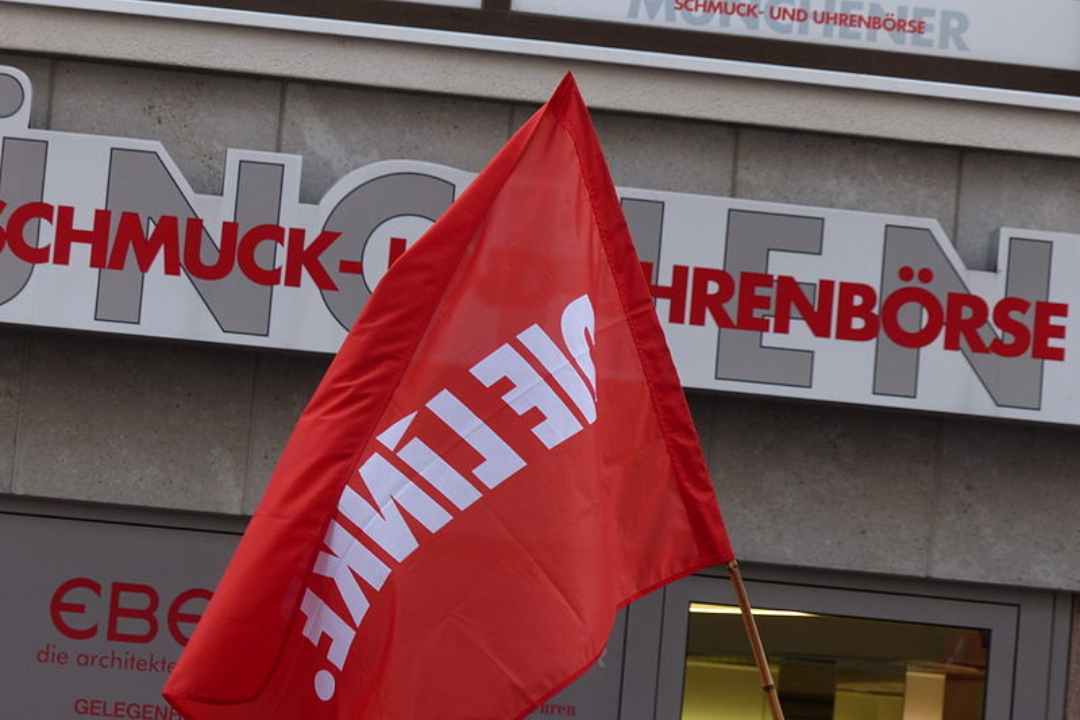
20. September, 6 pm. Cheers erupt, fists are raised, smiling faces everywhere. At this moment, there’s probably no better place to be than at The Left’s election party in Neukölln: 25.7 per cent. The strongest party. Berlin is turning red. And the comrades in Neukölln can confidently celebrate their election campaign – because they have rightly achieved the best result.
But Neukölln is not only place for a great celebration on the day. The district with a huge concentration of immigrant workers and poor section of the class in general, is also the most left wing district of the party. And it is the district with the largest membership of all in Berlin. And it is a branch hated by the establishment and by the reformist leaders of the party for its support of the Palestinian movement.
But before we turn to the political situation and the inner party disputes after the elections, we want to give a short overview of the result and the reasons for the victory. Election results do not explain themselves. Particularly against the backdrop of the shift to the right in recent years, the question arises: why was Die Linke able to secure such an electoral victory in Berlin of all places – and, above all, what do we do with this now?
Berlin is turning red – but the shift to the right has not disappeared
The clear winner: Die Linke. The result is historic. With 25.7 per cent, Die Linke has more than doubled its share of the vote compared with 2023 and has for the first time become the strongest force in the Berlin city council (Abgeordnetenhaus). In the district councils elections, which took place at the same time, it achieved 24.1 per cent across Berlin and gained 11.5 percentage points. It is not the strongest party in 6 out of 12 districts. It is the best result the party has ever achieved. The shift in voter support is also remarkable: on a net basis, The Left gained around 75,000 votes from among non-voters, 57,000 from the Greens, 39,000 from the SPD and even 16,000 from the conservative CDU.
The other winner: Yet anyone who, in light of Die Linke’s result, believes that Berlin has simply remained immune to the general shift to the right is taking the easy way out. The AfD also made significant gains, reaching 16.3 per cent. Among other things, it mobilised around 65,000 votes from the group of people who had previously not voted and, on a net basis, around 56,000 former CDU voters. Particularly in parts of the outskirts of the city, this reveals a different political dynamic to that in many inner-city constituencies, and here too Die Linke must admit: a significant proportion of those suffering from rising prices, poor wages, a housing shortage and social insecurity have not yet been won over to a left-wing perspective.
Those who have been punished: The CDU has suffered massive losses – 9.5 per cent – and ended up with 18.8 per cent. This also serves as a rebuke to the party’s course under Merz: the attempt to take the wind out of the AfD’s sails by resorting to ever more racism and right-wing policies of its own. Yet Berlin also shows that those who pursue this course do not weaken the AfD, but ultimately strengthen the original racist party.
The SPD has been hit even harder. The party that has shaped and (co)governed Berlin for decades is losing ground not only to the right but also, massively, to Die Linke. It has this to thank in part for an election campaign led by Steffen Krach, who did not even manage to use the word ‘expropriation’ in a positive light. The result of 12.1 per cent (a fall of 6.3 per cent) thus points to a deeper crisis within social democracy. For a large part of its former social base, it has long since ceased to appear as a party from which a fundamental improvement in their living conditions could be expected.
The Greens have also lost ground, ending up on 14.3 per cent (losing 4.1 per cent) – albeit under different circumstances. Particularly amongst younger, urban and progressive voters, they face competition from Die Linke, a party that frames social issues more radically and is better able to present itself as an opposition to the status quo. A net total of 57,000 votes alone have shifted from the Greens to Die Linke.
The insignificants: The liberal FDP with a mere 2.5 per cent have been consigned to parliamentary irrelevance – ‘until the twelfth of never’. The BSW (Sahra Wagenknecht), the right wing split from Die Linke, too, with 4.7 per cent, failed to win a seat in the city council. It is uncertain whether it will survive until the next election.
The Berlin result does not simply signify a general ‘shift to the left’. Rather, it highlights growing social polarisation: whilst parts of the city are shifting significantly to the left, the far right is gaining strength elsewhere in the country. The crucial question, then, is: why was Die Linke able to capitalise on part of this polarisation?
Why did Die Linke win?
As always, there is no single explanation for an election result; rather, it is the result of a combination of social developments and political decisions:
1. Societal and socio-spatial polarisation
The Berlin election does not take place in a vacuum. Just two weeks earlier, the AfD secured 43.8 per cent in Saxony-Anhalt. Yet the same societal crisis does not produce the same political responses everywhere. Different political dynamics are evident, particularly between metropolitan areas and rural regions, but also within Berlin itself between parts of the city centre and the outskirts. Underlying this are differences in social structure, age, migration, and working and living conditions.
Berlin is therefore not a contrary example to the societal shift to the right, but rather an expression of increasing polarisation, which can manifest very differently from region to region. The results from the southern part of Neukölln, where the right is relatively strong, also show that all is not necessarily lost. Whilst the party did not win any direct mandates in these parts of the district, it has made significant gains.
Generally speaking, this is particularly evident among young people. For the first time, 16- and 17-year-olds were also allowed to vote in the city council. Among 16- to 24-year-olds, 43 per cent voted for Die Linke; among 25- to 34-year-olds, the figure was as high as 49 per cent. Among first-time voters, it was also by far the strongest force, with 38 per cent of the vote.
This reinforces a trend that has been evident for some time: Die Linke is resonating particularly strongly with young people. No wonder, as a large proportion of a new generation experiences skyrocketing rents, the climate crisis, war and military build-up not as abstract problems of the future, but as an immediate reality. At the same time, their ties to the traditional mainstream parties are weak – but their trust can also be quickly betrayed.
2. Raising the social issue – putting rents at the centre
The decision to prioritise the fight for affordable housing and the implementation of the 2021 referendum ‘Expropriate Deutsche Wohnen & Co’. was the right one. This company owns over 100,000 housing units in Berlin. Hardly any other issue affects Berliners as directly as rent. This allowed Die Linke to tap into a real social debate in which hundreds of thousands have already taken action themselves. This in particular offers an important lesson: Die Linke gains strength where it does not merely promise to manage existing conditions in a slightly more socially just manner, but raises questions of ownership and power!
3. Successful mobilisation driven by membership growth
The enormous increase in Die Linke’s membership over recent years was not just a figure on paper. New members were specifically involved in the election campaign; door-to-door canvassing took place; neighbourhoods were canvassed; and people were mobilised. The result shows the potential that lies within this. But this is precisely where the next task begins: mobilisation must give way to organisation.
Getting people involved in an election campaign for a few weeks is one thing. Building lasting structures in which members can take on responsibility themselves, organise colleagues and neighbours, and wage social and political struggles is quite another. Electoral success is therefore not an end in itself, but a test of whether a party that has grown in size can also become one that is more firmly rooted in society.
4. Palestine: Silence is not worth it
Comrades in particular who have taken a clear stand against the genocide in Gaza and in solidarity with Palestine have been told time and again that this stance would isolate Die Linke and drive away voters. The election results tell a different story: whether it was Vedi Emde in Neukölln with 46.2 per cent, Martha Kleedörfer with 46.2 per cent or Deike Janssen with 43.4 per cent – they all won their direct mandates by a clear margin. In the Neukölln district council election too, where Ahmed Abed was the heading the party list, Die Linke emerged as by far the strongest force with 32 per cent and an increase of 17.6 percentage points.
This refutes the narrative that taking a clear stance on Palestine would scare voters away; rather, it shows that silence does not pay and that there is no need to fear the press’s smear campaign. Instead of constantly backing down and trying to win a race to see who can backtrack the most, just to please the last remaining conservative media editor, one should trust in what shapes political reality. Silence does not pay, and the combination of a clear political stance, a strong multilingual election campaign and a targeted approach to migrant communities has clearly proved successful. This also raises the reverse question: what potential has been squandered in other parts of the city?
Which strategy has won?
Many will try in the coming days to claim this election victory for their respective political strategies. But it is not that simple. In Neukölln, a deliberately rebellious, more radical election campaign was waged, one that placed organisation and social struggles at the centre and explicitly did not equate a change of government with a change in policy.
At the same time, the Berlin party leadership campaigned aggressively with Elif Eralp and the aim of capturing the Rotes Rathaus (Red Town Hall, named for its colour). For this the Berlin leadership had watered down the party election programme and promises. Now both sides point to their successes. Neukölln can cite its enormous gains and direct mandates; at the same time, Elif Eralp secured her direct mandate in Friedrichshain-Kreuzberg with 50.4 per cent. The election result alone, therefore, does not settle this debate on strategy.
And that is precisely why the crucial question is only now becoming clear: what do we do with this election victory? Because the fact that Die Linke has become the strongest party does not yet answer whether – and, above all, under what conditions – it should govern.
To govern – or not?
Many voters – and also many members – want Die Linke to govern now. This is understandable, particularly given the alternatives. Yet anyone who wishes to combat the shift to the right in the long term must not confuse the short-term bid for governmental power with social change. The question cannot therefore simply be: to govern or not to govern? Die Linke does not have an absolute majority and if it seeks coalition partners then what policies would this mean?:and at what cost to the party’s credibility?
What will happen to “Expropriate Deutsche Wohnen & Co.”? What happens if coalition partners demand further cuts? What happens to deportations of immigrants and the increasing militarisation of the city? A Left that promises expropriation but does not carry it out, that mobilises against cuts only to subsequently help administer them, or that continues to carry out deportations, would, in the long run, squander precisely the credibility on which its current success is based. It will alienate its young voters and do precisely what it fears: further strengthen the AfD.
Yet the result presents an enormous opportunity: almost half a million votes, tens of thousands of mobilised non-voters, numerous directly elected seats and thousands of new members. This can give rise to social power – if it is organised. This is precisely why those on the Left within the party must now learn some lessons.
Lessons for those on the left within the party
1. For the democratisation of the party: the question of coalition and government must be widely discussed and decided democratically!
The course had already been set before election day. Whilst it was repeatedly asserted in internal discussions that the campaign for Elif Eralp and the ‘Red Town Hall’ was, first and foremost, just that – an election campaign – the same campaign can now be used to argue after the election: we stood on the basis of our claim to govern; now we must deliver on that promise – after all, that is why we were elected.
It is precisely such strategic decisions that must not, in practice, be pre-empted by election staff and campaign teams who are primarily accountable to those from whom they hope to secure their next job. Before the next election, therefore, a democratic decision on the substantive and strategic direction of the campaign must be taken at the state party conference. But now, the question of joining a coalition must be discussed transparently and with binding conclusions at the state party conference. And not just there: the wider membership must also be involved; in all local organisations and districts, supporters and critics of a coalition with the SPD and the Greens must be given an equal say. There must be a consultation with members, allowing sufficient time for discussion of a potential coalition agreement, followed by a decision by a state party conference newly elected on the basis of this discussion!
And it is clear for anyone to see, that the Green Party and the SPD want to dictate their policies on the Left Party. That means to accept social cuts, to continue deportations, to delay expropriations of DWE for another period, to increase police surveillance and not to cause any trouble for the national government, its attacks on the working class. In order to prevent any of this the German ruling class has started a vicious campaign against the Left Party, demanding it purges its ranks from all those who solidarise with Palestine and the resistance struggle, branding them as “anti-semities”. The party leadership in Berlin is clearly willing to make almost all concessions in order to head a government which betrays all the Left Parties progressive promises. Therefore, the Left wing in the party has to reject this course, but it also needs to raise demands, which expose this treacherous course in the eyes of the working class voters.
2. Concrete prospects
We need a debate on tactics and strategies for how Die Linke can continue to raise – and win – the issues of power and ownership, rather than resorting to empty platitudes; and whether on the issue of expropriation or in social protests: Die Linke is trying to take the initiative – and that is right. At the same time, there is as yet no shared vision of how sufficient pressure can actually be built up to ensure these demands are met.
The ‘organising class party’ sets a general direction. Yet there is rarely any concrete discussion of what this means strategically. For whatever happens after this election: expropriation and the defensive struggles to come cannot simply be won at the ballot box. It is therefore up to us to make the idea of a political strike, backed by a broad social movement, popular once again. How can we build a social force that not only makes demands but can also force their implementation?
The more vague the party’s left wing is in its response to this, the easier it is for reformists to portray their path – via participation in government – as the only ‘realistic’ or even natural one.
3. Door-to-door canvassing is not enough: we need socialist practice.
Door-to-door campaigning must also be viewed in this context. It is one of the party’s strengths: it mobilises members, trains activists and brings us into contact with people outside our own political bubble. But it is, first and foremost, a form of mobilisation – not automatically of organising.
For comrades who want to build a socialist party, this therefore raises specific questions: How and when do we use door-to-door canvassing outside of election periods? What other forms of participation do we create? And how can we create similar opportunities for action in the places where we already find ourselves – in schools, universities, workplaces and neighbourhoods – in order to politicise everyday life there and build counter-power?
The latter, in particular, is the key question. Above all, we must be able to communicate clearly: it is not just your vote that counts. We can only expropriate, prevent cuts or fight for other improvements if people take action themselves and organise.
4. We need to build networks across the broader left and establish a revolutionary current.
The left wing within the party is fragmented. This is evident from the question of government alone. It is unlikely that there will be a single position on which the entire spectrum, ranging from marx21 (a current which comes from the Cliffite tradition and which is tied to sections of the party leadership and apparatus) through to the KPF (Kommunistische Plattform, a Stalinist current), SOL (Sozialistische Organisation Solidarität; German CWI section, RIO (Revolutionäre Internationalistische Organisation; German section of permanent revolution current) and GAM (Gruppe Arbeiter:innenmacht, German section of the ISL), from left-wing grassroots organisations to the LAG Palestine and other left-wing currents – can agree on every tactical and strategic issue.
But that is not necessary either. What is needed is coordination amongst those who can agree on common principles and objectives for an active, militant political strategy and for the democratisation of the party – whilst at the same time maintaining an independent revolutionary voice within this network. A campaign against participation in government would not, in this context, be a campaign against the party. It would be a debate about the character Die Linke is developing and what determines its political success in the long term.
For organised class politics does not thrive on the crumbs that fall from the ruling class’s cake. It thrives when it can answer the question of how we are going to take over the whole bakery. For this, we need to build up both – a strong left wing of party and, within this framework, a revolutionary current which can regroup the most determined on the basis of revolutionary programme and method.