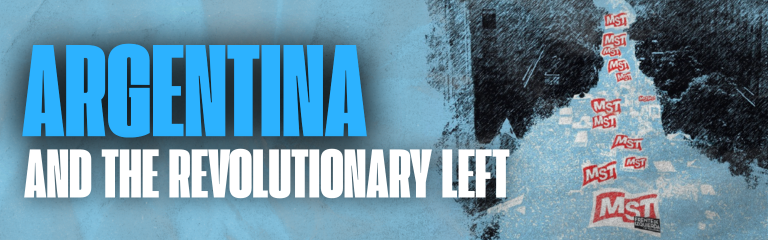
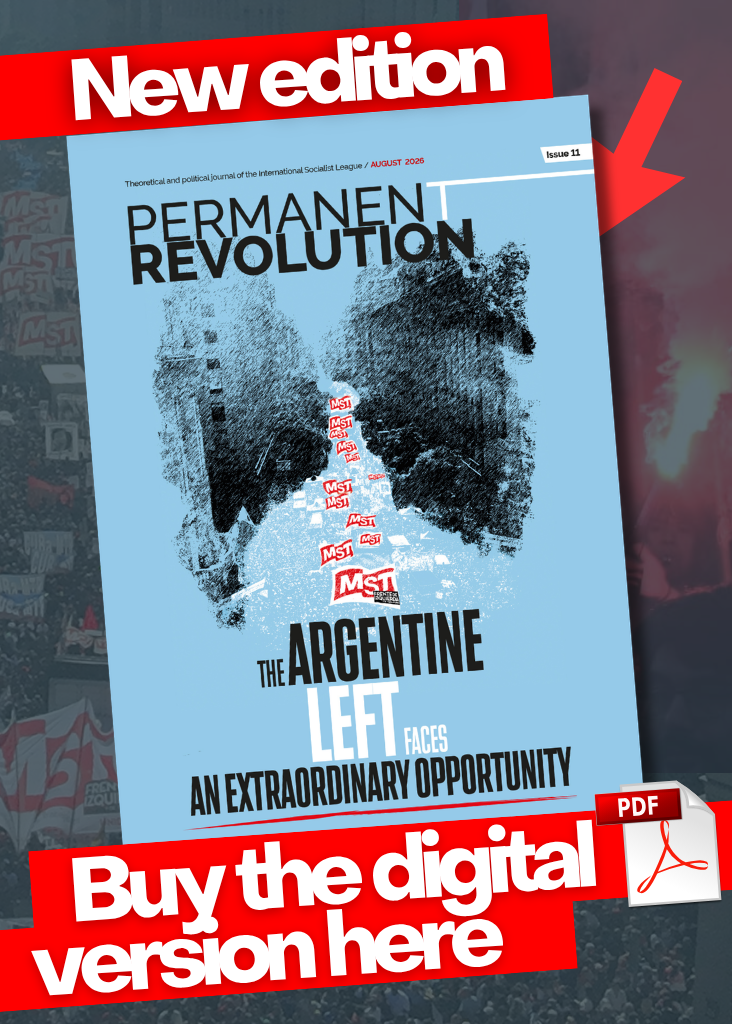
We share below the editorial article of Alejandro Bodart, coordinator of the International Socialist League and national leader of MST in the Left Front Unity, published in Permanent Revolution Nº 11, the political theoretical journal of the ISL, on the current situation of the revolutionary left in Argentina. You can purchase the full edition here.
In a world where the far right has gained ground and come to power in many countries, including the United States, it is important to pause and analyze the Argentine case. Because the rise to power of the ultra reactionary Milei, a protégé of Trump’s, far from consolidating, is in full decline and has provoked a social polarization of such magnitude that it has weakened the bourgeois opposition that has collaborated with him and strengthened the revolutionary left in an unprecedented way.
Today in Argentina, a significant chapter is beginning to be written in the long march toward a country and a world democratically governed by workers, where fully enjoying life and nature is not a privilege for the few but a right for all. Is this possible? How do we make it a reality? What tasks are urgent? Answering these and other questions is crucial at this moment, and the debate must engage not only the Argentine left but also the internationalist revolutionary forces.
The rise to power of the far right in Argentina in late 2023 was part of a phenomenon of international scope, albeit with local particularities. This homegrown libertarian experiment fueled violent rhetoric and brutal austerity measures, accompanied by an unprecedented subjugation and surrender of the country’s resources to U.S. imperialism—even surpassing the “intimate relations” with the U.S. that the Justicialist Party (PJ)1 promoted in the 1990s. Today, that project is rejected by more than 65% of the population, but it would be a mistake to write it off as dead. The far right is here to stay. It is an expression of the capitalist crisis and feeds on people’s disappointment with populist and reformist alternatives. In Argentina, as long as the electoral alternative to the libertarians is Peronism, there is a chance that Milei will be reelected in 2027. To defeat him, we must achieve large-scale national mobilization and continue to strengthen the revolutionary left.
Another significant aspect of the situation in Argentina is the enormous crisis of Peronism, the political and labor union leadership of the working-class movement over the past 80 years. This bourgeois movement, which has played the role of a popular front in the form of a political party and promoted class conciliation for decades, is now fragmented into several factions and lacks an alternative program to Milei’s. Its governors and some of its senators and deputies have supported the government’s most reactionary measures. They want the government to do the dirty work demanded by the IMF so they won’t have to do it themselves if they return to power. Peronist union leaders have been complicit and allowed austerity measures, the surrender of resources and sovereignty, and an enslaving labor reform to go unchecked. All of this, combined with the disaster of Alberto Fernández’s Peronist government—which opened the door for Milei— has led to the breakaway of entire segments of workers and the popular sectors, and has caused a segment of the population to turn toward the left. Between now and the 2027 elections, the PJ will try to field a single candidate—though it’s not certain they’ll succeed—and appeal to the “tactical vote to defeat Milei” and hold back the left, presenting themselves as if they were the only ones capable of doing so. Whether they succeed or not will depend on the pace of the class struggle in the coming months and on the actions of the revolutionaries, but the Peronist’s structural crisis with their social base will not stop.
A VERY UNUSUAL LEFT TURN
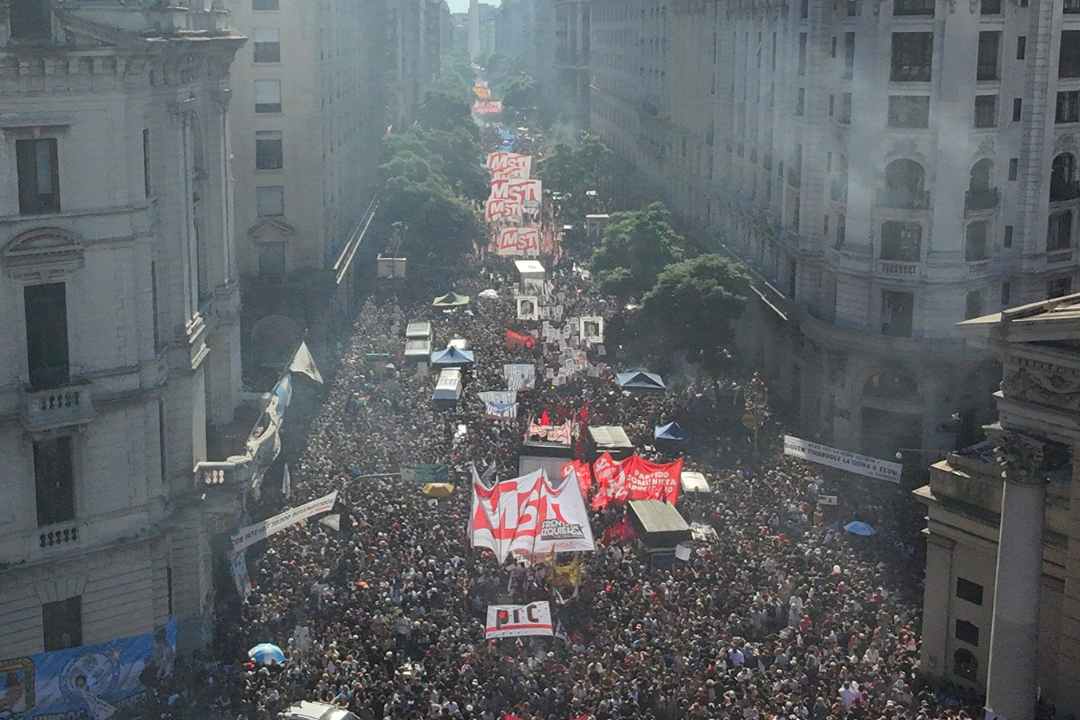
Milei’s decline and the political radicalization it fuels in vast segments of society, Peronism’s profound crisis, and the continual presence over several years of the Workers’ Left Front Unity (FITU)2—which has been the only real opposition to the government—are what explain the meteoric rise of the left that we are witnessing. The front has reached unprecedented levels of support and mass segments of the population have begun to view it as a viable option to govern the country.
Internationally, there are other shifts to the left: Zohran Mamdani’s victory in New York; the resurgence of Die Linke in Germany; and the possibility that arose in the UK with Your Party, though quickly thwarted by its leaders. What is unprecedented in Argentina is that the left that is gaining strength—unlike the reformist leaderships we just mentioned—identifies itself as revolutionary socialist, has its roots in Trotskyism, and has a program aimed at seizing power and establishing a workers’ government.
None of this is coincidence. Argentina is one of the countries with the longest-standing Trotskyist traditions, where it surpassed—both politically and organizationally— the various factions of the reformist left, including the Stalinists. This is not the first time that an acute crisis within Peronism has given the revolutionary left an opportunity to achieve organic influence among the masses and become a viable option for government. In the 1980s, the Movement Toward Socialism (MAS) grew, became hegemonic in the working-class and student vanguard, organized some 15,000 activists, becoming the world’s largest Trotskyist party. The death of its founder, Nahuel Moreno, in January 1987, and the fratricidal split in the leadership that succeeded him—the result of a series of theoretical, political, and methodological errors amid enormous changes in the global situation—led to the collapse of this organization in 1992. A few years later, in late 2001, the revolutionary rebellion known as the Argentinazo brought to prominence Luis Zamora- former congressional deputy of the ex-MAS who had converted to horizontalism influenced by the ideas of John Holloway—who came to win the sympathy of vast sections of the mass movement. Another enormous opportunity was squandered when his group refused to organize the thousands who followed it. They pursued a profoundly personalistic and sectarian policy toward the organic left that offered to support them, consciously refusing to run for the presidency despite Zamora being the politician with the highest level of support in the population at that time. The vacuum it left by abstaining from the contest that was unfolding paved the way for the emergence of Kirchnerism and the recovery of Peronism.
The current situation is the third opportunity since the fall of the dictatorship in 1982. Myriam Bregman, the FITU’s presidential candidate in 2023—when the coalition received 2.69% of the vote—is now, three years later, among the three political leaders with the highest positive public image in the country, and polling as high as 14% in vote intention. These figures are far higher than those seen during the previous periods of growth for the revolutionary left. But as we have seen in the past, opportunities do not last forever, and it depends on a correct political orientation to ensure they do not fade away.
THE STRUGGLE FOR GOVERNMENT AND FOR POWER
If the left rises to the level of the responsibility it is beginning to shoulder, we cannot rule out the possibility that it will continue to grow. Today, it is already a viable alternative for government among a segment of the masses. If it were to succeed in transforming this support into an organized force of tens or hundreds of thousands, it could become a viable alternative for power and help begin to build a new institutional framework—by winning leadership of unions and shop steward committees, coordinating them, and strengthening the emergence of new democratic organizations of the working class. This is the challenge at hand and the strategic importance of the debate currently unfolding within the country’s revolutionary left.
The shift to the left that we are witnessing is taking place without a massive rise of the mass movement yet developing, although discontent is on the rise and some processes of struggle taking place are taking place are an anticipation of what is to come. We cannot predict when a revolutionary uprising like the one that took place in Bolivia just weeks ago will arise. Could that happen before the next presidential election in October 2027? Could it come afterward, or is there little chance of it occurring in the medium term? Could the upcoming election itself be the trigger if the left performs exceptionally well? We don’t know. But it is clear that if the advances in consciousness we are witnessing continue to develop, they will sooner or later spill over into the streets. That is a situation that must find the left prepared to intervene and contest the government and power. And that requires immediately beginning to organize towards that objective.
There are significant but isolated struggles taking place. One task that the MST and the PTS are working on together is trying to coordinate these struggles across the country’s regions, with an ambitious initial goal of organizing a Marcha de la Bronca (March of Anger)3 in Plaza de Mayo and squares across the entire country in September—a demonstration we hope the rest of the front and all working class and progressive organizations willing to seriously confront the government will join.
But alongside this, the fundamental debate is how we build a new movement or party with which we can organize not only the current parties of the FITU, but also a significant part of the millions who want the left to govern. Without an organization of this kind, it is impossible to contest political power. Today, none of the FITU’s parties are hegemonic in the vanguard or capable on its own of organizing the tens of thousands that we need to organize before the opportunity slips away. That is why it is a mistake to proclaim any one of the parties as such instead of seeking a common orientation—with those willing to step out of their comfort zone—to take on the transformation of the FITU from a purely electoral front into an organization with centralized intervention on all fronts.
The debate on how to seize the open opportunity and emerging differences have created tension in the Front. This has been compounded by another crucial debate: how revolutionaries should intervene in the workers’ movement and its current struggles. The Workers’ Party’s (PO) disastrous orientation in the significant FATE4 struggle, where it has applied its characteristic sectarianism and endorsed thuggish and bureaucratic methods alien to the tradition of the revolutionary left, has deepened the crisis.5
The Socialist Workers’ Movement (MST), Argentine section of the ISL, defends the continuity of the FITU, but developments have been demonstrating that, as it currently operates, it is inadequate to face the new challenges ahead. To continue playing a positive role, it must evolve and overcome its most evident weaknesses. In this new issue of Permanent Revolution, we develop several proposals achieving this.
We invite all who share our views to join the MST and our trade union, social, ecosocialist, human rights or youth organizations such as La Zurda, to give more strength to our proposals and prevent the historic opportunity that stands before us from being squandered.
- The Justicialist Party (PJ) is the official name of the Peronist Party.
- Composed of our party, the Socialist Workers’ Movement (MST), the Socialist Workers’ Party (PTS), the Workers’ Party (PO), and the Socialist Left (IS).
- Conceived as a major political and social demonstration, led by the leading representatives of the left and the main struggles taking place, to raise the solution to the country’s crisis that the left proposes. The name refers to the 1970 protest song “La Marcha de la Bronca” written by Miguel Cantilo and performed by Pedro y Pablo, a long standing popular anthem against repression, censorship, and authoritarianism.
- Argentina’s largest tire factory.
- This situation has a manifestation in the municipal elections that will take place next November in Bariloche, a touristic city in the south of the country, where the FITU has presented two competing lists: one of the PTS-MST front and one of the PO-IS