By Peter Main
Note: This is transcript of an introduction by Peter Main at the summer school of the German speaking sections of the ISL (Arbeiter:innenmacht from Germany, Arbeiter*innenstandpunkt from Austria and Marxistische Aktion Schweiz). We reprint the speech here.
In this session we want to present an overview of China’s development since joining the WTO in 2001. Taking any specific date as the starting point for any historical development carries the danger of underestimating, even ignoring, what predates that point. Clearly, we should not underestimate the importance of key turning points in China, especially in the 1990s when the ruling party, the CCP, decided to dismantle bureaucratic planning and restore capitalist production relations. At the same time, China’s entry into the WTO does constitute a decisive moment in relations with the rest of the world, and in particular with the USA.
General Points on Method
Before we turn to the particulars of the last 25 years, however, a couple of general points for you to bear in mind. The first is the operation of the Law of Uneven and Combined Development one of whose insights is the survival of elements of a past economic system and regime even after it has been replaced by another. This explains, for example, the continued existence in my country, the UK, not only of a monarchy originating in feudalism but a landed aristocracy that not only transformed itself into, first, a slave trading class and then a key component of the industrial and financial bourgeoisie, they even retained law-making powers in an unelected House of Lords.
In China, like the British nobility, the bureaucratic caste, whose roots lay in centralised command planning, has survived into a capitalist economy, changing its immediate function but retaining its political power in the form of the CCP. Although it no longer attempts to control the exchanges between the different sectors of the economy, it continues to supervise economic development in accordance with an overall set of objectives formulated into a Five Year Plan. More than that, it has retained much of the same mindset in which the emphasis was always on what Marx called Department One of the economy, production of the means of production, leaving Department Two, consumption goods, much more to the operation of the market.
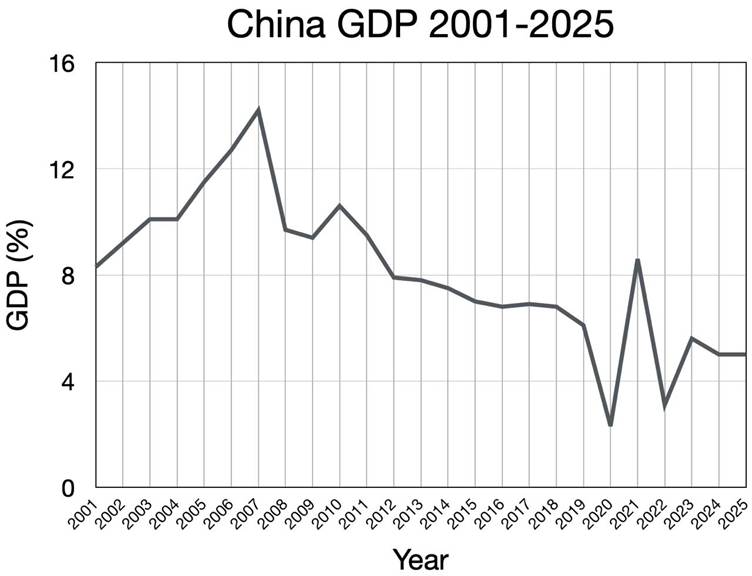
Secondly, I will refer throughout my talk to a graph of China’s GDP growth, based on figures from China’s Office of National Statistics. Many of you will be aware that those statistics are often viewed with a degree of scepticism in the “West” so my use of them should perhaps be explained: the point is not the arithmetic accuracy of any particular set of figures – or even the very concept of GDP, which is not a measure of production but of the total cost to end users of all the goods and services produced in a national economy. For our purposes, what matters is that much the same things are measured in much the same way every year, the resulting graph, therefore, gives us a visually immediately understandable image of the behaviour of the economy over the last 25 years. That is quite sufficient.
After Joining WTO
So, let’s take a look at the graph of China’s GDP growth rate. What is unmissable is the boom that followed entry into the WTO. Shortly before that, as a result of the Asian financial crisis, many foreign companies that had previously supplied components for assembly in China before export, had begun to shift their own production to China. To that was now added a really dramatic increase in Chinese investment to take advantage of the removal of tariff barriers. This was a classic early capitalism style of boom. With a steady stream of cheap labour from the countryside, some 200 million workers, mostly young and completely inexperienced, organised by regional and local governments, were put to work in hastily thrown up workshops. The great bulk of production was cheap consumer goods bound for Europe and the USA, where, as a result, capital was able to hold wages down to 1970s levels.
Production in such conditions, often supported by state subsidies to provide energy, transport and accommodation, easily undercut rival producers in other countries. Increasingly, in Europe and especially the USA, when purchasing managers were sourcing supplies, the crucial question was, “What’s the China price?” Such growth, however, had its own price. With most foreign competition defeated, Chinese manufacturers now found themselves competing with each other. Inevitably, competition to retain market share led first to price-cutting, then lower margins led to closures, then the survivors raised their prices for overseas customers.
The resulting rise in consumer goods prices was one factor in what became the USA’s sub-prime mortgage collapse and, subsequently, the Great Financial Crisis.
The backlash in China was rapid and brutal. Firms collapsed, owners disappeared without paying outstanding wages or suppliers’ bills, spreading the crash throughout the coastal provinces that had seen the greatest growth. Figures for job losses as high as 40 million within just three months may or may not be entirely reliable, but they capture the scale of economic collapse clearly enough.
This was the first such crisis the regime had had to face. Unlike longer established capitalist states that had weathered many storms and had developed, for example, social insurance and welfare schemes to deal with them, China had no system-wide safety net, indeed, under the hukou registration system, the vast majority of workers had no right to even live in the cities.
With hundreds of thousands of workers demanding relief and blocking highways and cities to enforce their demands, the Party responded quickly and, it has to be said, quite effectively. Local governments were instructed to distribute relief funds, often linked to subsidised transport to return workers to their home villages. This not only assured them of at least some support but, of course, also removed them from the cities.
Response to the Crisis
As the GDP graph shows, the collapse in production was dramatic but notice that, within a year, recovery had set in and soon accelerated. At the heart of this quite astonishing turnaround was a state investment programme the equivalent of $568bn. This sum was comparable to the cost of the bail outs and Quantitative Easing by which the US re-stabilised its financial apparatus.
The numbers, however, are all that is similar. In China, the funds were used to invest in, above all, infrastructure and associated means of production. This was the source of the thousands of kilometres of high speed railways, the new highways, the new municipal underground railways, the new airports, the new harbours and all the other developments at which tourists still marvel.
The early years after the crisis did not only mean a quantitative growth in the economy but a qualitative change in the society. Millions of more highly educated and skilled workers were needed, new towns were needed to house them, consumer goods were needed, the companies in Department Two, often denied low interest loans from state banks, generated demand from private or “shadow” banks, which demanded viable business plans – and the workers necessary to implement them.
One single statistic can be used to illustrate the scale and the significance of China’s transformation at this time; in 2011-12, it is said that over 90% of all the cement in the world, was used in China. Just think for a moment what that implies in terms of overseas trade, shipping, civil engineering, workforce training, international finance, in short every aspect of life in China. And not only in China, the demand for raw materials and energy supplies was enough to pull many other economies, very importantly including Brazil and Australia, out of the recession caused by the Great Financial Crash.
It was this ability not only to survive the worst economic crisis in decades but to come out of it stronger than before that persuaded us in the League for the Fifth International that China, far from being degraded into a subservient source of cheap goods for the USA and the EU, a semi-colony in Marxist terms, had actually grown into a global power, an imperialist state. Without the same terminology, a similar conclusion was being drawn elsewhere.
Xi Jinping
In Beijing, in November 2011, Xi Jinping was unexpectedly made the General Secretary of the CCP. Unexpected because it had been long assumed, as far we can tell in both China and abroad, that Li Keqiang, previously a vice-president under Hu Jintao, would be promoted to that post. If Li’s motto was, “Steady as she goes”, then Xi’s, by contrast, was “Full speed ahead!” Within months of being formally installed as the President of China in March 2012, he announced the four character strategy, “One Belt, One Road” for which he will probably be remembered.
Although it sounds rather odd in English, because the “belt” is the land route from China to Europe and the “road” is the maritime route round SE Asia and India to Africa, the Belt and Road Initiative, BRI, as it is now better known, made clear China’s intention to establish itself as a global power. The key to this was to be investment in infrastructure and construction in countries with either important raw material resources or strategic locations.
At home, too, Xi was anxious to encourage economic expansion and he signalled this by further relaxations of “market forces”. Although, as the graph shows, rates of growth were not as high as in the first decade, this was now a very much bigger economy so the absolute increase was considerable – and up to three times faster than other imperialist powers. Moreover, the emphasis on the export of capital for BRI projects inevitably had an impact on the domestic economy.
China’s rapid evolution did not go unnoticed in those other powers, particularly in the USA. In the very same month that Xi became the General Secretary, November 2011, President Barack Obama declared a change of foreign policy strategy with his “Pivot to the Pacific” – a sure sign that the White House, and the Pentagon, now recognised the arrival not just of a competitor but of a challenger.
In this context of substantial overseas investment, steady growth of the domestic economy but the first signs of a backlash from the most powerful imperialism, our attention now has to focus on the political situation within China, more particularly within the CCP itself.
The relaxation of controls on private capital prompted something of a backlash within the Party’s leading figures, often referred to as the “Red Families” because they included the remaining veterans from the pre-revolutionary days and their descendants. While most only voiced their concerns behind closed doors, one, Bo Xilai the son of Bo Yibo, an important figure in the Party and the PLA since the Twenties, made no secret of their preference for a return to stricter Party controls. Bo even went so far as to organise Mao-style campaigns in the city of Chongqing, where he was the Party Secretary, and became something of a figurehead for a current in the party that had long disagreed with Deng Xiaoping’s policy of restoration. In what was to become an oft-repeated pattern, Bo was charged with corruption and removed from office in 2015.
Elsewhere, the speed of the recovery after the crisis created a labour shortage that encouraged workers to demand better conditions and wages, with considerable success in regions like Guangdong. In this, they benefitted from the activities of both foreign NGOs and increasingly experienced legal activists. Reports of the growth of the Shanghai Stock Exchange and the rising value of shares in booming companies also led to increasing numbers of “retail investors”, that is, ordinary people with no experience of share trading who borrowed money to buy shares on the assumption that they could then easily sell them at a profit and then repeat the process.
Change in Strategy
Both of these developments came to an abrupt halt in June 2015. On June 12th, share prices began to fall, and they fell fast, losing one third of their value within a couple of weeks. Xi’s government responded quickly,. On the one hand, the Stock Exchange stopped trading, on the other, NGO and labour movement campaigns had to curtail their activists and were soon subjected to very tight legal restraints.
Even before the crash, the Party leadership had seen the need for a renewal of economic strategy both domestically and internationally and this took the form of the 13th Five Year Plan and its key targets, summarised as “Made in China 2025”. This aimed to make China not just an efficient producer of goods but a leading innovator in technology. More precisely, by 2025, 70% of key components and materials should be domestically sourced and the value content of products was to rise, ending reliance on imports of advanced goods.
What this was going to mean in practice became clearer at the 19th party congress in November, 2017. Reasserting the centrality of “socialist theory”, Xi declared there was a need for “supply side structural reform”, pointing to dangers of over-production and increased indebtedness.
Xi, of course, was returned as General Secretary but still had to include in the Standing Committee of the Politburo several of Hu Jintao’s allies such as Li Keqiang. At the time, rumours abounded that the “Red Families” did not approve of Xi’s increasing dominance, perhaps reflecting the increasing influence of a fast developing bourgeoisie, capitalists who had been allowed to join the Party since the late Nineties.
Whatever the truth of that, 2018 saw one very important intervention against freewheeling capitalists with the introduction of three “red rules” aimed at speculative property developers. With immediate effect, very tight controls on balancing debts against existing assets were imposed, cutting against the longstanding motto of the industry, “Build it and they will come”, which assumed never-ending boom conditions.
Before the effects of that dramatic change of policy could be seen, however, the biggest drama of them all began to unfold towards the end of 2019; the emergence of the Covid 19 virus.
As the graph shows, although the first lockdown was limited to Wuhan and the province of Hubei, it had a big impact on growth figures for the whole year. However, the lockdown strategy was seen as successful and recovery was rapid so that the figure for the following year, 2021, was significantly higher than the trend prior to Covid. The fact that the overall, downward trend was resumed in 2023, however, obscures an extremely important development in 2022.
The arrival of the Omicron variant of the virus, first reported in Shanghai in late February, led first to a complete lockdown in that city until May and then to the “Zero Covid” policy of very tight controls across the whole country. At the 20th Congress of the Party, in October 2022, Xi praised the effectiveness of the strategy and declared it would continue indefinitely. However, even before the opening of Congress, widespread discontent was demonstrated by the popularity of “Bridge Man’s” protest and then, just two weeks after Congress, the deaths of residents in a tower block fire in Urumqi prompted widespread unrest, beginning in Shanghai but spreading to the whole country within hours. This became known as the “White Paper” or “A4” revolution because protestors held up blank sheets of paper – a silent signal that invited everyone to realise what would be written if only that were allowed.
Almost immediately, despite Xi’s praise, “Zero Covid” came to an end. Both the protest and the speed of Xi’s retreat may come to be seen as significant in time but the Congress itself was also an important turning point. Even before it convened, it had already been decided that Xi would not stand down after his two terms of office as had been the rule after Deng’s rise to power. Now, his unchallengeable supremacy in the Party was underlined by his handpicking only those known to be his supporters as members of the Standing Committee.
By now, China was in the second year of the 14th Five Year Plan which included a redirection of the BRI, giving less emphasis to major infrastructure projects and much more to the export of technology and services such as transport and maintenance, surveillance, insurance and legal advice through commercial rather than state-led contracts. As in the past, however, payment could be arranged through raw material and energy supply deals.
Crisis
Domestically, Xi’s “red rules” for the property speculators began to have an impact from which China has not recovered to this day. Evergrande, one of the biggest construction contractors in the world, proved unable to pay interest on its debts in September 2021 and it soon became evident that the debts themselves could never be repaid and that Evergrande was only one of many firms that were actually bankrupt.
The consequences were shattering; it was discovered that there was a surplus of over 90 million flats that could not be sold. At the same time, there were millions of families who had paid “off plan”, that is, before construction had even started, and now never would be started. The knock-on effect can be imagined; the companies that had supplied the materials for surplus construction, the engineering firms who supplied the cranes, the earth-moving equipment, the lorries and the firms that had fitted out the completed buildings, not to mention all the workers who had actually built them, could not be paid.
Meanwhile, in keeping with the Plan, investment prioritised the high tech industries, electric vehicles, development of quantum computing, aerospace technology, biochemical research and, no doubt, sophisticated weaponry. By the end of 2023, the downturn of the second lockdown had been reversed and GDP growth was back to the trend line, although that, as we have already noted, was a trend downwards. What that obscured was the growing discrepancy between the “boom” industries and the rest of the domestic economy, essentially between Marx’s Department One and his Department Two.
Trump
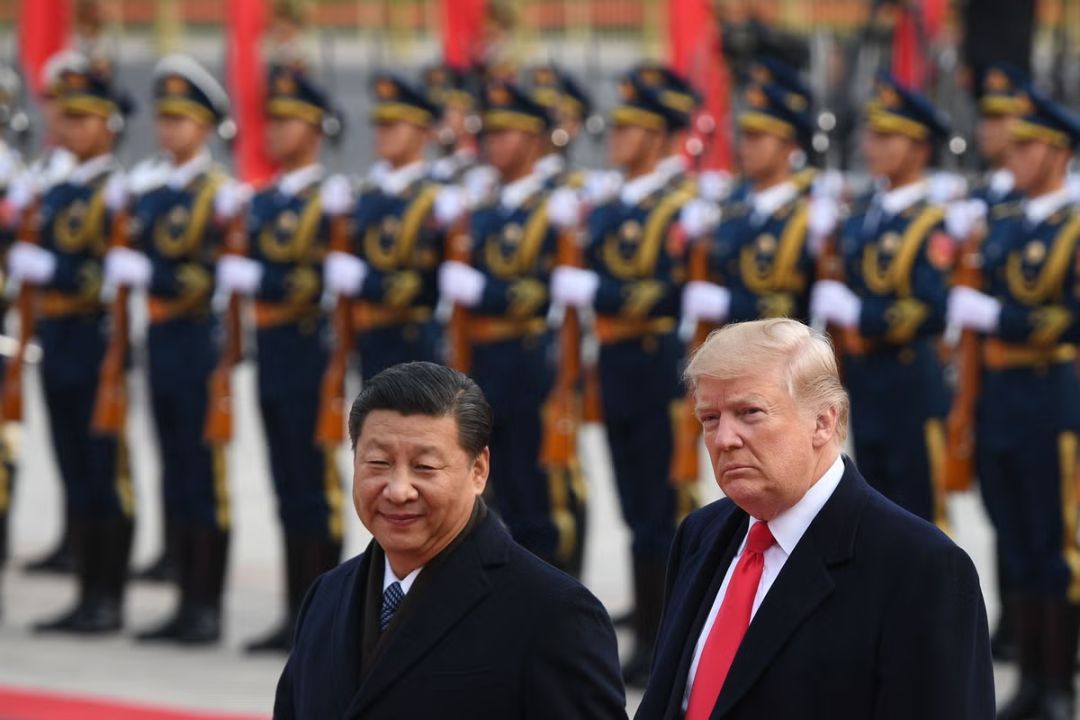
More recently, of course, the whole global economy has been impacted by the bizarre policies of Donald Trump. Unlike the great majority of countries, which tolerated his “Liberation Day” tariffs in the hope, sometimes justified, often not, that better terms could be negotiated away from the limelight, China simply retaliated with its own tariffs and diversion of trade away from US suppliers – buying its soya from Brazil, for example. That was enough to bring Trump to negotiations which generally led to a backing down on both sides.
Their next meeting is scheduled for September 14th with who knows what outcome. What we can say is that China appears to have a much greater sense of strategic planning and that Xi is no doubt prepared for many eventualities. He knows difficult times lie ahead, his plan is to rely on continued technological advance and increased exports supported by control of key minerals, new trade routes and an ever growing use of the yuan for trade and commerce.
The problem he faces, domestically, is very like that in the years immediately before the Great Financial Crash. China has out-competed many other countries in increasingly sophisticated products but it has neglected its own domestic market. The world market cannot absorb China’s surplus for ever but China is dependent on exports.
One statistic can illustrate the point; China already dominates the production of Electric Vehicles, while the US is content to continue guzzling gas, German and Japanese companies are now negotiating joint ventures with the likes of BYD. The estimated global demand for EVs is 23 million per year, China can absorb 12 million – but China already has the capacity to produce 25 million. At the same time, there are over 100 companies producing cars in China, clearly there is going to be a major reconfiguration, a huge destruction and centralisation of capital.
Similar calculations could be made for other sectors, all suggesting widespread lay-offs and, therefore, discontent. Xi has planned for that as well – the CCP now has 101 million members and the most complete surveillance system in the world. What that shows is that he isn’t scared of the Americans, he’s scared of the Chinese!