By Gustavo Garcia
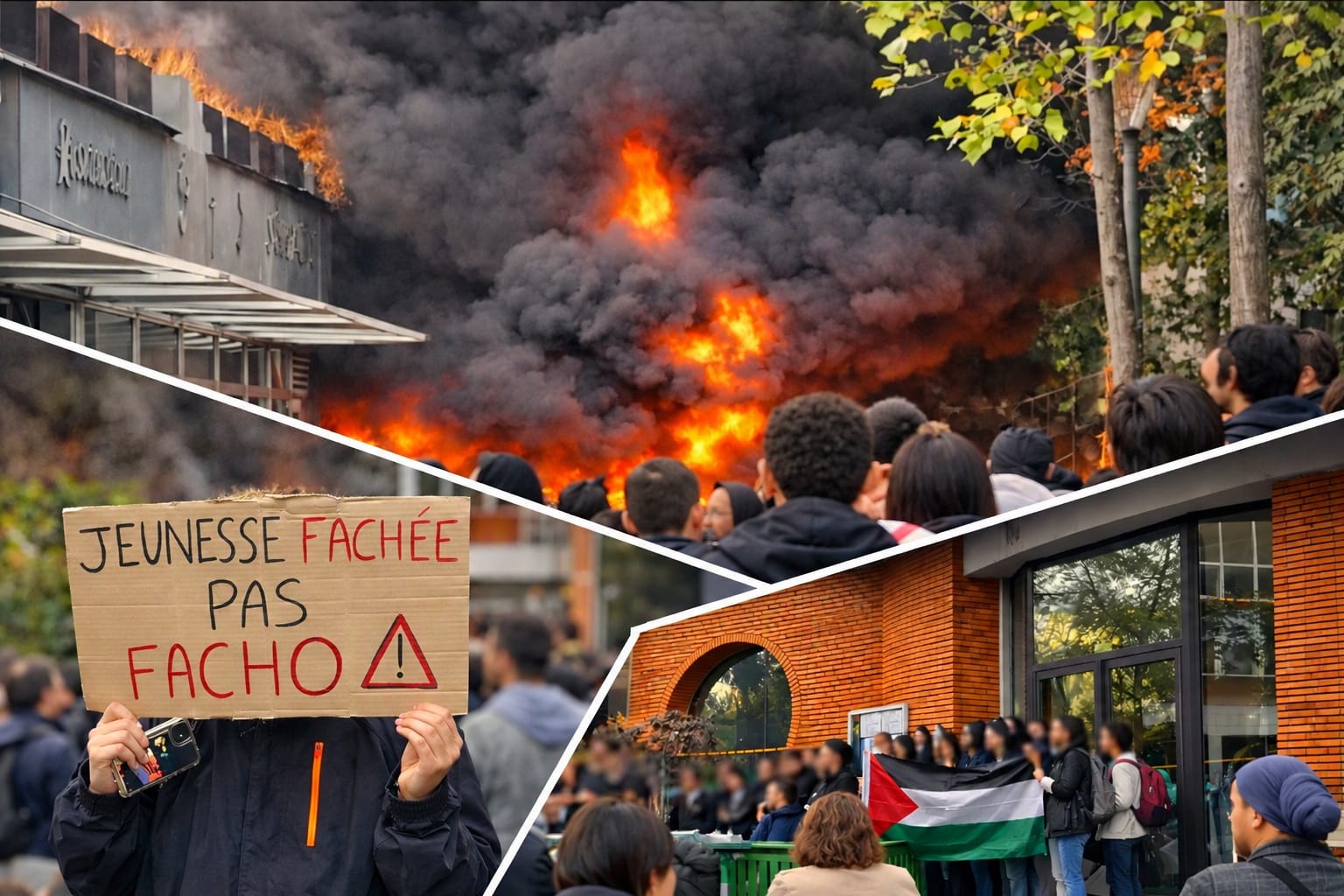
The anger of French youth has erupted. Faced with deteriorating conditions for their studies and daily lives, high school students have gone on the offensive, staging a full-scale uprising in high schools across the country. Through student assemblies and the systematic occupation of their schools and street blockades, high school students are organizing at the grassroots level to denounce overcrowded classrooms resulting from teacher layoffs and class closures, the lack of furniture, as well as infrastructure that is falling into disrepair and ill-suited to extreme temperatures—we freeze in the winter and swelter in the summer—and the deterioration of cafeteria services and the quality of meals served in school cafeterias. Compounding this structural decline in public education is the relentless social stratification that the Macron government has implemented through Parcoursup (an online platform that assigns students to universities based on their academic records), all while waging reactionary crusades against the abaya and the hijab in high schools, in concert with the far right.
It is precisely for this reason that, over the past week, spontaneous protests and blockades have been multiplying around high schools, led by the students themselves, who are burning trash, trash cans, and anything else they can get their hands on to make these blockades effective and, above all, to express the anger that has built up over years of institutional violence, economic austerity, and deteriorating living conditions.
In response to demands for decent learning conditions, an end to social exclusion filters, and a budget commensurate with educational needs, the government’s response has been fierce: it has unleashed a brutal and unprecedented crackdown, with police forces surrounding campuses, firing tear gas, carrying out arbitrary arrests, and encouraging legal proceedings to intimidate the rebelling youth. More than 5,000 arrests have been recorded since the protests began, and four students have suffered irreversible injuries during the crackdown.
The students’ demands are entirely legitimate, and they call for the formation of an alliance between workers and students to support the blockades, demand the release of those detained and the dropping of criminal charges, and to strike a united blow alongside striking workers. That is why the joint demonstrations we will organize on October 6 and 17 are of fundamental importance, and we must promote them in all workplaces and schools.
Economic crisis, poverty-level wages, and deteriorating living conditions
Added to the attacks on education and the youth uprising is the economic crisis, which is hitting working-class households hard. Working-class families have seen their purchasing power decline in recent years, with an estimated loss of about 1,200 euros per year since 2024. This trend is mainly due to the cumulative effect of inflation: although the rate of price increases has moderated compared to the levels recorded in 2022 and 2023, prices for essential goods and services—such as food, energy, and housing—remain high. At the same time, wages and certain social benefits have not risen at the same pace as mandatory expenses—such as rent or mortgage payments, electricity, gas, fuel, and insurance—which significantly impacts low-income families who have less financial flexibility to cope with the rising cost of living.
In this context, working conditions are rapidly deteriorating: exploitation is intensifying in both the public and private sectors—workforces are being cut, and we are forced to work longer hours under the pretext of a kind of “versatility” that is nothing more than a deepening of job insecurity— the working life is getting longer in order to secure a decent retirement, and incomes are being frozen, as we see in the draft budget presented for the year 2027, in which the government has confirmed the freeze on the civil servants’ salary index for the fourth consecutive year, thereby claiming that workers continue to bear the cost of the deficit.
This situation has sparked spontaneous mobilizations on social media, similar to those in 2025, but this time directly referencing the resurgence of the Yellow Vests’ struggle against the policies of Macron and his accomplices, and calling for demonstrations throughout France on October 17.
Action Plan: Uniting Struggles and Coordinating from the Grassroots
To ensure that the students’ demands are met, it is essential to forge an alliance between workers and students that supports the blockades, demands the immediate release of those detained and the dropping of criminal charges, and mobilizes alongside striking workers.
The working class isn’t sitting idly by either: this is evidenced by last week’s strike days led by transportation workers—both at the SNCF and the RATP — the civil servants’ strike on September 29, which mobilized more than 300,000 people nationwide to demand more resources and pay raises, and even the half a million people who turned out for the Pride march this past Saturday, the 3rd, and stood up against the far right.
We’re starting to feel the spirit of May ’68. The protests of recent weeks show that the will to fight remains intact. However, isolated actions and symbolic 24-hour strikes called sporadically by union bureaucracies are proving insufficient to force the bosses’ government to back down; a limitation that becomes all the more dangerous just a few months before an election in which the far right is emerging as a major contender.
At this critical juncture, the urgent task is to overcome fragmentation. We must unify and coordinate the struggles from the grassroots up, by organizing general assemblies in every school, every college, and every workplace, and by forming strike committees and unified coordinating bodies. Only in this way can we transform scattered anger into a fighting force capable of halting Macron’s austerity measures, defeating budget cuts, and defending our right to a life worth living.
France is on fire—it’s burning from the bottom up. If young people, alongside workers and retirees, are bearing the brunt of this system’s crisis, it’s time to coordinate our struggles so that the bosses, their government, and their political and union accomplices burn too.