Three years after October 7, 2023, we remain on the side of Palestinian liberation against Zionism and imperialism.
By Marco Ferrando
The Zionist state commemorates October 7 as an act of “anti-Semitic” terrorism. But it was, in fact, a legitimate act of Palestinian resistance against a barbaric colonial state. We disagree with the killing of civilians and with Hamas’s political agenda. But we have not been, nor will we ever be, neutral in the conflict between the resistance of the oppressed and the state that oppresses them.
We stand, unconditionally, with the Palestinian resistance against the Zionist state— a state born of the expulsion of Palestinians from their land through the most ruthless methods of terror, the culmination of a colonial project: the historic project of the Zionist movement. The project to replace the Arab population with progressive Jewish settlements, with the support of the major imperialist powers. First by British imperialism with the famous Balfour Declaration of 1917, then by U.S. imperialism in the period leading up to World War II. It was British troops who sparked the first major Palestinian intifada between 1936 and 1939, providing the Zionists with maps of the Arab villages most resistant to the occupation: not by chance, the very same villages that would be the first to be destroyed during the Nakba, the founding event of the current State of Israel.
A resolution jointly adopted at the UN by all the imperialist powers, including Stalin. The weapons used by the Zionists against the Palestinians in 1948 were of Stalinist origin, coming from Czechoslovakia. Without Stalin’s military aid, as Ben-Gurion acknowledged, the Zionist colonial state would never have come into being. The fact that Stalin deluded himself into believing he could secure Zionist support during the Cold War in exchange for this does not in the least diminish his historical responsibility for the Palestinian Nakba. Rather, it highlights the cynical stupidity of an autocrat.
Without a doubt, over the past three years, the Palestinian tragedy has resurfaced before the eyes of the world. It was not October 7 that accounted for the Israeli barbarism, as imperialist diplomats around the world claim in unison, regardless of Netanyahu’s “criticisms.” The opposite is true. It is the boundless barbarity of recent years that demonstrates once again the criminal and terrorist nature of Zionism and, therefore, the full historical legitimacy of the Palestinian resistance, including the events of October 7.
One hundred thousand Palestinians in Gaza were murdered in an act of genocide. Homes, hospitals, schools, universities, roads, bridges—everything was reduced to a vast pile of rubble, with the aim of making any return impossible. This same goal is being pursued in various ways in the occupied West Bank, where the terrorism of fascist settlers destroys homes and villages with the cover and support of the occupying forces.
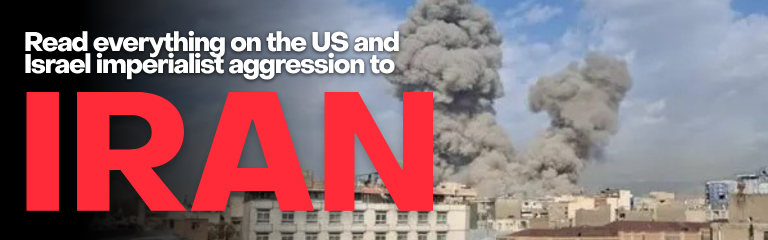
Once again, the State of Israel was able to carry out this plan thanks to the complicity of imperialism —all forms of imperialism. First and foremost, U.S. imperialism, which is decisive both militarily and economically: an imperialism that, alongside Trump, shared in Israel’s imperialist adventure against Iran, at the cost of its own imminent destruction. But also European imperialisms that still maintain lucrative collaborative relationships with Tel Aviv. And, finally, Russian and Chinese imperialism, which at the UN offered their “abstention” on Trump and Netanyahu’s so-called “Peace Council”: a colonial plan for a new partition of Palestine. The fact that Netanyahu reciprocates Putin’s attention with his own vote in favor of Russian imperialism at the UN on every anniversary of the invasion of Ukraine further clarifies the logic of this exchange between bandits at the expense of the oppressed peoples.
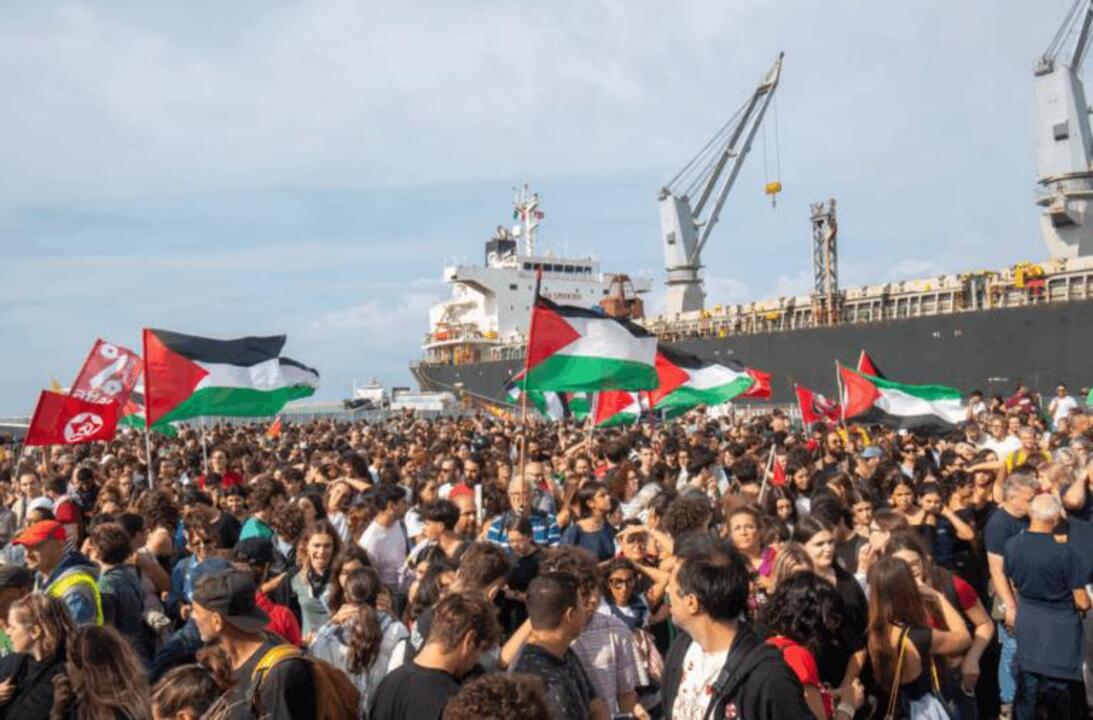
But these past three years have also witnessed the development of an international movement of solidarity with Palestine that is unprecedented in history. Its spread across every continent, its massive reach in various countries, and the emergence of a young generation everywhere that views what has happened in Palestine as a sign of “injustice in the world.” Often, they pay the price for directly opposing Zionism: as in the United States, Great Britain, and Germany, where the repression of the pro-Palestinian movement tramples even the most basic freedoms of expression.
The International Socialist League (ISL) and all its sections have been, are, and will continue to be an active part of this movement, fighting for its widest possible expansion and, above all, for the labor and trade union movement’s solidarity with Palestine. In Italy, the PCL, the Italian section of the ISL, fought for two years against the prevailing current within the labor movement in favor of a unified general strike for Palestine, which finally took place on October 3, 2025, due to popular pressure. Likewise, all ISL organizations support the dockworkers’ struggle to halt all trade with Israel, as in the international strike scheduled for October 30. The same applies to our anti-Zionist commitment in schools and universities.
But our involvement is not limited to solidarity. It addresses the crucial question increasingly facing the Palestinian resistance today: What conclusions must be drawn, and what outcome should the resistance itself aim for? The central strategic point is crystal clear: no solution to the Palestinian question is compatible with the survival of the Zionist colonial state. A sectarian state, lacking even a constitution, legally founded on the abolition of the right of return, military occupation, apartheid against the Arab population of the West Bank and Gaza, and anti-Arab discrimination even within Israel, is nothing other than a colonial structure. All the democratic demands of the Palestinian people, starting with the right of return, require the destruction of Zionist colonialism. “Palestine will be free from the river to the sea” is, not by chance, the dominant slogan of the international solidarity movement.
But the destruction of the Zionist state cannot be the work of the Palestinian resistance alone. The dramatic experience of recent years confirms this. The Palestinian armed resistance is, without a doubt, an essential component of the struggle. But liberation is inseparable from the revolutionary uprising of the Arab masses against their pro-Zionist and pro-imperialist regimes, and from the popular uprising of the Palestinian people themselves, especially in the West Bank. The integration of the resistance with the Arab revolution is a decisive step toward the liberation of Palestine.
All of this calls into question the current leadership of the Palestinian movement.
The Fatah leadership, responsible for the infamous Oslo Accords (1993), finds itself in a state of total bankruptcy. Its sole objective is to secure diplomatic recognition from international imperialism at the new negotiating table for the partition of Palestine. Its policy in the West Bank, through the Palestinian National Authority, has been reduced practically to collaboration with the occupier.
The Hamas leadership, the main beneficiary of Fatah’s discredit, pursues the vision of an Islamic republic—supposedly “negotiated” with certain Gulf monarchies—which, it claims, is “guaranteed” by Iran and Hezbollah. The facts demonstrate the dead end of this approach, even within the Islamist logic that inspires it. Hamas’s support for Trump’s plan for Gaza makes this clear.
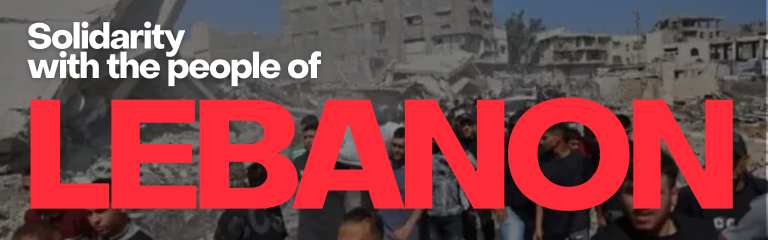
The liberation of Palestine is inseparable from the liberation of the Arab nation from Zionism and imperialism. Therefore, it is inseparable from the prospect of a socialist revolution in the Arab world and throughout the Middle East. Building a new leadership for the Palestinian and Arab resistance, one worthy of this task, is the commitment of the ISL and its sections, beginning with its Lebanese section, which currently stands on the front lines of the struggle against the Israeli occupation of Lebanon.