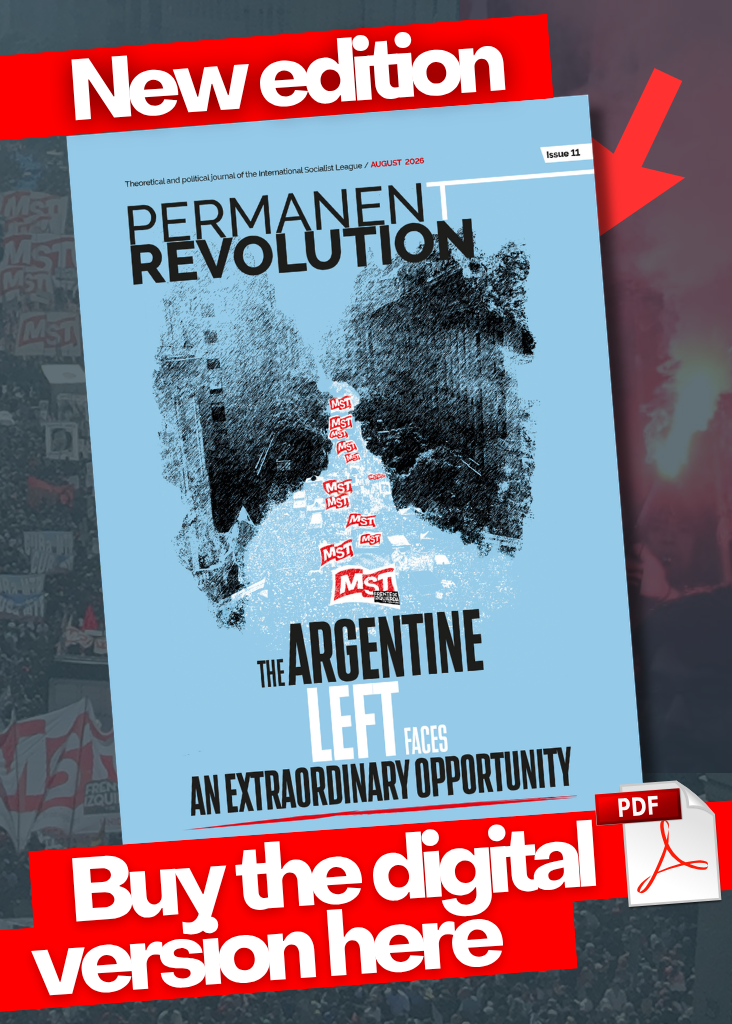
Below we share an article by Guillermo Pacagnini, a leader of the MST within the Left Front-Unity, published in Revolución Permanente No. 11, the ISL political-theoretical journal, on the current situation of the revolutionary left in Argentina. You can purchase the full digital edition here.
The Rise and Fall of a Project
The Irreversible Crisis of the Peronist Utopia
It is impossible to understand the shift to the left we are experiencing without linking it to the crisis within Peronism, which is undermining this chameleon-like movement’s ability to win people over again—a situation that opens up a historic opportunity for the revolutionary left.
By Guillermo Pacagnini, leading member of the MST in the FITU
Although the official history may suggest otherwise, Peronism is not a phenomenon that originated exclusively in Argentina. A proper analysis must begin by situating it within the wave of nationalist movements that emerged after World War II. Lázaro Cárdenas (PNR-PRI) in Mexico, Haya de la Torre (APRA) in Peru, Getulio Vargas (PTB) in Brazil, Carlos Ibáñez (APL) in Chile, Juan Arévalo and Jacobo Arbenz in Guatemala, and Paz Estenssoro (MNR) in Bolivia were some of the examples in Latin America that also had their counterparts in other parts of the world.(1)
Beyond their differences, they shared a common denominator: favorable economic conditions and a relative and temporary independence from the hegemonic imperialism of the time, a “welfare state” and concessions to the masses, Bonapartist regimes, and a movementist political architecture. Several emerged through coups d’état and/or processes of mass mobilization and were later consolidated through elections. (2)
And all of them, without exception, followed a similar historical cycle: after a period of peak prosperity, they began to decline, surrendered to rising imperialism, and entered a phase of decay. They emerged and experienced a period of rapid ascent in the 1940s and early 1950s. Then, inexorably, a phase of decline—of historical and structural crisis—set in. They transformed themselves into agents of imperialism and implemented austerity measures, rolling back social gains—including those achieved during their early years in office. Gradually, they became more traditional bourgeois parties or simply ceased to exist politically.
The Originality of Peronism and the Phoenix
Peronism shares these common traits, which are even more pronounced. But it has one distinctive feature: its period of decline was prolonged, and it rose again several times like a phoenix. This ability to reinvent itself as the dominant political and union leadership of the labor movement for nearly eight decades can be explained by a combination of factors.
- The interlude—between the withdrawal of British imperialism and the penetration of American imperialism—was even more pronounced. Argentina was the last region to be subjugated, by which time Latin America had already been organized as a semicolony, with an empire structured similarly to the British one but of a new kind. The 1942 and 1947 Rio de Janeiro Conferences, followed by the OAS Pact, constituted a charter of neocolonialism, which Perón signed but which was implemented later. The period between 1946 and 1949 marked the window of greatest relative independence. It was on this foundation that the banner of political sovereignty was raised.
- Perón led a new political project that reflected a sector of the bourgeoisie (and the military) that resisted U.S. penetration. It was aligned with the old, retreating British imperialism and drew on a bourgeois sector linked to the domestic market developed through import substitution and exchange controls. He was in competition with concentrated sectors of the bourgeoisie, backed by the church and the financial oligarchy associated with the U.S. embassy.
On this basis, the second banner was raised: economic independence ( nationalization of the Central Bank, exchange controls and foreign trade regulation through the IAPI, and nationalization of the telephone system, railroads, and public utilities).(3)
- It enjoyed an exceptional economic situation, superior to that of other countries with nationalist governments. A backward country but an export powerhouse: meat to England and grains to a world ravaged by war. Perón boasted of having 1,000 metric tons of gold in the Central Bank, a $560 million debt owed to England, bountiful harvests, and high meat prices. A historic situation that has never been repeated. (4)
Building on that material foundation, he made qualitative concessions, establishing a solid base within the labor movement and among the working classes. Social justice—the third of his “three banners”—reflected genuine progress in the face of the neglect of the “infamous decade.” (5) Workers secured a minimum wage, guaranteed minimum hours, social security contributions, a year-end bonus, paid vacation, job security, a rent control law, and numerous labor rights, in addition to housing programs and women’s suffrage. These achievements left a deep mark on the collective memory and marked the period of greatest worker participation in the economy.
- There were other factors that shaped the rise and consolidation of its social base: the betrayal by the Communist and Socialist parties aligned with the pro-American front, the reformist indoctrination of a segment of the old proletariat susceptible to the doctrine of class conciliation, and the new wave of internal migration that gave rise to a new proletariat lacking the Marxist and anarchist tradition inherited from previous generations.
When the economic boom came to an end in 1952, the employers’ front stepped up its pressure for the country to surrender to the world’s new master, and workers’ struggles intensified. Perón could have resisted, but he chose not to confront the 1955 military coup. (6) This had a twofold effect: on the one hand, it paved the way for U.S. semi-colonization and the implementation of the Bretton Woods agreements; on the other hand, it cut short the experience of having Perón and his movement as the leadership. For this reason, unlike other forms of nationalism, Peronism became etched in the workers’ consciousness as a political reference point.
That was the decisive factor in allowing the Peronist Movement to survive and reemerge nearly two decades later with a record number of votes, immense social support—including from middle-class sectors that had previously turned their backs on it—and a new opportunity in 1973.
A Shift in the Political and Union Consciousness of the Labor Movement
In addition to social achievements, early Peronism marked an unprecedented surge in the development of the working class, including in the realm of organization. There was a surge in unionization that left a deep mark on workers and explains why Peronism became their union and political leadership. New national unions were founded by industry, and the CGT was unified, becoming a very powerful mass labor federation.(7)
But the real leap forward in quality took place in the factories: internal committees and delegate bodies emerged for the first time and multiplied. They were the most important democratic achievement in the evolution of the working class and served as the combat units of the “Peronist Resistance” following the 1955 military coup.(8)
The phenomenon of unionization was contradictory: it reflected Perón’s support among workers to pressure the pro-American bourgeoisie, but it had its flip side in the nationalization of the unions through the bureaucracy co-opted by the government to control the labor movement. The delegate bodies were the hardest to subdue; it was there that the best of the militant vanguard emerged. It is no coincidence that it is there—along with self-organization—where the ongoing leadership transition within the labor movement is currently taking place.
This organization turned the Argentine labor movement into the one with the highest level of union consciousness in Latin America. At the same time, however, it displayed significant political backwardness by taking Peronism as its model, which had taught it to pursue class conciliation. A bureaucratic union model was created, nullifying independence through state-regulated bylaws, curtailing union democracy through top-down control, and establishing a regime of single-minded thinking under the slogan “The unions belong to Perón.”
The high level of union consciousness, despite its contradictions, stood in stark contrast to a veritable burden on political consciousness. Tamed by reformism and abandoned due to its betrayals, it became susceptible to the doctrine of class conciliation.
In furtherance of his strategy, Perón dismantled another key achievement: the Labor Party, which had been founded by union leaders. Although reformist in nature, it was a project aimed at political independence for the working class that was never replicated. Perón imprisoned its main leader, Cipriano Reyes, took control of the party, used it to win the first elections, and then dissolved it. Using its remnants and factions of Radicalism and Conservatism, he founded the Peronist Movement (later the Justicialist Party), characterized by a top-down structure, iron-fisted control from above, a bureaucratic union wing, and a political arm rooted in bourgeois sectors. He rolled out his program of class conciliation, social pact, and capital-labor alliance, similar to the classic popular fronts. Trotsky analyzed variants of the popular front in semicolonial countries, in which workers’ organizations participated in government indirectly, through single-party systems, as in China under Chiang Kai-shek (at the beginning) and Mexico under Calles and Cárdenas. This category of “party-based popular front” applies to Peronism.
This burden on the collective conscience persisted, with various and recurring cracks, for decades. Playing the role of the revolution’s firefighter, it emerged as the bourgeoisie’s last resort to curb semi-insurrectional processes whenever they intensified. It sought to demobilize the working class through confusion and systematic deception, operating at a level far beyond that of a “normal” bourgeois government. It convinced millions that the gains achieved through struggle were their own political victories and that they could be attained without the need for struggle. Of course, it was able to do so only to the extent that it had the resources to finance its propaganda machine.
Its support for imperialism—to which it inexorably succumbed—had a social rationale: to defend the crumbs of semicolonial exploitation, on which the bureaucracy, the most aristocratic strata of the working class, and the petty bourgeoisie feed. Hence, Peronism, like all Popular Front governments, ended up being a tool of exploitation and repression.
The Four Forms of Peronism and the Serial Metamorphosis
These central features of Peronism and their decisive influence on the direction of the masses persisted for nearly 80 years. The periodization proposed by historian Alejandro Horowicz helps us understand its rise, downfall, resurgence, and transformations leading up to its current state of decline.
- “Classic” Peronism ( 1945–1955)—the first two administrations—is the fundamental cycle that we have already analyzed and that the other nationalist movements also went through. As we noted, the pro-American military coup of 1955 ensured Peronism’s survival.
- Peronism Banned. From 1955 to 1973, military dictatorships and anti-worker bourgeois governments alternated in power; Peronism was banned, and Perón was in exile. The working class resisted with major strikes and waves of radicalized activists, and then a wave of semi-insurrections began following the so-called Cordobazo in 1969. A class-conscious current emerged within the labor movement. But politically, Peronism consolidated itself as the political leadership, and an urban myth took hold: that if Perón returned, the Peronism of the early days would return as well.
- The Third Peronist Era (1973–1976) was one of return. Under the presidencies of Cámpora, Perón, and Isabel Perón, Peronism governed with tremendous support, high hopes for change, and internal conflicts. But those expectations faded when the masses were harshly disillusioned to realize that Peronism had not returned to replicate the first era of Peronism, but rather to halt the pre-revolutionary upsurge that had begun with the Cordobazo and to sweep away radicalized activism and the left—including those who claimed to be Peronists. They spoke of “left-wing nationalism” and feigned a leftist stance, but quickly struck from the right with austerity plans and the fascist-like gangs of the Triple A, and they militarized the country in the face of the first major general strikes against a Peronist government. The military coup of March 1976 once again cut short that accelerated experiment; the survival that was achieved had very different characteristics and outcomes than what occurred after the 1955 military coup.
- Decline. From that point on, from 1976 to the present, the period of collapse unfolded, marked by the historic and structural crisis of Peronism. Without Perón and without money to “trickle down,” his heirs not only failed to lead the struggle against the bloodiest dictatorship in Argentine history, but they also lagged behind in the fight to restore democratic freedoms. To the point that in 1983, Peronism lost an election for the first time, began to fragment, and transformed into a more classic bourgeois party that was more clearly anti-worker, undergoing ideological and programmatic shifts. The Menem administration (1989–2000) revealed the Justicialist Party as an ally of the right and as the architect of the so-called neoliberal decade—that of Reagan and Thatcher—which promoted privatizations and labor reforms that undermined the gains achieved during the era of early Peronism. It was also the epitome of a decline with no turning back.
Kirchnerism: The Last Chance
The administration of Néstor Kirchner, continued by his wife Cristina Fernández, perhaps represented a last chance to rekindle the dream of the Peronist utopia. At its peak, there was a sense of déjà vu reminiscent of early Peronism, but this time there was no historical break. The experience of double-talk—promises that went unfulfilled and achievements that were short-lived—left an indelible mark on an entire generation, and the disappointment was here to stay. Once again, it played the role of “last resort,” dismantling the revolutionary process that had begun with the Argentinazo of 2001 and normalizing the country along capitalist lines. (9)
Although far from the magnitude of the exceptional situation in 1945, Kirchnerism had a certain material basis in the economic rebound and international tailwinds to create a new illusion. It capitalized on the energy unleashed by the Argentinazo in the absence of a left-wing alternative with mass appeal. Politically, it adopted a double-speak of the center-left, in tune with the trend toward progressivism. It yielded to the demands of the protests on the issues of democracy and human rights, and there was some wage growth. But, aside from a few specific issues, it essentially failed to reverse the regressive changes of the neoliberal Menem era. And the narrative collapsed in the face of a reality that brought inflation, unemployment, and renewed frustration. The progressive project that had once again captured the public’s imagination was short-lived; it mutated into the worst version of the old PJ. And the standard of living for the masses was once again hit hard. From that equation emerged Macri’s right-wing government, which ultimately exacerbated the regime’s crisis.
Cristina F. de Kirchner used up her last reserves of trust and leadership by anointing Alberto Fernández as president (2019–2023) to succeed Macri. This crisis coalition governed under the IMF’s program and triggered a spiral of inflation, increased poverty, and disillusionment. The international crisis and the pandemic called for transitional and in-depth measures, which the coalition government refused to implement. This led to a profound rift with the masses and a blow from which Peronism has yet to recover. To make matters worse, it bears the blame for having laid the groundwork for the rise to power of Milei, the monster of the far right.
End of Cycle
Peronism can no longer return to its heyday. We are witnessing the end of a cycle—the twilight phase of the project that once captivated and won the support of the working class and the popular sectors. A project that disappointed many times and reinvented itself. That capitalized on achievements won through workers’ demands while simultaneously erecting barriers to halt or delay the momentum of the revolution. It promoted unionization but enthroned the bureaucracy and the old union model to contain struggles and independent organization. It spread the culture of class alliance and fought against the emergence of a mass left-wing alternative.
Today, it shows a complete inability to stand up to Milei and present itself as an alternative to the far-right government.
It is fragmented, and all its factions are at odds with one another. Cristina Kirchner’s faction is severely weakened and bears the stigma of failure. Kicillof’s faction presents itself as the new force, but governs and implements austerity measures in Buenos Aires and pursues a more traditional bourgeois agenda beholden to the union bureaucracy. Massa’s faction is linked to sectors of big business and is an old friend of the U.S. embassy. And there is the faction of the governors, who organize themselves around their fiefdoms and even support Milei’s bills. Even Juan Grabois, who sought to revive a more leftist wing, doesn’t step out of line and is working to piece together a puzzle that includes all these monstrosities.
There is a shift in the historical and structural crisis, but we must not downplay it as an obstacle to the revolution. They may reinvent themselves once again. They were and will remain a class enemy disguised as a friend. But what we are certain of is that there is no going back—neither to 1945, nor to the “left-wing nationalism” of 1973, nor to the renewed project of Kirchnerism. There are no leaders who inspire enthusiasm. Although they will try, there are millions whom they can no longer convince that they are the lesser evil compared to Milei.
The roadmap of this Peronism does not include the streets and has abandoned its three historic principles, adopting a conservative agenda adapted to the demands of the capitalist crisis. It is a repeat offender in the utopian fantasy of coating a decadent capitalism with a veneer of humanism. It promotes extractivism and corporate interests, as well as policies—such as the flexibilization of labor relations—that it once claimed to oppose.
Today, to realize the three principles of social justice, political sovereignty, and economic independence, it is essential to break with capitalism and move toward socialism—and this will be achieved by fighting for a government of the working people. Today, these causes are championed by the left and form part of the anti-capitalist and socialist program that we are raise from the MST and the FIT Unidad.
That is why support for the left is growing—because people see us standing in solidarity with workers’ struggles, on college campuses, in neighborhoods, confronting the bureaucracy, and calling for serious mobilization to defeat Milei and his entire plan, as well as to discuss proposals for governing.
It is up to us to rally thousands, organize this growing support, and take on the challenge before us: that of building a new historic movement—this time a leftist and revolutionary one.
Recommended Reading
González, E. The Rise and Fall of Peronism. Antídoto, 1986.
Trotsky, L. *On National Liberation*, Ed. Pluma, 1974.
Pacagnini, G. “Fighting from Within Peronism? When You Feint to the Left and Strike from the Right.” Alternativa Socialista 854. 2024.
Pacagnini, G. What Kirchnerism Was and Is. Alternativa Socialista 856. 2024.
Horowicz, A. The Four Peronisms. Edhasa. 2013.
Horowicz, A. *Kirchnerism Unmasked: The Long History of the Fourth Peronism*. Ariel, 2023.
Moreno, N. A Method for Interpreting Argentine History. Pluma, 1975.
References
- On a different level, nationalist movements also emerged in the colonial countries during the same period and followed a similar trajectory: Nasser in Egypt, Jawaharlal Nehru and Gandhi himself in India, Sukarno in Indonesia, and Messali Hadj (MNA) in Algeria, among others.
- Juan Domingo Perón took part in the 1943 military coup and later served as Secretary of Labor. He was removed from office due to infighting among the bourgeoisie. On October 17, 1945, a historic mobilization took place that forced his reinstatement and laid the groundwork for his movement to develop, eventually win the elections, and consolidate its hold on power.
- When the war finally weakened England, the bourgeoisie became divided, realizing that aligning itself with Yankee imperialism would safeguard its businesses and the development of new sectors of production. Peronism reflected this contradiction: it was progressive insofar as it opposed U.S. imperialism and relied on the labor movement to do so by making concessions. But at the same time, it was highly reactionary because it defended the old capitalist society, and all its development was based on labor-intensive production rather than on the modernization of machinery.
- There were 1,425 million dollars in gold and foreign exchange reserves. Every Argentine was a creditor with a balance of 89 dollars in their favor. This contrasts with the current situation, where every Argentine is “in debt” by approximately 8,900 dollars.
- The so-called “infamous decade,” from 1930 to 1940, marked by a decline in production and a consequent widening of the social gap, was a reflection of the crisis of the 1930s. Conservative and authoritarian governments launched fierce attacks on the working class.
- On September 16, 1955, a military-business-clerical-imperialist coup took place, ushering in a dictatorship known as the Liberating Revolution until 1958, led first by Lonardi and then by Aramburu and Rojas. With Perón in exile and banned from political life, the following governments succeeded one another: Frondizi (1958–1962; developmentalist), Guido (1962–1963; civilian-military), Illia (Radical) from 1963 until another military coup in 1966, which ushered in a new dictatorship under Generals Onganía, Levingston, and Lanusse. In 1973, the bourgeois democratic regime was restored with Perón’s return.
- In 1936, there were 296 labor unions, and by 1945, with the rise of Peronism, that number had tripled. Similarly, the number of union members rose from 369,969 in 1936 to 3 million in 1951.
- The so-called “Peronist Resistance” was a period of struggle and reorganization for the working class during the military dictatorship from 1955 to 1958. Activism and militant groups emerged, and labor unions were revived. It was a major vanguard movement in which Trotskyism played an active role, but which looked to Perón in exile as its political reference point.
- The so-called Argentinazo was a revolutionary process that brought an end to the “neoliberal decade,” toppled five governments in 11 days, sparked a surge in mass movements and activist organizations, put an end to the old two-party system of alternating power between the UCR and the PJ, and created such instability that the desperate bourgeoisie turned to an obscure leader of Patagonian Peronism, Néstor Kirchner, to reorganize the Peronist movement, quell the social unrest, and restore the regime.