It is a victory for the movement that, at the same time, highlights the housing crisis. The eviction of an elderly woman, the massive response in the streets, and the encampment at Puerta del Sol brought the housing crisis to the forefront. Maricarmen will return to her home with a new lease, but the problem that led to her eviction remains unresolved: thousands of families continue to be threatened by unaffordable rents, evictions, and real estate speculation. The disintegration of the government and the regime is becoming increasingly evident and highlights the need to build a new, revolutionary, and socialist political alternative.
By Rubén Tzanoff
An eviction that epitomized the ongoing crisis
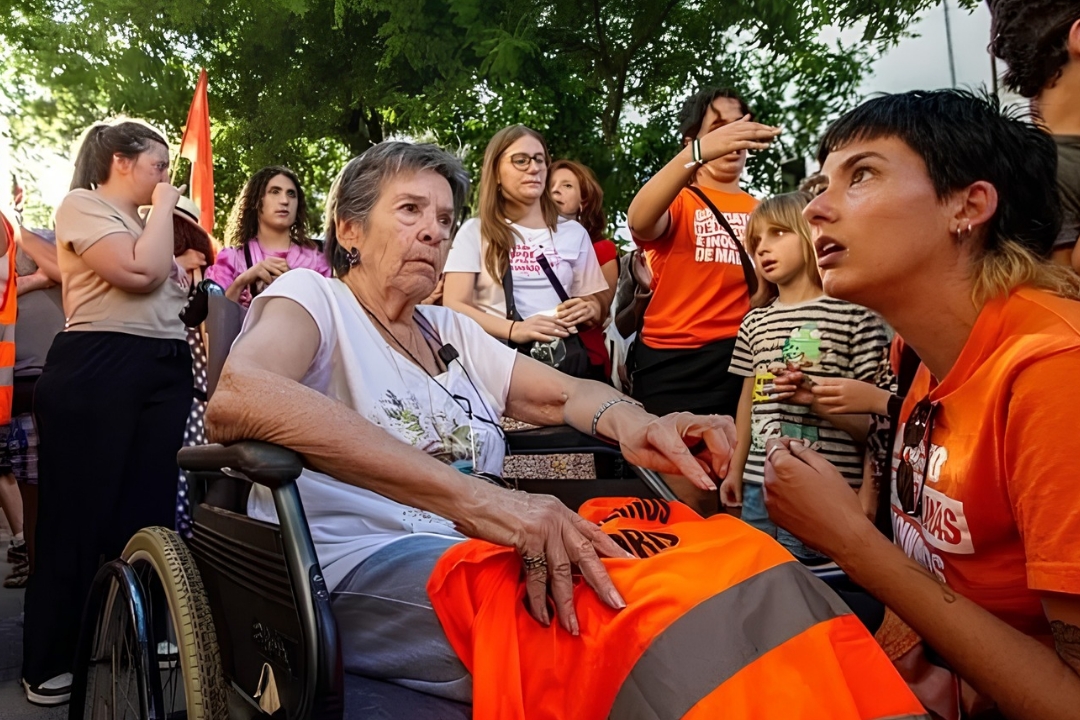
On September 23, Maricarmen Abascal, 87, was evicted from her home on Alcalde Sáinz de Baranda Street in Madrid’s Retiro district, where she had lived for 71 years. She had a recognized 50% disability and reduced mobility.
The property had been transferred to Urbagestión, which acquired it in 2018. Maricarmen had an old lease, and the dispute dragged on for years due to her legal situation. Finally, after a lengthy legal process, the Supreme Court authorized the eviction. Subsequently, the company proposed a rent that reached 1,650 euros per month, an amount the woman could not possibly afford.
The eviction took place on September 23, despite opposition from activists with the Tenants’ Union and a police operation. Maricarmen ended up being taken to the hospital.
Beyond the legal specifics of the case, the scene encapsulated a reality endured by thousands of people: a place that had been someone’s home for decades became a commodity for capitalist profit, transforming a right into an unscrupulous and inhumane business.
Given this reality, which is all too common in Spain, Maricarmen’s case quickly went beyond the scope of an isolated incident.
The straw that broke the camel’s back
The response was immediate. On the very afternoon of the eviction, rallies were held in various cities, and on Saturday, September 26, thousands of people filled the streets of Madrid under the slogan “Not one more Maricarmen.” It was a massive mobilization the impact of which extended far beyond Madrid, reaching the entire world.
The march was followed by a sit-in at Puerta del Sol. Starting on Saturday, the 26th, the encampment became a hub for organizing and protest, bringing together housing collectives and unions, student organizations, firefighters opposing evictions, and sectors of the revolutionary left, among others.
The image of Perta del Sol brought back memories of the 15-M movement in 2011, when the square became a symbol of a protest that went beyond institutional channels with the “Indignados.” Today, the housing crisis is the focal point of a much broader sense of discontent: wages that aren’t enough, rents that consume a growing portion of income, young people unable to move out on their own, and families under the constant threat of losing their homes.
The protests were not limited to Madrid either. There were protests and sit-ins in various cities, and on September 28, demonstrations took place in Barcelona during Pedro Sánchez’s visit, while the Sindicat de Llogateres called for automatically renewable leases, lower rents, and limits on investment funds. The housing crisis made headlines once again.
The protest succeeded: Maricarmen will return home
On Monday, the 28th, negotiations began between the family and Urbagestión, with mediation by the Madrid Municipal Housing and Land Agency.
Maricarmen will be able to return to her home once she is medically cleared. The new lease will last for eight years, and the rent cannot exceed 30% of her net income—about 500 euros per month. The agreement also includes a government guarantee, rent default insurance, comprehensive property insurance, and legal, financial, and tax advice.
This is a victory for a movement that succeeded in bringing the case to the forefront of public debate and accelerating negotiations that had been at an impasse for years. But it would be a mistake to stop here: Maricarmen is returning home, but the problem that led to her eviction remains.
It wasn’t a bolt from the blue
The movement didn’t come out of nowhere. For years, struggles against evictions, exorbitant rents, touristification, and real estate speculation had been building up. The Platform for People Affected by Mortgages, tenants’ unions, neighborhood organizations, and numerous local and national platforms led hundreds of protests.
In October 2024, tens of thousands of people protested in Madrid to demand lower rents. In November of that same year, Barcelona saw another massive demonstration, which even raised the possibility of a tenants’ strike.
On April 5, 2025, simultaneous protests took place in some 40 Spanish cities. Tenants’ unions called for rent reductions, an end to evictions, and measures to combat speculation.
In 2026, the pressure continued. The protests over Maricarmen joined other specific conflicts in neighborhoods and cities, as well as the efforts of organizations that have been fighting evictions and investment funds for years.
That is why Maricarmen’s case serves as a focal point for the serious housing crisis: an individual story that reflects a collective problem that has been building up for years.
An unavoidable emergency
The data illustrates the scale of the problem. In 2025, there were 25,540 rental-related evictions in Spain. In Catalonia, 6,814 were recorded, and in Madrid, 2,267.
This pressure affects not only those who are on the verge of losing their homes but also those who manage to keep them by sacrificing an ever-increasing portion of their income, which is failing to keep pace with the cost of living.
According to Eurostat, in 2025, 7.2% of the Spanish population lived in households that spent at least 40% of their disposable income on housing costs. Among households at risk of poverty, the percentage rose to 29.9%, and in Spanish cities it reached 8.2%.
The Bank of Spain estimated that in 2024, renting households spent, on average, 26.7% of their net income on rent; among those under 35, the figure was 27.4%. In Madrid, the average rent burden reached 34.5%, and in Barcelona, 31.3%.
The crisis is hitting young people particularly hard. In 2025, Spain was among the EU countries where people left their family homes the latest: the average age was 30.2 years. Added to this is overcrowding: 26.9% of young people between the ages of 15 and 29 in the EU lived in overcrowded households.
In July 2026, housing prices had risen for 36 consecutive months. The average price reached 2,112 euros per square meter.
We are therefore not facing a local or isolated problem, but rather a social crisis affecting all of Europe and taking on particularly serious proportions in Spain.
Sánchez is always up to the same old thing: quick fixes and electoral maneuvers
Social pressure forced the government to approve two royal decrees on housing on September 29. The measures include protection against certain evictions of vulnerable individuals through 2030, an extraordinary extension of leases expiring through December 2028, regulations on seasonal and room rentals, and restrictions on the purchase of homes by investment funds through 2028.
A second decree includes the automatic renewal of contracts, but it was separated from the first to facilitate its passage through Congress, a process that will be complicated by the current polarization and weakened government. The government has also launched a number of limited housing programs.
These are measures that introduce protective mechanisms or expand existing ones. But they are insufficient to bring about structural change in the housing situation. The splitting of the package highlights the government’s difficulties in securing parliamentary support for the most controversial measures, as well as its constant maneuvering and stopgap measures—which do not prioritize resolving underlying social problems, but rather focus on maintaining its increasingly precarious hold on power and its electoral standing.
The key issue is who owns, controls, and regulates housing and what it is used for: it must be considered a social right and not a commodity intended to generate profit.
PP and Vox: Other Responses from the Right
The PP has blamed the PSOE government for the crisis and has argued that the problem can be solved primarily by increasing supply, thereby appealing to the capitalist market that is causing the crisis.
Vox explicitly links the housing crisis to immigration and proposes what it calls a “national priority” for access to public housing and social services, along with land-use deregulation, tax cuts, and public-private partnerships.
These reactionary responses from the right and the far right are the opposite of those put forward by the housing movement.
Who Pays for the Crisis?
The problem is not merely the need to build more apartments. Housing has become a major arena for capital accumulation. Large property owners, real estate companies, vulture funds, and other financial actors participate in a market where property values rise while wages lag behind rent increases.
Investment funds have become one of the main targets of the protests. The government itself acknowledges the problem by including in its new decrees a temporary ban on certain home purchases by investment funds.
Added to this are the burden of mortgages and household debt, the rise in short-term and tourist rentals, the gentrification of working-class neighborhoods, and the long-standing shortage of public housing.
The overall result is a permanent transfer of income from workers to landlords.
Those hardest hit: workers and young people
Those who suffer the most from the crisis are workers whose wages do not allow them to afford their own home; young people who are forced to delay moving out of their parents’ home for years; families forced to share housing; older adults at risk of losing their homes; and households that must choose between paying rent and covering other basic expenses.
Housing is not just a real estate issue, but also a wage, employment, and social issue. When a worker has to spend a third or more of their income on rent, any rent increase, reduction in working hours, illness, or job loss can turn into a family crisis.
From Individual Conflict to the Coordination of Struggles
While the struggle for housing fills Sol, labor and social conflicts are unfolding in various sectors. Airbus saw two strikes in 2026, and the healthcare, education, and other public service sectors are also experiencing strikes and protests. The problem is that these struggles remain separate.
The Sol camp already represents a form of coordination among housing collectives, students, workers, and political organizations. We must support it, defend it against any attempt to evict it, and strengthen it to promote self-organization. One way to do this is to organize demonstrations and many “Puertas del Sol” events throughout the country.
The reference to 15-M is not merely symbolic. The aim is to revive the idea that a public square can become a space for democratic organization and the coordination of various social conflicts.
While some sectors of the housing movements are calling for a general strike, the UGT and CC. OO.—the two largest labor unions—are looking the other way.
A Transitional Response to the Crisis
At SOL, we support the struggle and propose a response that begins with immediate demands and moves toward structural change.
Ensure Maricarmen’s return and provide stable housing solutions for those who have been evicted; prohibit evictions; freeze and cap rents in line with workers’ wages; establish affordable rents and stable leases; regulate and limit tourist, temporary, and room rentals when they are used to circumvent residential regulations; massively expand public and social housing; expropriate housing owned by large landlords and investment funds for speculative purposes and repurpose it for social rental housing; prevent public housing from being privatized again; and develop a state plan for the construction of affordable housing based on social needs.
We must also ensure that no worker has to spend an unbearable portion of their wages on housing and protect families in debt from foreclosures and financial abuse.
No to austerity for wars: housing, healthcare, and education
The discussion of public resources also cannot be separated from the overall economic model. In step with the EU’s imperialist bloc, Spain has increased its spending on “defense”—as they call rearmament: in 2025, 10,471 million euros were spent on the Industrial and Technological Plan for Security and Defense, as part of the increased military effort.
The facts show that the government is lying when it claims that these expenditures are compatible with strengthening public services. Public funds must be directed toward social needs, including a genuine public housing plan. No to austerity for imperialist wars. Resources for the needs of the working class and the people!
Capitalism and Housing as a Commodity
Maricarmen’s case allows us to view the problem from a specific starting point. It’s a victory that the mobilization has stopped the eviction, and it shows that we have the strength to fight! We must also work to resolve the situation that millions of people are facing—or are on the verge of facing.
The struggle for housing cannot be separated from the struggle against the entire system that turns social needs into business opportunities. The experience of these past few days—which is still unfolding—leads to one conclusion: when a cause generates a sufficiently broad mobilization, it can change decisions that seemed set in stone.
The long-term solution lies in deepening self-organization, coordinating struggles, and building a revolutionary political alternative that places the needs of the majority above the interests of capital.
From that perspective, decent housing is part of a broader program to turn everything around and move toward socialism.