For the past thirty days, high school students have been throwing the Macron administration into crisis by taking to the streets, singing and dancing, and calling for unity among students and workers in preparation for a general strike.
Virginia de la Siega
Automatic translation made by AI.
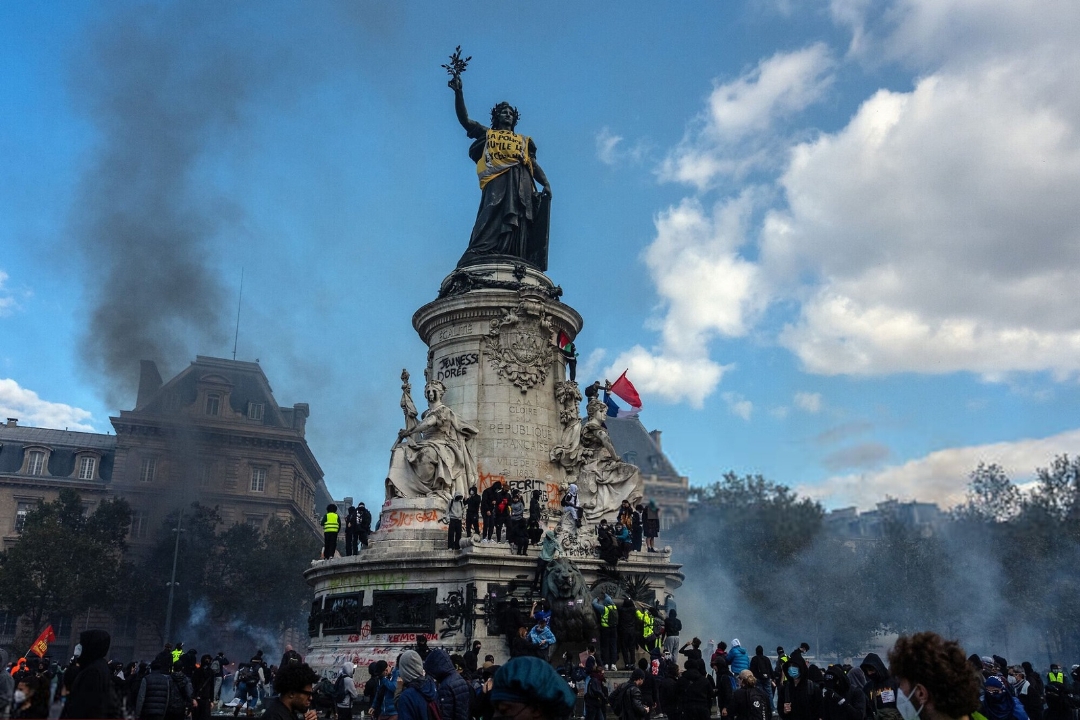
It’s an unusual demonstration for older Argentines who lived through the ’70s. A demonstration featuring Spider-Man costumes, marching bands, DJs, and a youth symphony orchestra called “The New World” that plays on the esplanade of Paris City Hall—everything from Star Wars music to the New World Symphony, from songs by Charles Aznavour to the March of Popular Unity. And a young crowd singing along and chanting at the top of their lungs: “The people united will never be defeated.” A demonstration in which young people march alongside the Yellow Vests, the CGT, and other unions, demanding the right to study under decent conditions and protesting the high cost of living.
Seen from the outside, it’s a chaotic demonstration. For those taking part, it’s hundreds of thousands of people marching through downtown Paris and cities large and small across France, singing, dancing, and chanting clever slogans against the government. For those watching on television, it’s ten seconds of people marching cheerfully, ten minutes of hooded individuals burning trash cans and looting and setting fire to businesses in front of desperate owners, and a few seconds of brutal police attacks targeting young people. On social media, meanwhile, videos are circulating of a police officer throwing a tear gas canister in the face of a 14-year-old boy and then arresting him for “assaulting law enforcement”; of those “law enforcement officers” charging head-on into the last groups of marchers under the pretext that “you must disperse—the demonstration is over,” or that there are “casseurs” (vandals and thieves) in their ranks. There are young people between the ages of 14 and 17 who have lost a hand or an eye due to the grenades used exclusively by the French police, as they are considered weapons of war. Since the start of the protests, nearly 10,000 people have been detained. Of those arrested (around 6,000 since the protests began), 85% were minors with no criminal record. So far, only 1,250 have been found guilty, most of them young adults who agreed to “summary trial,” which involves agreeing to go to trial immediately upon release from detention—leaving them no time to organize a defense with their attorneys. That is why attorneys advise against accepting this system.
In the beginning, there was anger
On September 18, teachers at the Saint-Exupéry high school in Créteil went on strike over poor working conditions. The students joined the strike, and the next day they resorted to the traditional tactic of high school students: blocking the school. On September 21, two members of parliament from La France Insoumise (LFI) visited the school and publicized the blockade on their social media accounts. This drew media attention, and from that day on, high school students in Greater Paris and throughout France began blocking middle and high schools.
The Secondary School Students’ Union called for participation on September 29 in a national day of mobilization by state employees— that includes teaching and non-teaching staff at all three levels. Student processions joined the union marches across the country. Police repression against the high school students was brutal, despite the protective barriers set up by parents and teachers. There were so many complaints that the General Inspectorate of the National Police was forced to intervene and open investigations against several police officers.
In response to this situation, on October 1, university student unions blocked 30 university campuses, calling for unity in the struggle with high school students. Violent incidents and clashes with the police continued. According to the Minister of the Interior, of the 3,700 high schools in France, 400 were blockaded and 560 were affected by “various actions.” To curb the mobilization, the Minister of Education requested that classes be held remotely so that the continuity of instruction would not be disrupted. Prime Minister Lecornu called for an end to the protests, promising to address building issues with the help of regional councils, fill vacant teaching positions, and improve Parcoursup[1], one of the main grievances of high school students. In return, he demanded that the strike be called off and classes resume.
A national protest was held on Tuesday, October 6, organized by high school and college student unions. Even elite high schools—which had never participated in student protests before—joined in. Their slogan was: “We are privileged. We want to share our budget with other students.” The Federation of Parent-Teacher Associations, the National Education Inter-Union, and other labor organizations and farmers’ unions joined the march to protect the young people from the police, raising their own demand: the high cost of living. Political figures such as Jean-Luc Mélenchon (LFI), Marine Tondelier (Greens), and Bally Bagayoko—the LFI mayor of Saint-Denis who played a major role in defending students in his municipality against the police—also participated. Notably absent were the leaders of the Socialist Party—despite their support for the students’ actions—as well as the centrist, right-wing, and far-right parties, which, on the contrary, focused on attacking the movement and calling for police repression. According to the organizers, 450,000 people participated nationwide. In Paris alone, there were 100,000. In light of this success, teachers and students called for another day of strikes and mobilization two days later—and another on October 13.
The government, desperately promised to fill 3,000 of the vacant teaching positions. The CGT responded that it was a drop in the bucket. High school student unions demanded the cancellation of Parcoursup and a 10,000 million euro plan to improve schools. According to organizers, on October 13, 480,000 people participated in the march across the country. The Yellow Vests, who had disappeared from the scene, called for a march on October 17. The students decided to continue the blockades and join the mobilization on the 17th.
October 17
This mobilization brought the crisis in society to a head. The student movement served as the catalyst for the social anger that has long been simmering in the country. The ten years of Macronist rule are coming to an end with catastrophic results for workers and French society. The promise of “trickle-down” benefits—supposedly the result of more and more concessions to big finance—failed spectacularly. France’s public debt rose from 98.80% of GDP in 2017 to 119.10% in the second quarter of this year. However, public services have never been worse. Food prices are sky-high. And wages have been frozen for years. Added to this is the rise in fuel prices. But the straw that broke the camel’s back was the start of discussions on the new budget for 2026/2027. The proposals regarding state workers’ wages—which are insufficient and will not increase—and the freeze on pensions have put society on edge. This combination of factors led, on October 17, to a convergence of grievances among workers and the “yellow vests” (marginalized and far more exploited workers from the country’s interior), who realized they are paying off the debt from a party to which they were not invited, and those of high school and college students, who see that the “necessary cuts” “demanded by the markets” are stealing their future.
Believing that the movement was already over because school vacation began on Friday the 16th, the police had prepared for a small demonstration. However, both the organizers and the Ministry of the Interior agree that there were 110,000 protesters in Paris. And according to the organizers, more than half a million nationwide. Police in all major cities were overwhelmed by the protesters.
And here we see the first sign that a social change is taking place. The bulk of the demonstrators was similar to that seen in traditional union marches. Students and workers marched peacefully, flanked by union security personnel. That uneventful march was given a few minutes of airtime on state television.
Meanwhile, the chaotic marches—playing cat and mouse with the police or clashing with them on the Champs-Élysées—were given many more minutes of coverage. But the “vandal of the day” award went to three other groups—some already well-known and others new—that converged on the fringes of the demonstration, taking advantage of a police miscalculation that left entire sections around the march uncontrolled. On the one hand, there were the black blocs, or autonomists, who had been around for some time. In the demonstrations a few years ago, they marched at the front of the procession and were easily identifiable by the police. Their “ideological” goal is to “lead by example” and “attack institutions.” They are the ones who destroy McDonald’s restaurants, smash store windows, throw Molotov cocktails at the police, and flee. Their goal is not to steal but to destroy. Behind them appeared the experienced thieves, acting with complete freedom due to the police’s miscalculation. These groups, who are also accustomed to confronting the police, are the ones who organized the looting. It was crystal clear to see how, amid the chaos, a group dressed just like the Black Blocs entered stores, gathered up packages of merchandise, and threw them outside, where they were grabbed by others who were waiting for them and ran off. And the third group consists of the “ni-ni” youth (neither working nor studying) from working-class neighborhoods—those who have fallen through the cracks of a bankrupt welfare system, for whom the only future is selling drugs or being unemployed for life. They—who will never have the chance to own a Louis Vuitton bag or a pair of luxury sneakers—took the opportunity to attack a society to which they will never have access. That’s why they proudly filmed themselves grabbing whatever they could while streaming it on TikTok, or sold what they’d stolen on eBay or Vintage. Most of those arrested were among them. In France, there are no statistics broken down by race, but when you look at the lists of those arrested and convicted, 75% have Arab or African names. This overrepresentation of that group is further confirmation of structural racism within the police force and a state system that is organized against them.
The protests that you consider to be over are going strong
Against all expectations, labor unions and the Yellow Vests called for “Act II” of the protests against the high cost of living on Saturday, October 24. The government attempted to ban the demonstrations and impose a curfew. The Administrative Court blocked these measures.
Since high school and college students were in the middle of their vacation, the Prime Minister attempted to block access to social media to prevent them from organizing on their own. The uproar that erupted as soon as the measure was announced forced Lecornu to back down. Student protests multiplied across the country.
The Ministry of the Interior did everything in its power to suppress the protest. First, it changed the march route: instead of the usual route from Place de la Bastille to Place de la Nation, it imposed a march along Boulevard des Maréchaux, a boulevard that circles Paris on the inner side of the Ring Road. Then, it increased the number of officers “monitoring” the demonstrations. In other cities, demonstrations were banned—though they took place anyway.
According to the CGT, on October 24 there were 150,000 participants in Paris and 800,000 nationwide. The media broadcast the demonstration almost live. While the demonstration in Paris took place in complete calm, there were scenes of looting and clashes with the police as the crowd dispersed. Obviously, those were the scenes that state television made sure to highlight.
The same thing happened again on October 31. Once again, the march route was changed at the last minute, diverting it yet again from the route requested by the labor and student unions to Bulevar de los Mariscales. Once again, people turned out in large numbers. Given that it was Halloween, the students showed up in costumes, dancing and singing to the tunes of bands featuring Ninja Turtles or Marvel characters. However, the mood had shifted. Between the two demonstrations, the racist attack in Trappes—an iconic city of immigration—took place. In that attack, a racist fascist opened fire on seven men, women, and even a young girl simply because they were Black and Arab—that is, “Muslims”—although the young Black man who was killed turned out to be Catholic. While young people have always marched with anti-fascist chants, this time they were joined by anti-racist slogans and chants condemning the attack. At 4:30 p.m., when the front of the march reached its destination at Place de la République, hundreds of people were still crowding into the cars of Line 3 (the only means of transportation to the starting point of the march) in order to join the procession. As night fell, the dispersal point for the demonstration turned into a trap for protesters, who were met with police tear gas upon arrival. Amid the chaos, a Molotov cocktail thrown from the demonstration landed on a group of police officers, striking one of them. The government initiated legal proceedings on charges of attempted murder.
The struggle continues
On Monday, November 2, classes resumed. Forty schools were blockaded. The following day, according to high school unions, 440 schools were blockaded, and the UNEF, the university students’ union, joined forces with the high school students to organize a new march, which was suppressed because the students refused to follow the route designated by the prefecture.
Today, November 5, the CGT, CFDT, SUD, and FO are calling for a general strike accompanied by a demonstration. The National Council of the Yellow Vests, which is also participating, has called for the general strike to continue on November 6 and 7, with a large demonstration scheduled for Saturday, November 7. The CGT proposed a route from the Bastille to the Place de la Concorde and urged the Paris Prefecture to respond. In the words of its general secretary, Sophie Binet, “They cannot continue to render us invisible.” This morning, hours before the demonstration, the Administrative Court ruled that the march must follow the new route proposed by the Paris Prefecture: Place de la République to Place de la Nation.
Meanwhile, the Socialist Party (PS), the centrist parties, and the “respectable” right-wing parties have disappeared. Rafael Glucskman, the candidate elected in the Socialist primaries, says he supports the high school students’ demands but is not participating in the protests because he is “afraid” of being pushed out, as has happened before—although he promised to participate in the march on the 5th. The Macronist and Republican (LR) candidates are not only refusing to participate but are also complaining about the students’ violence and calling for classes to resume.
The two political factions benefiting from this mobilization are, on the one hand, the RN—Marine Le Pen’s party—which is vehemently opposed to it and accuses the government of “lukewarmness”and “permissiveness” and praises the police for beating protesters, thereby winning over disillusioned voters on the right and in the center. On the other hand, there is LFI, which the government blames for the protests and which participates in all of them with its leader and presidential candidate Jean-Luc Mélenchon, always marching at the front of the procession alongside student leaders who cheer him on and union leaders who look at him “affectionately.” The LFI is becoming the party of young people in urban centers and working-class neighborhoods. Like any “sincere” reformist, it calls on people to wait until April and go out to vote so that Mélenchon can reach the runoff and defeat Le Pen. For now, the polls show him trailing far behind Le Pen, who, according to the latest polls, leads him by 68% in the runoff.
We are witnessing a profound crisis within the French government and regime six months before the presidential election, with a government incapable of offering any solutions. Not only have its proposals been rejected, but the National Assembly also rejected its budget proposal, which has now been sent to the Senate. If the deadlock in both chambers continues, the government will have to pass the budget by decree, risking the fall of the executive branch due to a vote of no confidence by the National Assembly. There are already factions within Macron’s party telling him it will be impossible to make it to the April elections amid this chaos, and they are asking him to resign and call for early elections. For now, he is refusing.
If today’s general strike turns into an indefinite strike, as the Yellow Vests are demanding, it could trigger a deep national crisis. The French bourgeoisie is terrified at the thought of a repeat of the chaotic Christmas and New Year’s holidays of 2022, during the struggle against pension reform, which ended with the burial of Macron’s reform.
The European bourgeoisie is also on edge. The revolt of Generation Z, which has already made itself felt in Asia—through uprisings in Nepal, Bangladesh, Indonesia, and India, including the “cockroaches” movement—and in other parts of the Third World, has reached Europe. The demands stemming from the failure of the neoliberal model—caused by the breakdown of the social contract: “if you study and work hard, you’ll get a good job” —manifest as different issues in each country. In Spain and Portugal, the issues center on housing. In Germany, it’s opposition to military service and cuts to the education budget in favor of the military. In France and Italy, it is the lack of adequate conditions for studying and the high cost of living. And in Hungary and Serbia—which led the way—youth mobilizations against censorship, the curtailment of rights, the dismantling of public education, and government corruption led to the fall of the governments.
If we add to that Trump’s catastrophic defeat in the midterm elections—in which minorities and young people played a crucial role—perhaps we can say, for the first time after so many years of failure, that a small glimmer of hope is beginning to emerge. And now I’ll leave you because I have to go to the rally.
[1] Parcoursup is the official national platform in France for pre-enrollment in the first year of higher education. Its operations lack transparency.