Martin Suchanek
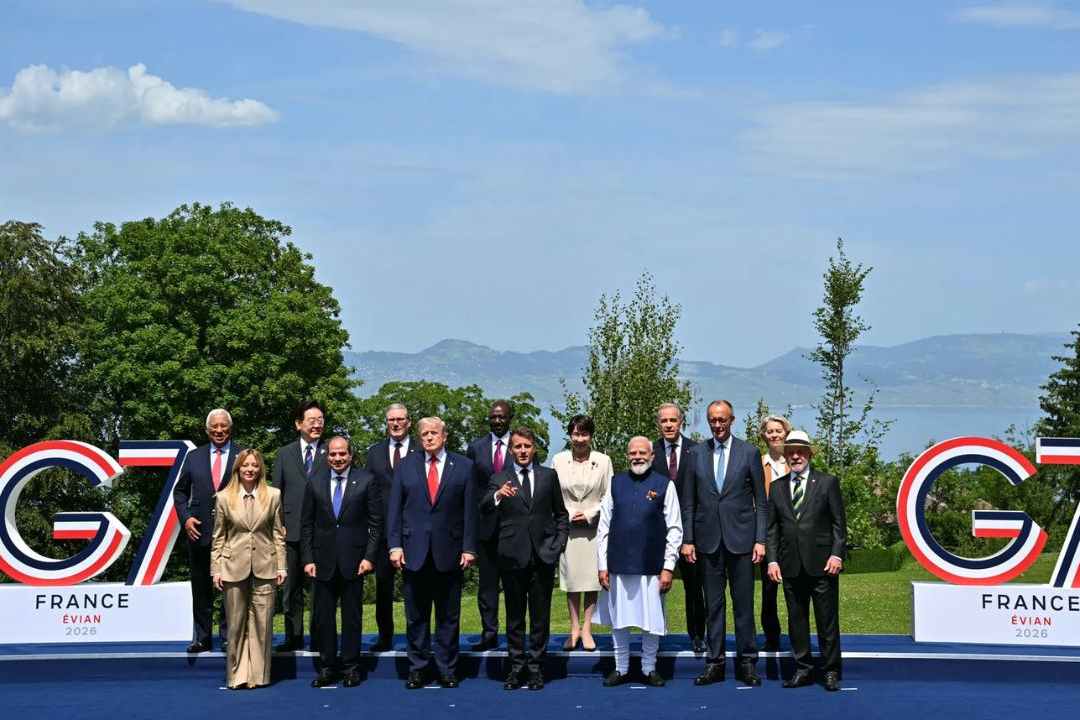
At last, there was a sense of optimism at the G7 Summit once again. Only one year ago, the meeting ended in a public row, with Donald Trump leaving early with no final declaration agreed upon by all parties.
By comparison, the summit in Evian, France, is being billed as a real success. Trump was feted from start to finish, stayed for the duration and is also and went on to a sort of ’bling’ banquet at the Palace of Versailles. Moreover: there was also a joint statement on geopolitical issues – a final declaration all seven could agree too. Even more pleasing to his hosts Trump announced he was signing a Joint Memorandum of Understanding (MOU) with Iran, including a 60 day ceasefire and the opening of the Strait of Hormuz.
No wonder, then, that Western heads of state and government are falling over themselves to heap praise upon the president. According to German Chancellor Merz, Trump had been “very cooperative” and the world’s leaders are finally pulling in the same direction again in global politics. France’s President Macron even claimed the summit as a “moment of strategic awakening”. Cooler heads have warned that the MOU could well be a memorandum of mis-understanding and Israel has made it clear that when it comes to the bombing of Beirut, the occupation and ethnic cleansing of southern Lebanon meant to be part of the peace deal there is no deal.
Ukraine
However, looking at the final declaration and the unity on display, it might seem that on one issue there is an achievement for the European powers – a joint statement on Ukraine. The country will continue to be supplied with weapons, including sales of US anti-missile and anti-drone systems plus financial and diplomatic support. Trump pointed out that he had spoken to Putin on the phone and that the latter had held out the prospect of peace negotiations, he nevertheless suggested there could be further sanctions against Russia, including those on oil and gas.
The aim of these measures remains to force Russia to the negotiating table. To this end, the latter must refrain from any further territorial gains, according to Friedrich Merz. At the same time, of course, neither Trump nor the European imperialist powers are concerned with self-determination for Ukraine, but rather with being able to appropriate the country’s resources in future, including access to its now advanced armaments industry. Whether formally a member of Nato or not Ukraine‘s battle-hardened armed forces would be a valuable future ally for the European imperialists.
Whether this constitutes a lasting change of course on the part of the US is, however, questionable. Rather, the Trump administration appears to have concluded that its previous policy of reaching peace in collaboration with Russia has led nowhere. Putin has, in fact, exploited this shift in US imperialist policy under Trump to launch further offensives in Ukraine, rather than to engage in substantive negotiations. Ultimately, the US still wants a deal with the Putin regime, but this also involves increasing the pressure to force a ceasefire which, whilst effectively recognising Russia’s territorial gains, would also strengthen Ukraine’s ties with the West (although it remains to be seen to what extent it is the European powers or the US that will determine these ties).
The Middle East
However, it would also be too simplistic to interpret the rapprochement over Ukraine solely in terms of relations between Ukraine, Russia and Western Europe. Rather, the situation in the Middle East is the real reason driving Trump and the US to put their conflicts with the other G7 states on the back burner at the summit.
As is well known, Trump initially presented himself to the outside world as a ‘peacemaker’ in the Middle East. Yet it was the US and Israel which jointly instigated the war against Iran. At the start of the war, Trump had arrogantly claimed, after Israel successfully assassinated the top Iranian leadership, that his object was regime change in the country, urging the population to rise up. When the ‘change’ turned out to be a younger an even more hardline leadership, Trump had to scale back his war aims and the shutting of the Strait of Hormuz soon had him on the ropes, offering a deal if anything weaker that the one struck with Obama which he reneged on during his first administration.
Now he is presenting the MOU as a ‘breakthrough’ and a tremendous opportunity for the entire region. The G7 statement fawningly reads:
“We welcome the announcement of a deal between the United States and Iran, secured
under the strong leadership of President Trump, with the support of mediating countries, which provides an historic opportunity to prevent Iran from acquiring any nuclear weapon and tackling the threats related to its regional and ballistic activities. We support and are ready to contribute to its implementation.“
The reality, however, is that the US did not win the war; it lost it. It failed to achieve its key war aims and simply dropped some of them without a word.
We can only welcome the fact that the US has lost, for any weakening of US imperialism and its allies undermines their hegemony and shows that resistance against this barbaric war machine is not a lost cause.
Added to this is the fact that the war, which was actually intended to divert attention from problems within the US, has further weakened Trump domestically. This is another reason why his government needs peace and, if at all possible, diplomatic successes – or at the very least a fiction that can be sold as victory.
The US is now attempting to limit the damage, which also means ‘normalising’ relations with allied, albeit rival, powers in Western Europe for the immediate future. For their part, France, Germany, Britain, Italy and the EU are not in a position to escalate their differences with the US either. Consequently, the G7 summit unexpectedly allows the Western powers to be presented as a ‘united West’.
Divisions remain
The G7 states are, of course, well aware of how precarious the agreement with Iran is, an agreement rejected not only by the Israeli government but by the opposition too. Neither Netanyahu nor his fascist ministers, nor his opposition, want anything to do with recognising the territorial integrity of Lebanon, which is proclaimed as an objective in the G7 declaration and which Iran insisted should be part of the MOU. Thus, on 17 June, the Israeli Air Force once again carried out air strikes on southern Lebanon. The US and the G7 regard this as an obstacle both to an agreement with Iran and to a more comprehensive peace and reorganisation of the Middle East – yet at the same time, the US is reluctant to put the Zionist attack dog on a leash. Consequently, doubts are already hanging over the agreement even before it has been signed.
Yet this must not blind anyone to the fact that the Trump administration’s doctrine is by no means geared towards a revival of the G7 and restoring the ‘partnership’ with the EU powers. For the US, a central geostrategic objective lies precisely in asserting its unilateral leadership status over the “Western hemisphere” – no ifs and no buts.
Thus because the EU, for all its internal contradictions, is the most important and effective instrument of the strongest European powers for countering that dominance in that part of the world, it is logical that the US regards it as a potentially hostile force rather than a reliable ally. All the Western heads of state and government are, of course, well aware of this. Hence the campaign for large scale rearmament, floating the possibility of a return to compulsory military service, exaggerating the threat Russia poses to Europe. It is therefore only a matter of time before the US-European tensions openly resurface again.
For all these reasons the love in and self-adulation at the summit Evian was little more than diplomatic hypocrisy. And it is vital that the workers movement of Europe and the United States break from the ‘camps’ of their own imperialisms without any illusion that Putin’s or Xi Jinping’s’ multipolar world is an advance for the workers and oppressed people of the world.