Dave Stockton
Trump’s ‘ceasefire’ was undermined before the ink was dry. Israel’s assault on Lebanon, the collapse of the Islamabad talks and Trump’s blockade threat have brought the region back to the brink.
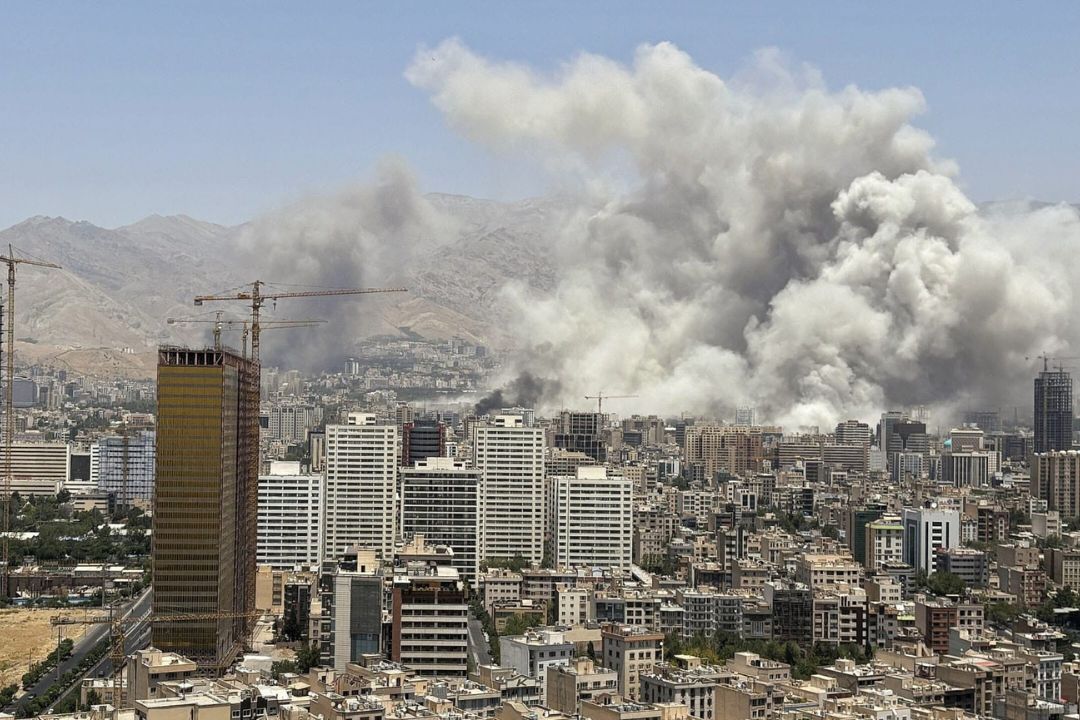
Only hours after claiming “a whole civilisation will die tonight… never to be reborn” and promising to bomb Iran “back to the Stone Ages,” Trump posted on Truth Social on 8 April that he would “suspend the bombing and attack of Iran for a period of two weeks” and that an agreement had been reached to open the Strait of Hormuz.
Media reports claim the ceasefire was brokered by Pakistan, following a last-minute appeal by China to Iran to agree. What the exact terms of the 10-point agreement are remains far from clear — there is no single agreed version, and as we will see, the gap between the versions matters enormously.
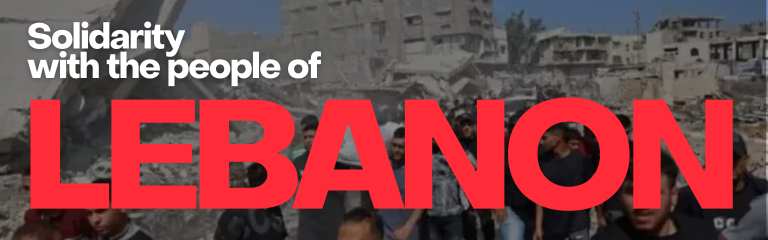
Within 24 hours of Trump’s announcement, Israel launched air strikes without warning on civilian apartment blocks in Beirut and other Lebanese cities. Lebanon’s Civil Defence reported at least 254 people dead and 1,165 wounded. Iran claimed the ceasefire covered Lebanon; Israel and Trump flatly denied it. Meanwhile, Trump, Vance and Hegseth were competing to claim a “historic and overwhelming victory.” These rival accounts cannot be reconciled. What they do reveal is the real balance of forces that has emerged from 40 days of war.
Israel’s role: saboteur by design
Israel’s assault on Lebanon was not simply a refusal to comply with a ceasefire it claimed did not apply to it. It was a deliberate attempt to destroy the entire US-Iran deal. Had Israel’s aim been merely to continue the war in Lebanon and consolidate its occupation of the south, it could have held off bombing temporarily — as Vance himself suggested — and resumed once the situation had stabilised. Instead it launched its most murderous single attack of the entire war: over 100 strikes in under ten minutes, killing more than 250 people and injuring over a thousand.
There is a strategic logic to this. Israel’s offensives across Lebanon, Syria, the West Bank and Gaza are not separate operations but components of a single project: the territorial construction of Greater Israel. Consent for that project requires a hostile Iran that can be presented as an enemy not only to Israel, but also to US interests. The moment Tehran is received as a diplomatic equal to the US the justification for permanent war and occupation loses its foundation. A peace process does not merely pause Israel’s war aims; it directly contradicts them.
The same logic explains why Israel fought so hard to destroy Obama’s 2015 nuclear deal. Iran under the JCPOA posed no credible military danger; it was meeting its enrichment commitments. The threat was economic and political: Washington was preparing to reintegrate Teheran into the global economy, and US capital was ready to follow. Netanyahu could not accept that. The drive to sabotage diplomacy with Iran is not an aberration, it is central to Israeli policy.
Iranian Foreign Minister Araghchi put the immediate dilemma: ‘The US must choose — ceasefire or continued war via Israel. It cannot have both’. Vance claimed the ceasefire ‘never included Lebanon’. Yet Pakistani Prime Minister Sharif had publicly stated that the US and Iran, ‘along with their allies, have agreed to an immediate ceasefire everywhere including Lebanon and elsewhere’. Someone was lying, and it was not Sharif.
Washington has placed Iran in an impossible position. It cannot accept the exclusion of Lebanon without abandoning a core ally and the terms it understood to have been agreed. But it cannot walk away from the ceasefire without handing Israel the renewed confrontation it is actively seeking. The resolution — US pressure on Israel to halt — is the one option Washington consistently refuses to take.
Israel has made clear there will be no let-up in its occupation of southern Lebanon and parts of Syria, where the Israeli offensive has killed at least 1,500 people and displaced 1.2 million. Under cover of the war, Zionist settler and IDF clearances of Palestinian farms and villages on the West Bank have been stepped up, as has the IDF’s partition and near-total blockade of Gaza. Israel will continue to sabotage any serious peace proposal, because its expansionist war aims in the immediate region remain its overriding objective.
The terms: contested and unresolved
Iran’s proposals, accepted by Trump as ‘a workable basis’, cover five areas: a regional ceasefire encompassing Lebanon, Yemen and Iraq; a navigation framework for the Strait of Hormuz; full sanctions relief and release of frozen assets; war reparations; and a commitment not to seek nuclear weapons. A second version Iran also circulated goes further, demanding outright sovereignty over the Strait, explicit recognition of enrichment rights, termination of all UNSC and IAEA resolutions, and full US military withdrawal from the region. None of that would Washington accept as a starting point, and both sides know it.
The nuclear question is the structural obstacle. Iran’s commitment not to seek a nuclear weapon has been its stated policy for two decades, and the claim that it was secretly building one was always a political construction, not a finding of international inspectors. Iran had already agreed in negotiations in 2025 and early 2026 to cap enrichment at civilian levels under IAEA oversight — and was bombed before any deal could be finalised on both occasions. The US demand for zero enrichment has no basis in the NPT (Non-Proliferation of Nuclear Weapons Pact)and is imposed on no other non-weapons state. This is the language of surrender, not negotiation.
The limits of US power
The competing victory claims reflect the real balance of forces that has emerged from six weeks of war. Iran’s closure of the Strait of Hormuz — through which a fifth of the world’s oil passes — was the decisive factor. What had long been threatened was now demonstrated: Iran could control access selectively, maintain its own export revenues, and impose cascading economic costs on US allies across the Gulf, Europe and East Asia. For Washington, losing effective control of the world’s most critical energy chokepoint — whatever Trump’s claims about US energy self-sufficiency — was clearly strategically unsustainable.
Beyond the Strait, the war has confirmed what Afghanistan and Iraq already showed: US military preponderance increasingly cannot translate into political outcomes. Despite overwhelming air power deployed against a country with no effective air defences, despite full naval deployment in the region, Washington has not committed ground forces, has not forced the Strait open, and has not achieved neither regime change nor unconditional surrender. The post-Cold War ‘unipolar moment’ continues its slow-motion collapse.
The war has simultaneously damaged what remains of US soft power — its claimed role as coordinator of the global economy and guarantor of international law. Trump’s conduct throughout the conflict, including the public rupture with NATO allies (first dismissed as militarily useless, then accused of betrayal), has left the architecture of US-led order more visibly strained than at any point in decades.
Islamabad: the talks that failed
The Islamabad talks, held on 11–12 April, were the first direct engagement between the US and Iran since the 2015 nuclear deal. After 21 hours of negotiations, Vance announced no agreement had been reached. Iran’s delegation leader Ghalibaf said the US had been unable ‘to gain the trust of the Iranian delegation’ — a pointed reference to a pattern of agreements reached and then destroyed. The sticking points were enrichment and the Strait. On both, neither side moved.
Trump’s immediate response was to announce a US Navy blockade of the Strait of Hormuz — threatening to interdict all ships entering or leaving, destroy Iran’s sea mines, and ‘finish up the little that is left of Iran’. This is an act of economic warfare directed not only against Iran but against every state dependent on Gulf energy supplies. It carries a real risk of uncontrollable escalation. US intelligence suggests China is preparing to supply Iran with new air defence systems; Trump has threatened Beijing with severe consequences if it does.
The ceasefire nominally holds until 22 April. Pakistan has pledged to continue mediating. The situation is still open — renewed war, extended stalemate, or resumed negotiations on modified terms are all possible.
The fact that the US was forced at least temporarily to the negotiations table, was a retreat and a political defeat of the Trump administration, aiming to avoid potentially even worse effects on the global economy, US hegemony in the region and the political weakening of his presidency at home. But, given the adventurist nature of Trumps Bonapartism, one cannot rule out a further massive escalation and a resuming of the imperialist and Zionist attacks on Iran. In this case, Iran has every right to defend itself as throughout the war. The working class and all oppressed need to fight for the defeat of the US and Zionist attacks, just as they continued to defend Lebanon against Israeli aggression and occupation. They must do so without giving any political support to the regime in Teheran or to Hezbollah.
What we demand
The mass movements — the millions who took to the streets in the US ‘No Kings’ protests, the global solidarity with Palestine, the anti-war movements across Europe, Latin America and Asia — must intensify the pressure to stop this war by the US and Zionism. The Islamabad failure and the blockade threat make that more urgent, not less.
In Europe, workers’ action must target sea and airports to block economic and military supplies to Israel. Trade unions and socialist parties must mobilise — on the model of the May Day strike in the US — against both Trump’s racism and his warmongering. Initiatives like the new Global Sumud Flotilla, aiming to refocus attention on Israel’s crimes in Gaza, must be supported and publicised.
Liberation will never come from one of the world’s most brutal imperialisms, from an administration that opened this war with genocidal threats and is closing it with a naval blockade. It will come from the organised resistance of workers and the oppressed — in Iran, Palestine, Lebanon, and everywhere else the consequences of this conflict are felt.
We fight for:
• Immediate and permanent ceasefire across Iran, Lebanon, Gaza and Yemen
• Full lifting of all sanctions on Iran; immediate release of frozen assets
• No to the US naval blockade — an act of aggression against the global working class
• Defend Lebanon against the Zionist attack, defend Iran against any renewed US and Zionist aggression!
• End the genocide in Gaza; end the Israeli occupation of Lebanon, Syria and the West Bank
• Withdrawal of all US and Israeli forces from the region
• Break up NATO, AUKUS and all imperialist military alliances; close their bases
• Liberation for all the peoples of the Middle East — including Iran — from their oppressive regimes.