By Umair Khurshid (JKNSF)
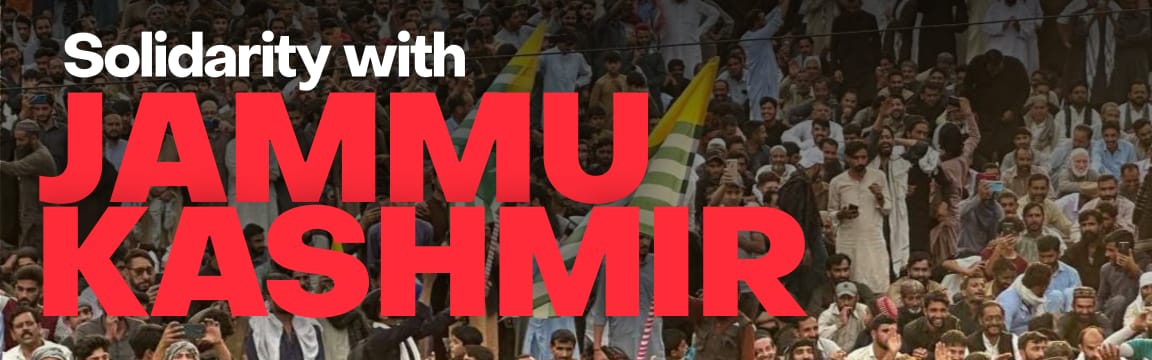
As these words are being written, the people of Pakistani-administered Jammu Kashmir (PAJK) remain in the streets after almost 10 days of blackout, siege, and state violence. Since around 11:35-11:45 pm on the night of 5 June, the entire region has been cut off from the world. Internet access has been shut down, mobile networks have been blocked or badly disrupted, towns have been militarized, and whole areas have been pushed into near silence while paramilitary troops and police carry out raids, arrests, shelling, and firing.
This blackout is meant to cut people off from one another, stop the wounded and the bereaved from reaching the outside world, hide the scale of state violence, and give the state and its media time to shape the story before the people can speak for themselves. Around two dozen people have been martyred, and more than 200 people have reportedly been injured so far, though the actual figure may be higher because the blackout and curbs on access have made independent verification nearly impossible. Homes of activists, workers, and Joint Awami Action Committee (JAAC) leaders have been raided. Protesters have been attacked with tear gas, batons, shelling, and live fire.
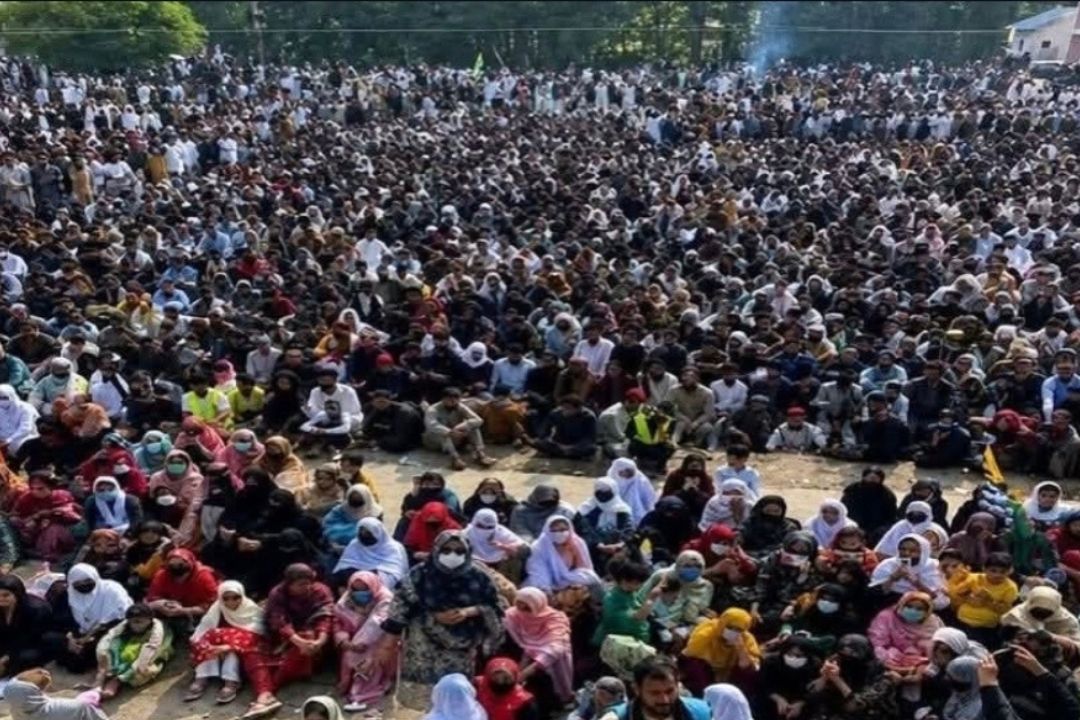
Yet the movement has not been broken. Sit-ins continue, people are still coming out in large numbers, and the state has failed to force the masses back into silence. In fact, there are now reports that the government has been pushed onto the back foot and is trying to open negotiations. As communication remains cut and access to reliable information is still blocked, the exact nature of these talks cannot be stated with certainty. It would be wrong to declare a complete victory while the siege continues and people remain under threat, but it is already a significant achievement of the movement that, after days of open firing, the state has been forced to look again toward negotiation.
What is unfolding today is neither a sudden riot nor a narrow dispute over one clause. It is the latest and sharpest stage of a mass movement that has grown through years of anger, organizing, betrayal, repression, partial victories, broken promises, and renewed struggle. The present uprising cannot be understood without going back to the road that led here: the early campaigns against electricity bills and wheat prices, the long march of 2024, the unfinished gains that followed, the renewed confrontation of 2025, and the return of the same unresolved demands in 2026.
The immediate roots of the movement lie in the economic crisis that followed the COVID period. Across Jammu Kashmir, people faced rapidly increasing electricity prices, fuel costs, food hikes, and worsening living conditions. While workers, students, unemployed youth, and lower middle-class households struggled to make ends meet, the political elite continued to enjoy privileges that appeared increasingly detached from the realities of everyday life.
Yet economic hardship alone does not automatically produce a mass movement. Those issues acted as catalysts, but the political conditions had been developing for years.
The events surrounding India’s revocation of Article 370 in August 2019 had a profound impact across Jammu Kashmir. While the immediate constitutional changes occurred on the Indian administered side, the political shockwaves were felt throughout the region. The event renewed discussions about sovereignty, representation, self-determination, and the future of Jammu Kashmir as a whole. It also exposed the limitations of the dominant political forces operating in Pakistan-administered Jammu Kashmir, many of which appeared incapable of offering any meaningful political response.
In response, various left-wing, nationalist, and progressive forces attempted to build broader coalitions. One such effort was the People’s National Alliance (PNA), which sought to bring together different strands of political opposition. Although these initiatives generated enthusiasm and, at times, substantial public support, they struggled to develop a coherent political program capable of connecting broader constitutional questions with the everyday economic concerns of ordinary people. As a result, they failed to establish themselves as durable mass organizations.
At the same time, worsening economic conditions, inflation, rising utility costs, and declining living standards steadily expanded social discontent. By the early 2020s, political frustration and economic grievances had begun to converge, creating conditions for a movement with a broader social base than previous campaigns.
The earliest protests against high electricity bills and wheat prices were spearheaded by left-wing and nationalist organizations, student groups, and trade unionists. Among these, the Jammu Kashmir National Students Federation (JKNSF) played an active role in mobilizing students and other sections of the youth, participating in demonstrations, organizing discussions, and linking immediate economic grievances to broader questions concerning democratic rights, political representation, and control over local resources.
Local protests over electricity prices and wheat costs began appearing across different areas during 2022 and 2023. These protests often involved symbolic burning of electricity bills, non-payment campaigns, sit-ins, shutter-down strikes, and local demonstrations. What initially appeared as isolated protests gradually developed into a broader movement that connected communities across the region.
One of the important early centers of agitation emerged around Rawalakot, where protests over wheat prices helped demonstrate the potential for sustained mass action. As these campaigns spread, activists increasingly recognized the need for a common platform capable of coordinating activity across Jammu Kashmir. This process ultimately led to the formation of the JAAC in September 2023.
The contradictory strength of the movement
The formation of JAAC represented a major achievement. For the first time in many years, a movement succeeded in bringing together social layers such as workers, students, transport unions, traders, nationalist organizations, and left-wing activists.
Commercial electricity rates hit traders particularly hard. Small business owners, shopkeepers, transporters, and other middle strata had immediate economic reasons to support the movement. They also often overlap socially and politically with nationalist and progressive currents. This broad composition gave the movement enormous strength. Yet it also introduced contradictions that would become more visible as the struggle developed.
With the industrial proletariat virtually non-existent in the region, as traders and transporters entered the movement in larger numbers, they acquired growing influence within its leadership. This was not merely a matter of numbers. In these peculiar conditions, their organizations possessed practical leverage as traders could shut markets, and transport unions could halt movement. Together, they possessed the ability to enforce shutter-down strikes and wheel-jam actions across entire districts.
This growing influence gradually shifted the center of gravity within the movement. Many of the forces that had helped initiate the struggle came from left-wing, nationalist, student, and progressive political traditions. Yet the expanding leadership increasingly adopted the language of being “non-political.” While the movement continued raising political demands, it avoided developing a broader political program capable of explaining how those demands would be secured and sustained.
This remains one of the movement’s key limitations. It did not develop a comprehensive political and economic program. This gap became increasingly visible as the movement grew stronger. At the same time, it would be a mistake to dismiss the movement because of this weakness. The absence of a program did not prevent it from becoming the most significant popular mobilization in Jammu Kashmir for decades, but it does explain why many of the same questions continue to return.
The first great turning point arrived in May 2024. After months of organizing, protests, strikes, negotiations, bill boycotts, and growing confrontation with the authorities, the movement announced a long march toward Muzaffarabad, the capital of Pakistan-administered Jammu Kashmir.
The state responded with arrests, intimidation, road blockades, and the deployment of additional forces. Movement leaders and activists were detained, while a sustained propaganda campaign sought to portray the movement as illegitimate, foreign-funded, and dangerous. Yet every effort to halt the march appeared only to strengthen public support for it.
As the caravans advanced, they were welcomed by communities throughout the region. Entire villages and towns mobilized around the movement. People lined the roads to greet the marchers, provided food and water, opened their homes, and offered shelter to participants. What had begun as a campaign against electricity bills and wheat prices had developed into a genuine mass movement capable of paralyzing the state across large parts of Jammu Kashmir.
The government attempted to stop the march through force. Clashes broke out in several areas as protesters confronted roadblocks and security forces. During the confrontation, 3 protesters were killed and more than 100 people were injured, exposing the willingness of the state to use violence against a movement whose demands centered on basic democratic and economic rights.
The authorities eventually found themselves facing a dilemma. Stopping the march entirely risked provoking an even larger confrontation, while allowing it to continue risked exposing the weakness of the government itself. As the movement continued to grow and thousands advanced toward Muzaffarabad, the state’s room for maneuver steadily narrowed.
Faced with mounting pressure, government in Islamabad announced a package worth Rs 23 billion, while the government of Jammu Kashmir announced major concessions. The movement succeeded in forcing significant reductions in electricity tariffs and wheat prices, while additional commitments were made concerning elite privileges and other demands.
For the first time in many years, ordinary people saw a government retreat under pressure from a mass movement. The victory was real, but it was not complete.
The return of the movement in 2025
The victory of 2024 changed the political mood across Jammu Kashmir. For the first time in decades, a mass movement had forced the state to retreat. But as the months passed, it became clearer that the deeper questions raised by the movement had not been answered. The issue of elite privileges remained. The question of control over local resources remained. Democratic accountability remained little more than a slogan in the mouths of those who had no wish to be held accountable.
By late 2025, JAAC returned with a broader 38 point charter of demands. The movement had now moved beyond electricity and wheat alone. It raised demands concerning health, education, governance, employment, accountability, hydropower royalties, elite privileges, democratic reforms, and the abolition of the 12 reserved seats in the Pakistan-administered Jammu Kashmir Legislative Assembly for migrants residing in Pakistan. These seats are often used by the state to influence or manipulate politics and the process of government formation in Jammu Kashmir. This showed that the movement had grown through its own experience. The people had learned that high bills and wheat prices were not isolated hardships but part of a wider order built on extraction, patronage, and outside control.
The state understood at once that this was no longer only a dispute over subsidies. On 26 September 2025, nearly 13 hours of talks between JAAC, the AJK government, and federal representatives collapsed. The deadlock centered mainly on two demands: the abolition of elite privileges and the abolition of the 12 migrant seats. The government could bargain over subsidies, delays, committees, and administrative steps, but it refused to yield on demands that struck at the political frame through which the region is ruled.
As the announced shutdown approached, the authorities answered in the same way they would answer again in 2026. Mobile and internet services were suspended. Security forces were deployed. Entry and exit points were tightened. The state tried to break the movement’s ability to speak, gather, and move before the strike could take hold.
Yet the strike and long march went ahead. Demonstrations took place across Muzaffarabad, Rawalakot, Kotli, Mirpur, Bhimber, and other towns. Markets closed, transport was halted, and the movement again showed that it could bring the region to a standstill. The clashes that followed were bloody and 5 people were killed. Eventually, after days of confrontation, a new but relatively vague agreement was reached in early October, reflecting the limitations of the leadership. The government once again promised implementation, and the movement once again suspended its immediate actions. But the underlying dispute remained alive because the state had not dealt with the heart of the matter. It had once again bought time without settling the political questions standing at the center of the conflict.
Within months, it became clear that implementation was stalled, delayed, or only partly carried out. The lesson of 2025 was therefore sharper than the lesson of 2024. The state could be forced to retreat, but it would retreat only as far as it needed to save itself. On questions that touched elite privileges, political engineering, and control over Jammu Kashmir’s own future, it would resist until forced again.
Outside Jammu Kashmir, discussions concerning the demand to abolish 12 seats of migrants living in PAJK are often misunderstood. The word “migrant” immediately leads people to believe that the dispute is driven by hostility toward migrants or displaced people. Such interpretations completely miss the substance of the issue.
The demand is not directed against migrants but directed against an arrangement that has long been viewed as a mechanism of political engineering.
The people elected through these seats participate in making laws for a territory in which they do not reside. At the same time, the laws they help make do not apply to the places where they themselves live. Over decades, these seats have repeatedly functioned as a channel through which political outcomes within Jammu Kashmir can be shaped by forces outside the territory itself.
Even mainstream political parties have frequently criticized these seats while sitting in opposition, only to defend them when political circumstances change. The pattern through the years has been difficult to ignore. The party ruling in Islamabad always enjoy disproportionate success in these seats.
For many supporters of the movement, the issue is fundamentally democratic. It concerns political representation, accountability, and the right of people living within a territory to determine the composition of institutions governing that territory.
As socialists, we support the abolition of these seats not because we believe this demand will, by itself, solve every social and economic problem facing Jammu Kashmir. Under the present constitutional order, built through the 1974 framework and upheld through Pakistan’s control over the region, the local ruling class would still remain a ruling class, and exploitation would not disappear with one democratic reform. Yet this is no argument against the demand. Revolutionary socialists have always fought for democratic rights even when those rights fall short of the full transformation of society, because every democratic gain can widen the ground on which workers, students, women, peasants, and the poor are able to organize and fight.
The right to form trade unions does not abolish capitalism, nor does student unions, freedom of speech or the right to assemble. Yet each of these rights gives ordinary people more room to organize, speak, gather, resist, and fight those who rule over them. The same applies to the demand for abolishing the 12 seats. It will not end exploitation by itself, but it would remove at least one of the long-standing tools of outside political control and weaken a mechanism through which the political will of the people of Jammu Kashmir has been bent, managed, and overridden from outside. For us, this is a democratic demand that must be defended, not as an end in itself, but as part of the wider struggle for working-class power, control over resources, and genuine self-rule.
June 5 to June 15: The siege that failed to break the people
The current protest is the direct outcome of agreements left unimplemented and political questions left unresolved. Its immediate trigger was the continuing dispute over the 12 migrant seats, which had become the clearest symbol of what many people viewed as outside political control over Jammu Kashmir. Negotiations failed, and the courts upheld the constitutional protection of the seats. In response, JAAC announced a renewed call for a long march on 9 June. The question of whether the leadership should have adopted a different approach as the general elections approached, and whether the path of direct action is always appropriate, remains open to debate. In any case, the state responded with repression before the march had even begun.
Shortly before midnight on 5th June 2026, internet services were suspended across much of Jammu Kashmir. This was not an isolated administrative step. It was the opening move in a broader operation against the movement. In the days that followed, FC, Rangers, police, and other security forces were deployed across the region. Roads were blocked, activists were arrested, and the homes of JAAC leaders and workers were raided and ransacked.
The state believed that by cutting communication and isolating towns from one another it could prevent the movement from gaining momentum. Instead, the opposite happened. On the night of 6 June, state forces opened fire in Rawalakot. Among those martyred was Shahzaib Habib, an activist of JAAC. Rather than frightening people away from the struggle, his killing deepened public anger.
By 8th June, Rawalakot had become the centre of a major confrontation. Protesters attempting to continue the movement faced direct firing. Reports from the ground indicated 13 deaths and hundreds of injuries.
The following day, curfew was imposed in Rawalakot. Yet despite the killings and the curfew, protesters continued moving toward the city. The state had expected fear to stop the march. Instead, every act of repression appeared to bring more people into the struggle. Reports also emerged from Kotli and other areas of further firing, injuries, and around 4 more deaths.
What followed was perhaps the most remarkable development of the entire confrontation. Caravans continued advancing toward Rawalakot. Protesters crossed barriers, bypassed blockades, and reached areas that the authorities had hoped to isolate. The same city where the state had tried to crush the movement through bloodshed became a gathering point for even larger numbers of people. By the time the marches reached the outskirts of Rawalakot, it had become clear that repression had failed in its primary objective.
On 11th June, security forces again opened direct fire on protesters. At least 4 people were martyred. This incident further exposed the reality of the state’s strategy. Rather than addressing the demands of the movement, it was relying more and more openly on force to intimidate and disperse protesters. Once again, the killings failed to achieve their intended effect.
From 12th June onward, women began participating in much larger numbers, joining sit-ins, demonstrations, and public gatherings despite the ongoing repression. Earlier phases of the movement had been marked by informal restrictions and conservative pressures that limited women’s visibility and participation. The growing presence of women therefore became one of the most important political developments of the struggle. It reflected the strengthening of progressive tendencies within the movement and the weakening of efforts to keep women on the margins of public political life.
On 14th June, security forces attacked protesters once again. According to reports from the ground, at least 3 more people were martyred and 8 others injured when FC and Rangers opened fire while attempting to disperse peaceful demonstrators. By this point, the pattern had become unmistakable. The state was no longer relying only on arrests, roadblocks, raids, and blackouts. It was increasingly turning to direct violence in an attempt to break the movement.
By 16th June, the sit-ins and protests still continue despite everything that had taken place during the previous ten days. Unable to force the movement off the streets through bullets, arrests, raids, curfews, and communication blackouts, the state has started to deepen the siege further. Reports from the ground indicated restrictions on food supplies, medical supplies, and other essentials reaching protest areas. The state was attempting not only to suppress the movement but to exhaust it through isolation and deprivation.
JKNSF has been part of this struggle from the beginning. Long before the movement became a headline, JKNSF activists were involved in organizing students, supporting protests, linking economic grievances with democratic demands, and helping build the political atmosphere from which the movement emerged. Our comrades participated in demonstrations, strikes, sit-ins, discussions, and mobilizations through every phase of the struggle.
Unlike some sections of the left that dissolve themselves entirely into broader movements, JKNSF has sought to maintain an independent political position while remaining fully committed to the struggle itself. We support the movement. We defend it against state repression. We participate in it. At the same time, we also recognize its limitations.
The greatest weakness of JAAC has never been its demands. Most of its demands are democratic and legitimate. The problem is that demands are not the same as a program, and the movement has not yet developed a coherent political and economic program explaining how these wrongs can be permanently overcome.
Another major weakness has been its inability to draw organized sections of the working class more directly into the struggle. Health workers, electricity department employees, and other public sector workers were already protesting around their own demands. We understand that bringing government sector workers openly into a mass movement is not easy, especially under conditions of repression, intimidation, and the threat of victimization. But JAAC already had broad popular support. Had the demands of these workers been consciously linked with the wider democratic and economic demands of the movement, it could have pulled in an important section of workers whose position gives them real strategic power. Their participation would not only have broadened the social base of the struggle, but also strengthened its capacity to resist repression and move beyond protest toward organized mass pressure.
This criticism, however, must not be confused with opposition to the movement. On the contrary, we raise these questions precisely because we are part of the struggle and because we want it to advance. The movement has already shaken the existing order, exposed the brutality of the state, and shown that ordinary people can challenge forces that once appeared untouchable. Its courage, scale, and persistence deserve the full support of all progressive, democratic, and revolutionary forces throughout the world.
Our criticism is therefore not from outside the movement, but from within it. We defend JAAC and the wider people’s movement against state repression, propaganda, arrests, bans, bullets, and siege. At the same time, we believe that the movement can only move forward if it deepens its social base, links democratic demands with the struggles of workers, women, students, and the poor, and develops a program capable of turning mass anger into lasting political power. To support the movement seriously means to stand with it, defend it, participate in it, and also help strengthen it where it remains weak.
As these last lines are being written, the state is once again tightening the siege. Essential supplies are being restricted from reaching protest areas, while preparations are being made for another operation against the movement. This makes solidarity not a matter of distant sympathy, but an immediate political responsibility.
The key internationalist task at the moment is to stand in active solidarity with those facing repression, while also understanding the deeper political questions beneath the immediate confrontation. We call on trade unions, student organizations, progressive forces, academics, writers, journalists, socialist groups, and working-class organizations across Pakistan, South Asia, and the world to raise their voices in support of the people of Jammu Kashmir, demand an immediate end to the siege, and stand against the repression being carried out by the state.
The struggle in Jammu Kashmir is not simply about tariffs, subsidies, or assembly seats. It is about democratic rights, political representation, control over resources, and the right of ordinary people to shape their own future. Its success would not belong only to the people of Jammu Kashmir, it would strengthen every struggle against exploitation, repression, dispossession, and undemocratic rule in the region. Its defeat would also not be a defeat for Jammu Kashmir alone, it would strengthen the hand of every state and ruling class that believes popular movements can be crushed through force, siege, propaganda, and fear.
The ordinary people of Jammu and Kashmir have already shown that they can fight and force the state into retreat. The question now is whether the movement can transform these acts of resistance into lasting political gains. In this regard, international solidarity is both essential and urgently needed.