By Manuel Iraola, journalist and leader of the RS/ISL*
The situation has become increasingly confusing over the past two weeks, with contradictory statements and news reports, particularly when the COB (Bolivian Workers’ Confederation) and other sectors began to talk about negotiations. Faced with the uncertainty of the working class, peasants, and the popular sectors, the protests began to lose momentum. Even so, yesterday marked 50 days of the general strike and 45 days of roadblocks, although some are now more worn down and only partially active.
Rodrigo Paz’s government was effectively paralyzed throughout this period and failed to implement any decisive repressive measures. When they made an attempt in San Julián, a city of 45,000 inhabitants in the interior of Santa Cruz, the police were defeated and fled, at which point the peasants destroyed and burned down the police station. It is clear that, throughout the country, there is a parallel power structure on the avenues, highways, in factories, and within parts of the public services.
The policy of the traditional right and the far right is to demand that the government militarize the country, because the bourgeoisie concentrated in the Santa Cruz region—even with the support of paramilitary groups—has been unable to act decisively.
The bourgeoisie as a whole could not find a way out because the people’s main demand was the president’s resignation; therefore, the bourgeoisie feared that indiscriminate repression could trigger the outbreak of a civil war. In other words, the government does not do what it wants; it does what it can.
The COB, which—under pressure from its rank-and-file members—had been playing a leading role and representing the entire working class and its allies, began to back down and shift its focus. Massive assemblies, known as “Cabildos Abiertos,” voted to oust Rodrigo Paz and to refuse to negotiate with the government. The union federation refused to accept what left-wing sectors of thousands of grassroots activists were demanding: that the COB take over the government and seize political power in the country.
The peasants, especially those from Tupac Katari, signed a “Pact of No Betrayal” with the COB to see it through to the end. Today they are outraged because the union’s leadership broke the pact, which is why they are not participating in the negotiations. During the first attempt at negotiation, COB leaders were pelted with stones.
A segment of the population—including street vendors, artisans, and workers in urban transportation and retail—wants the situation to return to normal because without business, they cannot make a living.
The shortage of goods and supplies is something rarely seen; gas stations are facing lines that are literally kilometers long, there is a shortage of meat, vegetables, and medicine, and even restaurant menus have been scaled back; many businesses are closed, and prices have doubled or tripled.
We also know that leaders from various sectors began negotiating separately, thereby weakening the overall struggle—including the leaders of the major state-owned mines in Colquiri and Huanuni, which have been at the vanguard of the working class since the 1950s.
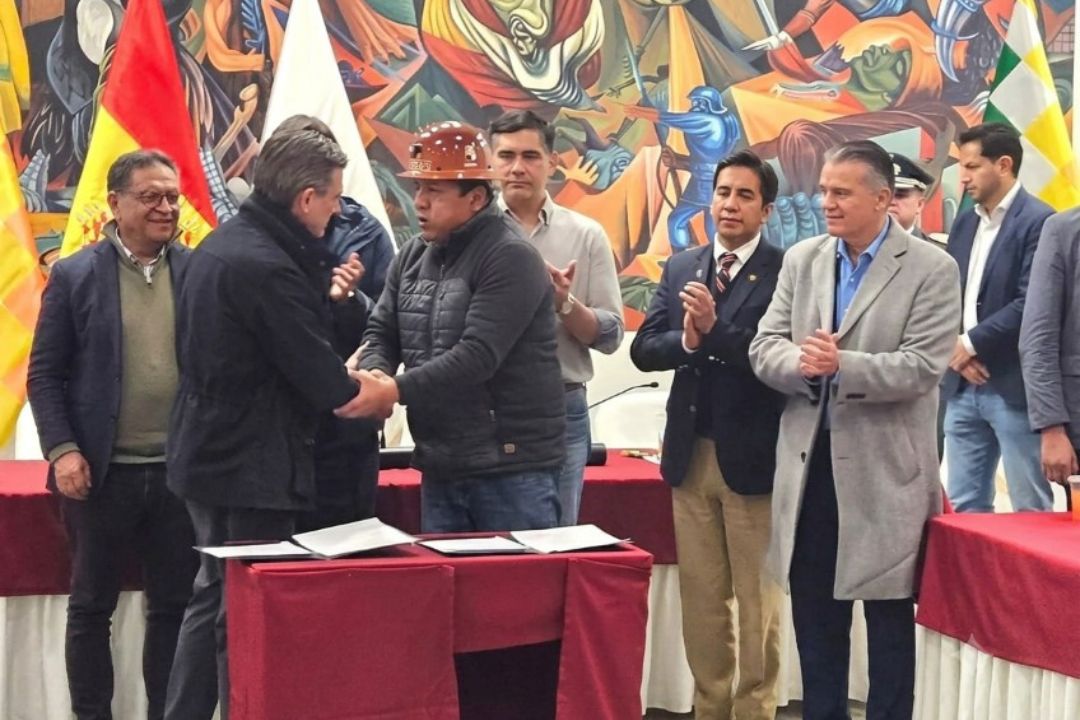
On the 18th, after much back-and-forth, negotiations began between the government and the strikers. According to press reports, about a hundred leaders from the COB, FEJUVE (residents of El Alto), and other organizations participated. The meeting was suspended and reached an impasse. On the 19th, there were public accusations against the protesters from the government, members of Congress, and political parties, as well as further demands from mining and peasant leaders. The situation remained at a standstill; no meeting was scheduled, but on the 20th, negotiations resumed in the late afternoon.
Finally, an “Agreement” was reached, along with a sort of ongoing negotiation. The statements are very general, and so far, no written documents have been presented. The strongest statement comes from the government and its ministers, who have assured that they will clear the roads within 48 hours. In fact, army and police troops are deploying along the country’s main highways used for freight transport, including in El Alto, and—more slowly—at the farmers’ roadblocks. The government is reportedly “reviewing” the cases of the detained and charged union members, but has not promised the release of all of them; it stated that the militarization of the roads is not intended to repress but only to clear them, apparently banking on persuasion and intimidation by taking advantage of the COB’s retreat.
The Central, for its part, called for an end to the protests and said the government would fulfill a 29-point agreement, including the “promise” not to privatize. It did not specify which demands would be met or address the days the strikers had not worked. Meanwhile, the Tupac Katari organization declared that it would maintain the 47 roadblocks.
In this afternoon’s newspapers, the following headline appears: *“Just a few hours after the Emergency Measure went into effect, Cochabamba, La Paz, and El Alto are showing the first signs of recovery.”* Defense Minister Ernesto Justiniano stated that *“it will be gradual and last for 90 days. There is no curfew.”*
In our view, the situation appears to be entering a phase of “normalization” that will affect different cities and social sectors to varying degrees. In the short term, it will become clear what the government’s promises are and whether it will fulfill them. Popular outrage could lead, in the short term, to new struggles against the government. On the other hand, frustration with the leaders who betrayed the struggle could give rise to a new process of organizing class-conscious and anti-bureaucratic leaderships that seek new ways to reorganize.
In short, we can say that during this fantastic revolutionary uprising, the movement’s leadership once again squandered an opportunity of the kind that comes along only once every 10 or 20 years; standing at the gates of the Government House, with a workers’ and people’s movement ready for anything—even seizing power—it backed down to strike a deal. It refused to take power through the direct action of the masses and prefers the mechanisms of bourgeois elections dominated by the rich and powerful.
The decision by the COB leadership, headed by Mario Argollo, to call off the strike was a tragedy for the activists and strikers. Even if this were merely a protest movement, the greatest betrayal by this leadership is not only that of backing down, but also that of failing to consult the rank and file and surrendering, in the name of the working class, to class conciliation, thereby subordinating themselves to the Paz government itself. Last month, Argollo used unthinkable phrases such as: “pacify the country”… “we are doing this so that no blood is shed”… “let’s participate in the dialogue; let’s not allow our country to suffer any more”… “let’s not be the villain in this story.” And he responded to the people’s criticism: “I am not a traitor; we must look out for the rank andfile”…
The final chapter of this long battle will be shaped by the class struggle and by the determination of the tireless Bolivian people to continue fighting for their demands.
We continue to declare and demonstrate, even here in Bolivia, our unconditional support for the Bolivian working class and its struggle to forge a new leadership for the COB, to oust all union, peasant, and popular leaders who abandoned or openly betrayed this revolutionary process, and to build a new union and political leadership worthy of this battle-hardened people.
- End the state of emergency, repression, and military occupation!
- Immediate release of all detained activists!
- Let’s Hold an Open Town Hall Meeting to Decide on the Next Steps Following This Absurd Agreement!
- Hold the COB leadership accountable for failing to consult with the rank and file and for violating the “No Betrayal Pact”!
*Signed by: A Brazilian delegation composed of members of RS (Revolução Socialista), a member organization of the ISL (International Socialist League) and of Unidos pra Lutar, made up of leaders of the Chemical Workers’ Union of São José dos Campos, São Paulo.
Note: The information presented here was gathered directly at the picket lines in El Alto, at demonstrations in La Paz, in conversations with dozens of residents, activists, and party members, and through local news reports.