In this first round of elections, don’t vote for the far-right Bolsonarists or the Frente Amplio led by Lula! Vote for independent left-wing candidates!
The presidential elections once again present the working class and the popular sectors with a situation marked by polarization between two distinct bourgeois agendas: on one side, the far-right Bolsonarists; on the other, the Frente Amplio led by Lula.
There is no doubt about the reactionary nature of the far right. Bolsonarism represents an attack on democratic and social rights, strengthens conservatism, and seeks to expand its influence over increasingly broad sectors of society. Flávio Bolsonaro’s candidacy seeks to occupy that space and strengthen its position at the national level by capitalizing on the frustration and dissapointment of millions of people over the unfulfilled promises of Lula’s government.
But addressing the seriousness of the threat posed by the far right does not mean accepting that the only possible alternative is political subordination to the neoliberal government and the Lula-led Frente Amplio.
It is precisely this choice of the “lesser evil” that we want to fight against.
PSOL is wrong to give up on having its own candidate
The PSOL should field its own candidate in the first round and contest the election politically with an independent, socialist platform that challenges the interests of the capitalists.
However, the party’s leadership once again decided to subordinate itself to the Broad Front led by the PT and Lula. The argument that it would be necessary to guarantee a new democratic period, strengthen institutions, and only then consider other economic and political battles reflects a deep alignment with the program of bourgeois democracy and the policy of class conciliation.
As if it were possible to separate the defense of democratic freedoms from the concrete struggle against hunger, precarious living conditions, low wages, debt, the dismantling of public services, and all forms of exploitation that afflict the majority of the population.
The democracy they claim to preserve is the democracy of bankers, agribusiness, big corporations, and the very same sectors that continue to profit while millions face increasingly difficult living conditions. It is the same democracy as that of the military police and the judges who, on a daily basis, kill or criminalize poor and Black youth in the outskirts of our country.
The first round should be precisely the moment to present an independent political platform, raise awareness, and demonstrate that there is an alternative to both the far right and the class-conciliation policies of the Lula-led Frente Amplio.
By abandoning that struggle, the PSOL ceases to exist as a distinct political alternative for the masses and deepens its assimilation into Lula’s government. That is why we, as a critical internal current, have always argued that the PSOL should field its own candidate and break all political ties with the federal government. Unfortunately, the left-wing currents within the PSOL—such as the MES, Fortalecer, APS, Alicerce, Ecosocialistas, LSR, and others—decided to follow the majority leadership’s mistaken political line.
Lula and the Broad Front are not an obstacle for the far right
There is a real difference between the Broad Front’s agenda and that of the far-right Bolsonaro movement. This is not about equating Lula with Bolsonaro, nor is it about denying the dangers that a victory by the far right would pose to the working class, women, Black people, Indigenous peoples, the LGBT community, and social movements.
These are distinct projects that fulfill different roles. The far right represents an authoritarian and reactionary offensive, aimed at launching an even more voracious attack on democratic, labor, and social rights and further strengthening the most fascist sectors of society. The Frente Amplio, for its part, seeks to manage the interests of capitalism within the framework of bourgeois democracy, combining the rhetoric of class conciliation with neoliberal policies and the preservation of the fundamental interests of bankers, agribusiness, and big business, to the detriment of the rights and gains of the majority of the population.
But this is precisely where the problem lies: this policy does not eliminate the conditions that fuel the rise of the far right.
When the government maintains austerity policies, limits public investment, and prioritizes the interests of the financial market, the lives of the working class do not improve; on the contrary, they get worse. As millions continue to face low wages, job insecurity, debt, and inadequate public services, frustration also grows toward those in power who make false promises during election campaigns.
And it is in this arena that the far right manages to gain ground. It falsely presents itself as an opposition to the system, attempting to channel popular discontent toward an even more reactionary, authoritarian agenda that favors the interests of capital.
The best way to confront this trend is not to abandon the political struggle and call for votes for the Frente Amplio ahead of time. It is to build an independent alternative, capable of addressing that discontent with a platform that truly holds those responsible for the crisis to account.
No to subordination to imperialism!
The fight against the far right also requires a consistent policy of confronting imperialism.
Trump and U.S. imperialism will seek to intervene in and exert pressure on the political situation in Brazil in accordance with their interests. Bolsonarism, for its part, maintains political ties with the international far right and seeks to strengthen its links with reactionary figures and governments worldwide. We must denounce this policy and combat any attempt at imperialist intervention in Brazil, as advocated by the far right and Bolsonarism.
But neither can we turn a blind eye to the limitations of the Lula administration’s policies. The maintenance of close ties with international capital and the willingness to negotiate the exploitation of the country’s strategic resources by large corporations demonstrate that there has been no break with dependence on and subordination to imperialist interests. Fundamentally, maintaining relations with the Zionist and genocidal state of Israel—which commits all manner of atrocities against the Palestinian people and acts to exterminate them—is unacceptable.
We advocate for an independent policy, based on the sovereignty of the peoples and on opposing the interests of the great powers and multinational corporations. We are anti-imperialist and, above all, anti-Trump. That is why, in the face of the U.S. president’s constant intervention, we must build the broadest possible unity in the struggle to truly confront the imperialist monster and defend sovereignty as a first step in the fight for all the rights that we, the exploited and oppressed, still need to win.
In the first round, vote for the independent left-wing candidates!
The first round and a possible second round are not the same political situation. In the first round, the contest is between two distinct political programs and projects, both linked to capitalist interests. It is precisely at this moment that the need arises to present an alternative of our own for workers and the popular sectors who reject the far right but who also do not identify with the Broad Front’s policy of class conciliation. Pledging electoral support for Lula as early as the first round means giving up that contest.
We advocate for the independent left to participate in the elections with a single candidate and a platform capable of addressing the problems faced by the majority of the population. A unified campaign by those who do not simply settle for the “lesser of two evils,” but rather present society with a different vision for the country and a different perspective for the working class.
Unfortunately, the parties that could represent this independent leftist project chose to field their own candidates, prioritizing their own development. We do not question the right or the legitimacy of each organization to field its own candidates. What we do question is the effectiveness of that decision at this historic moment. Amid the deep crisis of the capitalist system, a political polarization has taken hold between the far right and the Frente Amplio. It is precisely in this context that the fragmentation of the revolutionary left has a negative effect, weakening its ability to intervene in this polarization and win over the consciousness of the working and poor masses.
Although we are critical of fragmentation, we call on people to vote for the independent left-wing presidential candidates, including the PSTU, the UP, and the PCB—the only candidates independent of the bosses and the governments.
A Campaign for a Socialist Program
What program do we support?
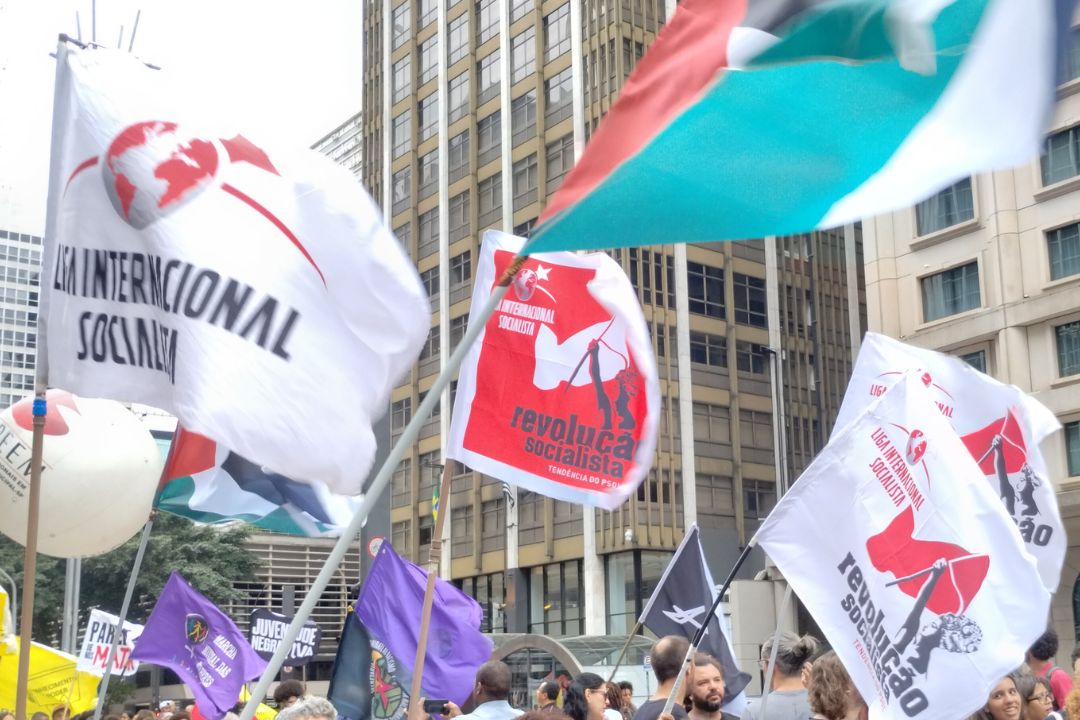
We are not starting from scratch. The Socialist Revolution and the International Socialist League have accumulated years of political development, experiences of struggle, and programmatic debates in Brazil and internationally.
We advocate for a program based on the needs of the working class and the working people, rather than on the limits imposed by the market, bankers, or so-called fiscal balance. A program to tackle the precarious nature of work, raise wages, combat debt, defend and expand public services, guarantee quality housing, education, and health care, and challenge the economic power of agribusiness, banks, and large corporations.
A program that breaks with austerity and subordination to imperialist interests, one that places at its core the need to ensure that workers and the poor do not pay for the crisis and that those who profit from it foot the bill.
What is our political agenda?
We are building and defending a project to unite the revolutionary forces, because the struggle for a program cannot be separated from the discussion of how to build a political force capable of fighting for it.
The current landscape of the Brazilian revolutionary left is marked by fragmentation. Although we do not currently see, in the immediate term, the conditions for an organic regrouping of revolutionary organizations, we cannot abandon this perspective and must fight for it. On the contrary. We must open up a debate on the need to overcome the dispersion of revolutionary forces, bring together sectors that share a strategy of class independence, and, through shared experience and political struggle, forge paths to strengthen a revolutionary alternative.
Let’s use this campaign to advocate not only for what needs to change, but also for how to build a movement capable of fighting for those changes.
Socialist Revolution – Brazilian Section of the International Socialist League – ISL