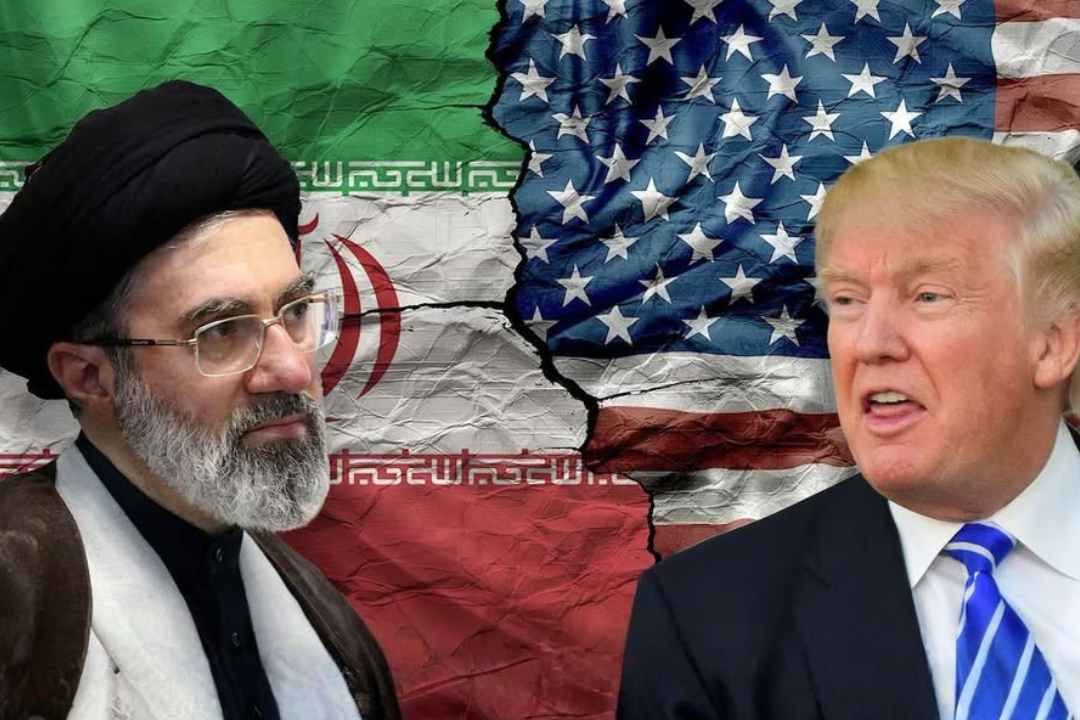
The announced 14-point memorandum of understanding between the U.S. and Iran has not yet been made public in its formal wording. But four aspects are already all too clear.
By Marco Ferrando
This is not a “peace” agreement, but rather the start of negotiations. The only definite aspect of the agreement is the gradual reopening of the Strait of Hormuz, which, however, involves a complex mine-clearing operation that will certainly not be a quick one.
The memorandum will be ambiguous enough to allow both sides to claim victory before their respective publics: the contrast between the two sides’ propaganda regarding future control of the Strait, compensation for Iran, and the lifting of sanctions is a significant indication of this.
Its stability continues to be contingent on the political and military conduct of the Zionist state, which has not signed the memorandum and considers itself unilaterally exempt from the obligation to respect it, in Lebanon and beyond.
But beyond the uncertainties and diplomatic balancing acts, one fundamental fact emerges: Donald Trump and U.S. imperialism have suffered a crushing political defeat in Iran. The U.S. president’s effort to portray it, as usual, as a “fantastic victory” is directly proportional to the magnitude of the defeat suffered. The absurd idea of replicating the “Venezuela operation” in Iran—decapitation and surrender of the regime, followed by its subjugation—ran up against the lack of internal support for the reactionary Iranian regime and the strength of a military apparatus infinitely more powerful than Venezuela’s, hardened by numerous wartime experiences (from the war with Iraq to the war in Syria), long prepared for the announced U.S.-Zionist war—all the more so after the experience of the twelve days of bombing in June 2025. Hence the dilemma that arose from the outset for the U.S.: either an adventurous leap toward a ground invasion of Iran—for which both the military and political conditions were lacking, and whose outcome would likely have been catastrophic—or the search for a way out that could be presented as a “victory.” The latter is exactly what ultimately happened.
But the scope of the U.S. defeat extends far beyond the military realm. The disaster of the war against Iran has laid bare the extreme fragility and improvisation of Trump’s current political leadership. Never before has a U.S. imperialist war been launched without a majority consensus among the domestic public, without and against the guidance of the Pentagon, without and against the imperialist allies in NATO and Asia, with the Zionist state as its sole ally at a time when it is at its most unpopular worldwide. The disastrous outcome of this adventure was, therefore, inherent in its very premises. And the effects are profound—not only on the global economy but also on the political and diplomatic fronts, both within the U.S. and internationally. The interpretation that, deep down, everything is returning to the reality that existed before February 28 (the reopening of the Strait of Hormuz and the resumption of negotiations) is very superficial.
In reality, the U.S. defeat reveals and deepens the crisis of U.S. hegemony on a global scale and within the Middle East itself. Trump’s vision of a “Board of Peace” and a new regional balance centered on Israel through an expansion of the Abraham Accords has been shattered by the war against Iran. This has been brought about by the Gulf monarchies’ exposure to Iranian retaliation, the vulnerability of their defense by the U.S., and the U.S.’s inability to control and contain the Zionist state. Only the United Arab Emirates (paradoxically a member of BRICS) followed the U.S. script, breaking with OPEC and consolidating its alliance with Israel, with the indirect involvement of India and Greece. Saudi Arabia, Qatar, Oman, Egypt, Pakistan, and Turkey are moving toward forging their own regional alliance to fill the U.S. vacuum and protect themselves from Israeli expansionism. This is exactly the opposite of the Abraham Accords.
The U.S.’s own relationship with Israel reveals the crisis of American hegemony and an unprecedented landscape of difficulties. Israel used and drove the Zionist-U.S. war against Iran to serve its own warmongering interests: the invasion of Lebanon, the further expansion of what remains of Gaza to cover 70% of its territory, and a new dramatic leap forward in the colonization of the West Bank. For this very reason, the U.S. withdrawal from the war against Iran left the Israeli government completely disoriented. Moreover, Iran now has the strength to demand that the U.S. bring peace to the Lebanese front in defense of Hezbollah—that is, an end to the bombings of Beirut and an Israeli withdrawal from southern Lebanon. This is something Netanyahu cannot concede without bringing about his own political suicide. Hence the new dilemma facing Trump’s policy. Trump cannot and will not break with Israel, the region’s historic imperialist outpost and, even more so today, his only reliable ally. But at the same time, he cannot and will not accept an Israeli veto on the agreement with Iran. The suggestion to Israel to set aside Hezbollah and entrust the new Syria with settling scores in southern Lebanon could not be more poisonous for Netanyahu: it would amount to replacing Zionist troops with troops controlled by Turkey. And Turkey, with its military strength and neo-Ottoman ambitions, is today Israel’s main adversary in the region. The Zionist state cannot accept this solution. Therefore, it will attempt to exploit U.S. difficulties to preserve and expand its military room for maneuver—with all the uncertainties that this implies for the stability of the agreement between the U.S. and Iran.
More generally, the U.S. defeat in Iran has repercussions for the balance of power among the imperialist powers. China, though plagued by deep internal contradictions, emerges from the war strengthened. Economically, this is due to its enormous accumulated oil reserves and its energy diversification. Politically, it is entering the Middle East arena with a more active diplomatic role than ever before, working behind the scenes through Pakistan and expanding the scope of its relations with the Gulf states. The idea of weakening China by striking at its Iranian ally has failed. More generally, the entire project of rebalancing negotiating relations with China by leveraging power politics has failed. The anti-China protectionist campaign, with its initial threat of 45% tariff increases, had to back down quickly in the face of China’s semi-monopolistic control over rare earth minerals. The idea of separating Russia from China through Trump’s overtures to Putin regarding Ukraine ended up producing, in many respects, the opposite result: an even greater strengthening of Chinese hegemony over a Russian ally in distress, to the point where Beijing is directly reestablishing its relationship with North Korea. Finally, the idea of appeasing China through calculated gestures regarding Taiwan has, for now, resulted in an arms race by Japanese imperialism and new relations between South Korea and China—exactly the opposite of what was expected. Meanwhile, Chinese imperialism’s military control over the South China Sea is being reinforced in Asia.
On the other hand, the idea of confining China to Asia—even if it eventually means ceding Taiwan to it—clashes with the global reach of a rising imperialist power that is unwilling to give up its global ambitions.
The U.S. crisis also indirectly affects relations with Russian imperialism. The pact signed in Alaska between Trump and Putin was based on an agreed-upon division of Ukraine that was to be imposed on Zelenskyy in some way. The U.S. withdrawal of support for Ukraine was its natural corollary. But the pact did not unfold as planned. Putin cannot exit the war without a victory to show his country. And he cannot claim victory without conquering, at the very least, the entire Donbas. Hence his attempt to capitalize to the very end on the U.S. withdrawal and the deep crisis of the transatlantic alliance by intensifying the winter military offensive. But the attempt failed. Contrary to the predictions of the “campist” camp, Ukraine managed to regain, after a terrible winter, its own military initiative—thanks above all to the use of low-cost, easily producible drones, free from the previous constraints imposed by NATO “aid.” The intensification of the Ukrainian offensive against Russian refineries within the Federation undermined the stability of its war economy and helped erode domestic support for its regime. Hence the crisis in the Trump-Putin pact: Putin failed to secure militarily what Trump had granted him, and Trump now faces greater difficulties in honoring an agreement that has been overtaken by events. This is all the more true given his political weakening following the defeat suffered in Iran. The new tone adopted by the U.S. president in Evian (“Russia must reach an agreement”) reflects a new scenario. It remains to be seen whether this will translate into a concrete shift in position.
During the war in Iran, European imperialist powers have experienced a new chapter in their own crisis. Their complete marginalization from a military initiative undertaken without their consent and even without prior notification, followed by U.S. recriminations over the lack of European support in the war; the announced partial U.S. military withdrawal from the European theater in favor of the Indo-Pacific; and the deepening crisis within NATO—all of these factors are increasingly forcing the European imperialist powers to develop their own “rearmament” plan. Not to “obey” Trump, nor to “wage war on Russia,” nor to defend themselves against an unlikely “Russian invasion,” as their respective war propaganda narratives would have it. But simply because they cannot rebuild their own capacity to negotiate the division of the world (including Ukraine) without possessing their own military power. It is the natural law of imperialism. And it is even less possible to confront the general resurgence of the power policies of other imperialist powers—whether rivals or allies, but always competitors. Added to this is the hope of the European imperialist powers that the military conversion of entire sectors of production will lead to the revival of continental industry, which is caught between the U.S. and China.
The problem is that European imperialist powers, unlike the great powers, do not have a federal state structure. The grand calls for the Union to take a leap forward clash with the deepening of national rivalries among the various imperialist states. The rearmament plans themselves depend primarily on national budgets and, therefore, on their varying spending capacities. Germany’s major rearmament and the crisis in the Franco-German axis must be understood within this framework. In turn, national contradictions are politically amplified by the emergence of reactionary sovereignty movements with mass bases in key EU countries.
The proliferation of different formats of the so-called “voluntary groups”—whether consisting of three (Germany, France, and Great Britain) or five (with the addition of Italy and Poland)—is the result of the crisis within the Union. The return of British imperialism to the scene following Brexit reflects this. These are all attempts—more or less illusory—to compensate for the U.S. retreat in the realm of political and diplomatic initiative, without possessing either the strength or the unity necessary to do so; or to maximize pressure on U.S. imperialism to induce it to back down and restore the so-called “unity of the West.” Evian has provided a stage for this latest performance, capitalizing on the crisis of Trumpism following its defeat in Iran. “You need us; you can’t do this alone”: that is the message from the European imperialist powers to their overseas ally. But the historical decline of the U.S. has a structural dimension that goes far beyond Trump. The sheer magnitude of U.S. public debt prevents American administrations from sustaining the costs of its former global hegemony. The G7 itself now accounts for less than 30% of global GDP, and the U.S. for less than 15%. The European crisis is part of this decline.
The historical decline of an imperialist power never follows a linear, uniform course. This was not the case with Britain’s decline, nor is it the case with that of the United States. Today, the U.S. maintains undisputed primacy in the global spread of its military presence and in the monetary sphere, through the dollar. But the use of these levers is no longer enough to offset the drastic decline in global manufacturing output and the costs of federal debt. In other words, it is not enough to allow the U.S. to exercise its former global hegemony. On the contrary, Chinese imperialism has achieved undisputed primacy in global goods production, both in heavy industry and, to some extent, in new technologies, but this still cannot compensate for the limitations of its military presence on a global scale or its monetary inferiority relative to the U.S. China’s rise underscores the crisis of U.S. hegemony, but it is not yet in a position to replace it. Trumpism is, at the same time, both a reflection of the United States’ historical decline and a (futile) attempt to halt it.
The instability of the current world stage lies in the contradiction between a hegemonic power in decline—yet still dominant—and a rising power—yet incapable of replacing it. The absence of a center of gravity. The proliferation of medium-sized regional powers and their ambitions. The general arms race among all major and middle powers. The proliferation of wars of plunder waged by each imperialist power in its own backyard, in accordance with global balances of power and within a logic of division and plunder. The invasion of Ukraine by Russian imperialism, the piracy of U.S. imperialism in Venezuela and the imminent threat of aggression against Cuba, the Zionist-U.S. war against Iran, and the genocidal barbarism of Zionist colonialism in Palestine are all chapters in the current global scenario.
Only the overthrow of imperialism and capitalism can free the working class and the oppressed peoples from the advancing barbarism. Only the unity of workers around the world, only the unity of the oppressed peoples, can pave the way toward a new world. Only revolution changes things. The International Socialist League, active in forty countries and on every continent, seeks to unite revolutionary Marxists around the world around this project of liberation.