Bolivia has entered a revolutionary crisis. This introduction brings together the analysis of MST comrades in Bolivia and explains the background, the role of the COB, and the fight over what replaces Rodrigo Paz.
By KD Tait
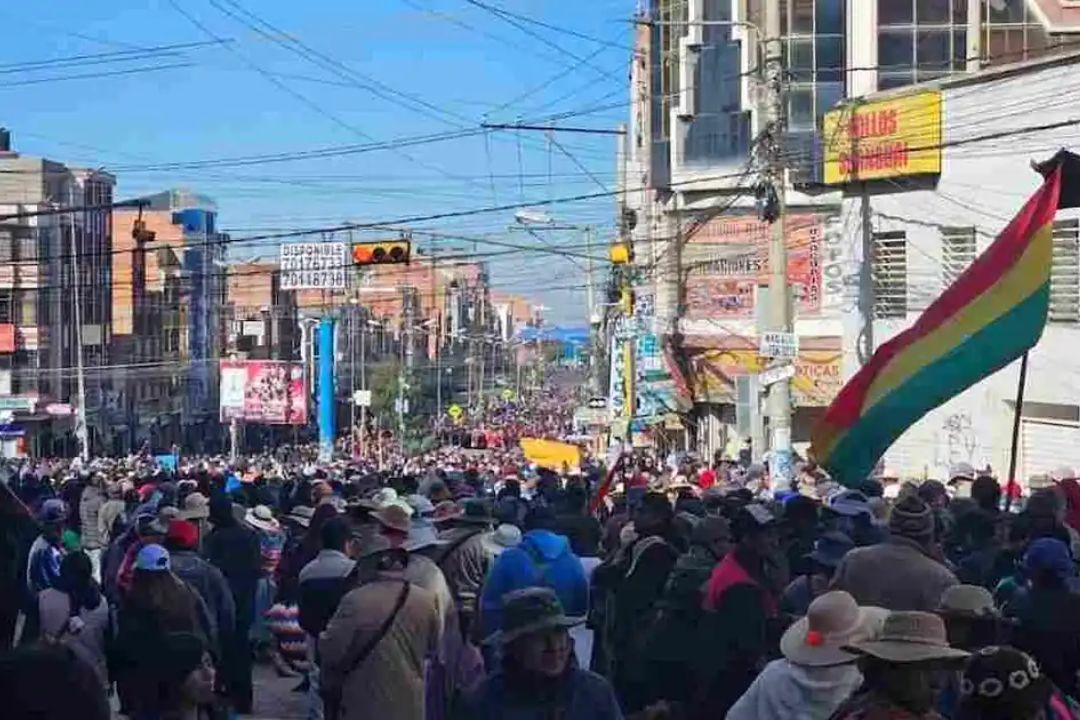
Since the beginning of May, Bolivia has moved from strikes and road blockades against fuel-price rises and austerity measures into an open political confrontation with the government of Rodrigo Paz. The capital city La Paz has been cut off by blockades led by the Central Obrera Boliviana (COB)—the country’s main trade union federation, founded in the wake of the 1952 revolution—together with peasant unions and miners. The movement has broadened to include transport workers, teachers, neighbourhood organisations and the urban poor, while the demand for Paz’s resignation has moved to the centre of the struggle.
The crisis has already drawn in the region. The Trump administration has denounced the protests as an attempted ‘coup’ and publicly backed Paz’s government; Colombia’s left president Gustavo Petro has described the events as a ‘popular insurrection’, provoking the expulsion of Colombia’s ambassador; and the MST reports that Argentina’s far-right president Javier Milei has supplied material aid to the Bolivian state. Once again, a revolutionary situation is developing in Bolivia. This article introduces the background to the struggle and the key political questions that will be decided in the days and weeks ahead.
The articles linked below are produced by the Movimiento Socialista de los Trabajadores (MST) in Bolivia, with which the International Socialist League—the international tendency to which Workers Power is now affiliated following the regroupment process begun last year between the League for the Fifth International and the ISL— collaborates.
They matter because they come from militants involved in the movement itself: in the miners’ movement, in the debates of the COB, and in the wider workers’, peasants’ and popular mobilisations now confronting the Paz government. They are written in the heat of events, as an attempt to clarify the slogans and strategy needed to carry the struggle forward.
Background: the end of the MAS era
Rodrigo Paz Pereira took office in November 2025 as the candidate of the Christian Democratic Party (PDC), a centre-right Catholic formation. A former senator from Tarija and son of former MIR president Jaime Paz Zamora, Paz was elected with his running mate Edmand Lara, a cashiered police captain who built his profile denouncing corruption inside the security apparatus. His victory ended twenty years of government by the Movimiento al Socialismo (MAS), the party of Evo Morales and his successor Luis Arce.
The collapse of the MAS project—Latin America’s longest-running ‘pink tide’ experiment, sometimes theorised by its own leaders, notably former vice-president Álvaro García Linera, as ‘Andean-Amazonian capitalism’—is the political backdrop to everything that has followed. Two decades in office did not break the power of the eastern agribusiness oligarchy, did not loosen the country’s dependence on extractive capital, and ended with the bitter Morales–Arce split, an economic crisis and the alienation of much of the MAS’s old indigenous and working-class base.
A section of that base voted for Paz on the promise of a ‘moderate’ break with the old neoliberal right and the preservation of MAS-era social bonuses; another section voted null or stayed home. Paz’s right-wing run-off opponent, the former president Jorge ‘Tuto’ Quiroga Ramírez, was rejected as a representative of the old oligarchic right.
This is the latest turn in a country with one of the most combative working-class and peasant traditions in the hemisphere: the 1952 revolution, which established the COB as an organ of workers’ power alongside the bourgeois state; the 2000 Cochabamba water war; the 2003 gas war, which brought down a neoliberal government; and the upheaval of 2019. The articles linked below should be read against that history.
How the situation developed
The trajectory of events is sketched across the articles linked below. The October 2025 elections ended twenty years of MAS government. The exhaustion of Arce and Morales’s project broke its hold over much of its old mass base, while a section of that base swung to Paz on the promises set out above.
Those promises lasted only as long as the campaign. By Christmas, Paz had imposed Supreme Decree 5503, eliminating the fuel subsidy and opening a wider privatisation agenda. The COB called an indefinite general strike. A key element here is that the strike was carried out under a new COB leadership. At its 18th Congress in October 2025, the COB elected the Huanuni miners’ representative Mario Argollo Mamani as executive secretary, replacing Juan Carlos Huarachi, who had headed the confederation for eight years and was widely seen as having protected MAS governments from rank-and-file pressure. Argollo’s election was driven by the mining federation, the FSTMB, and reflected a broader rebellion of the rank and file against the conciliatory leadership of the MAS period. The congress also rejected Huarachi’s report and barred his outgoing committee from holding further union office.
The new leadership won the abrogation of Decree 5503 by mid-January, but then signed an agreement with the government and called off the blockades. This gave Paz room to return with a fresh package of measures, including Law 1720 on land conversion, which would have allowed banks to seize peasant smallholdings.
That betrayal lit the fuse for May. Since the May Day mobilisation called by the COB, the rank and file have forced the leadership to sign a ‘No Betrayal Pact’; the demand has crystallised as ‘Paz out’; the workers’ and peasants’ alliance has been reinforced by the urban poor of El Alto and the self-employed workers’ confederation; and after a military offensive disguised as a ‘humanitarian corridor’ killed Víctor Cruz in Calamarca on 24 May, self-organised supply networks have begun moving food, oxygen and medicine outside the control of the state. Argollo and twenty-four other union leaders now face arrest warrants on charges of ‘terrorism’.
The strategic question
The MST comrades are fighting to draw revolutionary conclusions from the real organs and slogans thrown up by the struggle itself. The argument is set out at length in a substantial interview with MST leader Juan José Villa, which we recommend reading in full.
Villa argues that the COB, through the January and May confrontations, has been pushed beyond the role of an ordinary trade union confederation and has begun to act as an organ of dual power. On this basis, he argues that the slogan of the hour—the slogan that links the immediate demand for Paz’s resignation to the question of power—is: all power to the COB and to the peasant and popular organisations in struggle. This includes the Central Sindical Única de Trabajadores Campesinos de Bolivia (CSUTCB), the main peasant union; the Tupaj Katari Federation of the Aymara provinces of La Paz; and the FEJUVE neighbourhood councils of El Alto.
So what replaces Paz if he falls? On one side stand the bourgeois succession solutions: Vice-President Edmand Lara taking office, fresh elections, or a parliamentary recomposition. These are being promoted, in different forms, by Evo Morales’s new ‘Evo Pueblo’ formation and by the Communist Party. On the other side are currents on the far left that raise abstract alternatives such as ‘people’s assemblies’, while denying that the COB and the organisations around it have become the concrete focus of the struggle for power.
The MST argues for a different course: to fight through the real mass bodies that the movement has created, to demand that the COB and the peasant and popular organisations take responsibility for power, and to build the revolutionary leadership needed to carry that struggle through.
That is the position counterposed to those who deny the revolutionary situation because their own organisation is small. The issue is not whether revolutionaries are already strong enough to lead. It is whether they can recognise the objective potential of the movement and intervene in it with slogans that correspond to its real development.
A revolutionary situation is underway in Bolivia. Its outcome is not yet decided. Workers Power stands for the methods set out in the programme of the International Socialist League: class independence, the fight for organs of workers’ power, and the struggle for an international revolutionary leadership. We will be publishing further material from the MST comrades, including the full Villa interview, on this site as events develop.
British and international readers can follow the MST’s writing directly at lis-isl.org.
Further reading from the ISL and MST Bolivia
- Bolivia: MAS paved the way for the far-right
- Bolivia: Out with the murderous pro-imperialist Paz government!
- Bolivia: “All power to the COB and peasant and popular organizations in struggle”
- Bolivia: Paz is cornered: Let’s take the country’s future into our own hands!
- Bolivia. Out with Paz!
- Bolivia: Blockades and mobilizations corner the Paz government
- Bolivia: Frustrated dialogue. The COB agrees with the government
- Bolivia. President Paz’s peace of mind was short-lived: war on Gasolinazo
- Bolivia: Support for mobilizations
- Bolivia. Paz Pereira took office: The second round is on the streets